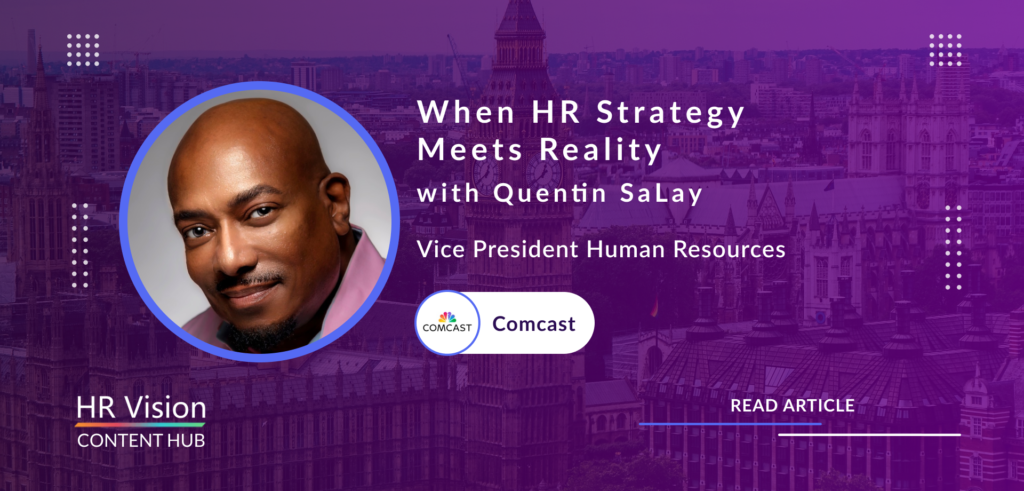
- What’s the clearest sign that an HR strategy looks good on paper but won’t survive real business pressure?
The clearest sign is complexity without trade-offs. If your strategy is a laundry list of “priority” initiatives that does not clearly state what the business will stop doing to make room, it will collapse the moment a quarterly target is missed. A strategy that survives pressure is built on a few “brutal truths” rather than twenty “aspirational goals.”
- In global organisations, where does strategy most often break down, at the top, in the middle, or locally?
It almost always breaks down in the middle. The top sets the vision, and local teams adapt their specific markets, but middle management is where the “frozen layer” exists. They are often caught between high-level strategic mandates and the daily operational reality of keeping the lights on. Without their buy-in and the resources to execute, strategy simply becomes noise.
- How do you tell the difference between a real transformation and a rebrand with new language?
The litmus test for real transformation is whether the path of least resistance has actually changed. In a rebrand, the vocabulary evolves, but the mechanics of work remain static. You can recognize a real transformation by looking for three structural shifts:
- • Decision-Making Velocity: In a rebrand, decisions still crawl up vertical silos for blessings. In a real transformation, decision rights are pushed downward. You see fewer steering committees and more autonomous teams empowered to act without weeks of deck reviews
- • Structural Simplification: True change involves “delayering. “If the org chart is still a rigid 19th-century hierarchy but everyone has a “modern ” job title, it’s just a rebrand. Real transformation removes the “middleman” layers that exist solely to coordinate and report.
- • Operational Friction: Watch how cross-functional problems are solved. In a rebrand, teams retreat to functional bunkers to protect their own KPIs. In a transformation, the structure forces collaboration through unified workflows and shared data, making it physically difficult to operate in a silo.
- What’s the first uncomfortable question HR should ask when the business says, “We need to move faster”?
“What are we willing to stop obsessing over in exchange for speed?” Speed is rarely a matter of “working harder”; it is usually a matter of reducing the cost of permission. If the business wants to move faster, HR must ask which layers of approval, committee meetings, or risk-mitigation steps they are prepared to kill.
- When leaders resist change, what’s usually driving that resistance?
It’s usually a perceived loss of something they view as highly valuable to and for themselves. Resistance is rarely philosophical- it’s personal. A perceived loss of control, status, or competence. Change often makes people who were “experts” in the old system feel like “novices” in the new one. Leaders resist because they fear they no longer have the tools to succeed or that their hard-earned influence is being diluted
- How do you decide which people initiatives deserve investment when everything feels “critical”?
Anchor decisions to business value, not sentiment. I use three filters to cut through the noise:
- • Impact on the business strategy (Does it enable revenue, innovation, client outcomes?)
- • Risk reduction (Does it prevent talent, legal, or operational exposure?)
- • Feasibility and time-to-impact (Can we execute it well with current capacity?)
If an initiative doesn’t win on at least two out of three, it’s not critical-it is noise.
- What’s one strategic conversation HR should be having with the CEO more often, but isn’t?
“What are the tradeoffs you are willing to accept to get the culture you say you want?” CEO’s articulate aspirations, innovation, accountability, speed, empowerment- but avoid discussing:
- • Which leaders may no longer fit
- • Which decisions must shift downward
- • Which legacy practices must die
Culture is created by tradeoffs. HR needs the CEO to name them explicitly.
- Looking ahead, what strategic capability will matter most for HR leaders over the next few years?
Organizational adaptability will be central to strategic capability, not traditional change management—true adaptability. The HR leaders who thrive will be the ones who can help the business pivot—not once, but continuously. The strategic capability that focuses on faster operating model adjustments, leading through ambiguity driven by AI and geopolitical shifts coupled with shifting talent models, will deliver unprecedented value to the organizations they serve.
Ready to stay ahead in the ever-changing world of HR? Join us at HR Vision, where top HR leaders gather to explore the future of work, HR trends, and the power of HR analytics and technology.