Q Last year, you were ranked in the Forbes top 35 most innovative people in the learning field. What does the learning transformation mean to you?
Learning transformation means a lot of things depending on who you ask and certainly, on the particular context, you are working in. To me, the overarching objective in learning transformation is trifold: learning needs to be made purposeful, efficient and meaningful (all three are equally important). Of course, behind each of these words, there are several ideas/concepts with various tools and techniques that can be put into place depending on the organizational context/need. For example, to make learning purposeful, we need to go deep into the “why” of learning as a whole, identifying and clarifying the role it is supposed to serve in the organization.
Personally, I believe that learning has a dual purpose: to develop individuals and to develop organizational capabilities. I’ve seen companies in my past experience where the accent was placed on only one of these, whereas it’s much more powerful if learning can serve both at the same time: “My company gives me the means to develop myself and my career (whether in- or outside the company), and the competencies I develop will also serve the company I currently work for.” Second, in order to make learning purposeful, we need to clearly identify the expected outcome of learning for both the employee and the organization. What current or future problem does learning help solve? Job mobility? Career advancement? Is the organization aiming to reduce external recruitment and upskill its internal talent? Is learning filling a current or future skills gap that puts competitiveness at risk (this can be true for individuals and organizations)? Successful learning transformation needs to address such strategic questions.
Q What are the recent L&D practices you use at Sanofi?
When I talk to a lot of organizations, they sometimes list a whole host of digital concepts such as artificial intelligence, augmented reality, virtual reality, gamification, blended learning… While these concepts are widely used at Sanofi and are certainly exciting, I think what sets our learning transformation apart is that we’ve organized our learning around skills that are directly linked to strategic workforce planning. In the talent space, we’ve been talking about skills for a few decades, but we live in an era where skills (as opposed to jobs) have increasingly become the foundation of our careers and professional development. These skills are evolving faster and faster, and both individuals and organizations need to make sure they have the right skills at the right time if they want to be successful. This is why our newly-launched Sanofi University has not organized learning around org structure, which can change, evolve and disrupt the learning organization. Instead, we have established a global governance model where critical skills and their related learning solutions are owned and updated by dedicated teams sitting in the business, in order to maintain maximum relevance.
From the employee perspective, each employee can select the skills they want to acquire/deepen and find learning opportunities that target those skills. The learner is therefore empowered to drive his/her own development while at the same time increasing organizational capabilities. The strategic workforce planning framework clarifies the skills our company has today and those that we need to acquire for the future, and Sanofi University matches up those skills with learning solutions. Once the employee has gained those new critical skills, he/she then has opportunities for career growth. This value chain actually allows our learning transformation to guarantee all three components of powerful learning transformation: Purposeful, because we know why we need to learn specifically for ourselves individually and to serve our organization’s needs; Efficient, because we know what learning we need to offer (no more, no less) as well as how we make that learning available; and Meaningful, because we can then begin to monitor the impact of this learning across the whole organization in terms of talent management/internal job mobility/attrition rates/organizational culture and expected behaviors.
Q The learning transformation processes require rethinking of the educational practices. How often do you bring in something experimental?
I definitely believe in creating a culture of MVP (minimum viable product). Before joining Sanofi, I was leading a team in learning tech product development. That experience taught me that we shouldn’t strive for perfection, at least not immediately. Instead, you start with something small, launch, monitor, measure. If it’s successful, you scale and improve incrementally. Taking this approach often creates positive surprises: perhaps you launch a small experiment and look for a benefit you had imagined, only to discover that the experiment generates a completely different benefit. An example of this at Sanofi is the Playlists we launched last year, which are personal curations of content by internal experts. When we launched with a small pilot group, we were convinced that thought leaders and experts in the organization would be passionate about sharing their knowledge broadly. While this proved true, surprisingly, we received requests from employees who volunteered to translate existing playlists into local languages, and also from our regions who wanted to manage in-person events using playlists. Instead of forcing yourself to imagine all the possible use cases: just take one, deepen it, and if it works, people will find other creative ways to use the tool and give it a twist that you might not have thought of.
I also believe that learning innovation doesn’t systematically require big budgets and investments: I’ve always liked to use tools that already exist in the company and find creative ways to leverage them to serve learning. Why? Because learning happens everywhere, and perhaps you have tools at your fingertips that you can easily adapt or “tweak” to serve the strategic outcomes your organization needs to achieve. One example of this is our videoconferencing technology (Zoom) that allows us to record meetings. We recently launched an experiment that allows colleagues to create video tutorials with screen sharing that they can share across the organization. The initiative has generated a lot of enthusiasm, and we’re helping to standardize the tutorials to guarantee quality and impact. I think this is a great example of using what you have and creating value with no added financial investment.
Q What is your secret of creating an engaging learning experience?
For me, engagement is 4-dimensional: cognitive, emotional, behavioral and social. If you want to create a truly engaging learning experience, you need to be thinking about all of these at once. I learned this at the beginning of my career when I spent a number of years teaching in a large business school. Creating an engaging learning experience for a classroom full of 20-year-olds was a challenge because of a number of factors with this population: short attention spans (mainly due to mobile technology), heightened fatigue, perceived lack of relevance of subject matter, fear of making mistakes and taking risks in front of others… I’m convinced that the challenges we face in corporate education are not entirely different. Employees today navigate continuously among a range of technologies, multitask, and often don’t see the point in engaging in formal learning. And, notably depending on the culture (national and/or corporate), some learners are fearful of going out on a limb in the learning experience.
There are several ingredients that we can cook with to boost and maintain engagement: first, the content in the learning experience has to speak to the learners. It must be structured appropriately, and allow learners to see their progress and the value in what they’re learning. We need to generate curiosity and a constant will to go deeper in understanding. To do so, we mustn’t underestimate the emotional dimension: I like to think of a learning experience as a plot where I should keep my viewers/readers asking for more until the very end. Like my former college students, I tend to be inspired by Netflix series where I deliberately plant a cliffhanger at the end of a session/activity. Such techniques maintain the momentum in the experience and keep learners curious and coming back for more. From a social standpoint, it’s essential to create a safe space where people learn together and aren’t afraid of making mistakes. I’m a social constructivist at heart and believe that as learning experts our role is to design learning experiences where everyone has something to learn and everyone has something to teach. In such an experience, the role of the expert is less about providing answers, and more about asking the right questions to lead a group of learners to acquire new knowledge together.
Q What kind of innovative digital learning programs do you use these days?
Digital technologies abound in the learning space. And while digital tech has the potential to optimize cost, I think that cost efficiency often overshadows other valuable benefits to learners and the organization. Digital technologies notably allow organizations to increase scale and reach, which is a common need in large organizations. Last year we launched an experiment that consisted in blending a Marketing course that originally was a face-to-face session spread over five days. Because of travel requirements and limited seats in each session, some of our marketeers in more remote locations weren’t benefiting from the course. By blending the course and spreading it over six weeks, including asynchronous and synchronous activities, we were able to maintain the same NPS as the original face to face course, while more than doubling the reach.
Another exciting example of innovative digital learning programs we have at Sanofi consists in developing highly complex technical skills using virtual reality. In certain laboratory environments, many lab technicians used to need to leave the production site to receive technical training to work in a highly regulated setting. Now, thanks to VR, our colleagues can learn and develop these skills on-site in a simulated virtual environment, thereby building efficiencies and accelerating the time to competency.
Q How do you see the future of learning culture in companies?
Learning cultures will become increasingly democratized and self-driven, and personalization will have increasingly tremendous effects in the learning space. To give an illustration, think back to 20 years ago when we went to a record store and bought a CD. That CD was a curation of musical content that was selected by a team in the record company and sequenced in a certain way to be pleasant to listen to. Today, we don’t listen to CDs much anymore. Why? People simply want to have more control over the content they consume. And because of the abundance of content available, we’re all becoming master curators. Artificial intelligence will become more powerful (we’ve only seen the tip of the iceberg) and give us the best content we need/want at the point of need. These technologies will have even greater “listening” capabilities that will analyze our behaviors and cater to our learning needs in real-time. This is easy to imagine for immediate on-the-job needs that can already be solved by microlearning today (think about a pop-up showing me how to use a particular feature on Microsoft Excel while I’m using the software). However, I think that these technologies will also guide learners to macro-learning solutions, for deep skills acquisition to transform their careers, all of this based on complex data analytics.
So how does this influence the learning culture in organizations? Learning culture, in general, will become much more open, assisted by technology, less centralized, less controlled, and much more personalized. Content will be increasingly generated and produced by individuals and only the most useful (ie used) content will be retained for AI-powered curation. Despite hyper-personalization, I don’t think that the learning culture of the future will be a solitary one. If we look at the array of social media today used by the rising generation of “digital influencers” paired with much more disruptive artificial intelligence, the learning culture of the future will not only bring the right solution to the right learner at the right time but will also bring the right people together at the right time to share and learn together.
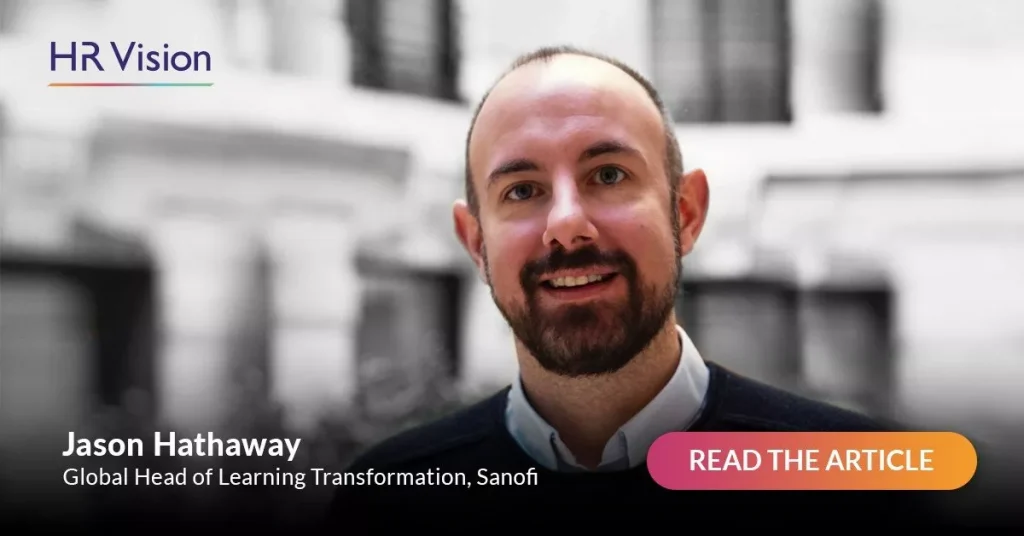
Meet Jason Hathaway, Global Head of Learning Transformation, Sanofi in person and learn so much more first-hand from him and other senior HR practitioners, talent acquisition experts, global executives, from large complex organizations with their valuable insights on HR trends and the future of work!
Attend our upcoming HR Vision event! A flagship, two-day events with 3 streams running in parallel, enabling deep dive conversations focused on the future of work, digitization, leadership, L&D, culture and employee experience, D&I, future talent acquisition strategies, and more!