

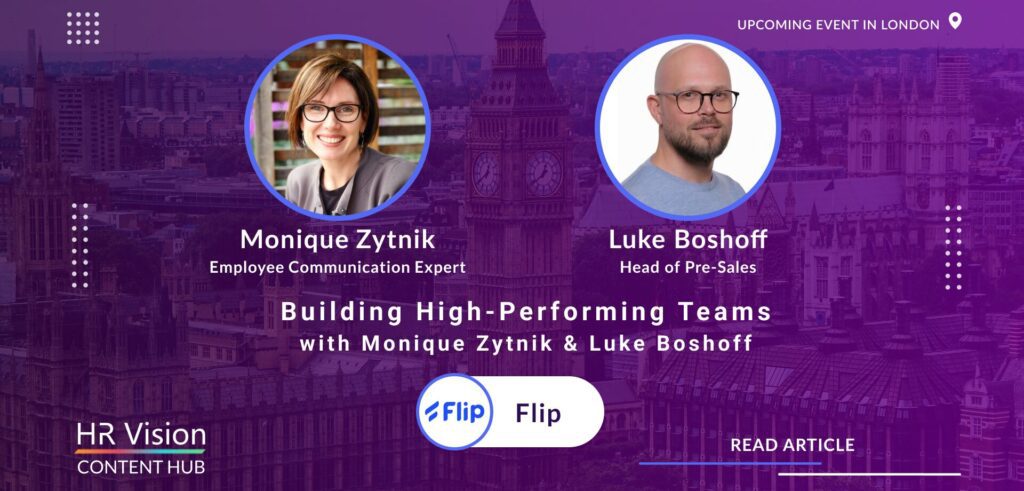
This is an insightful Q&A article featuring two distinguished professionals, Monique Zytnik and Luke Boshoff, who bring a wealth of experience and expertise to the table in their respective domains.
Monique Zytnik, an Employee Communication Expert, captivates us with her journey from a background in physiotherapy to becoming a stalwart in internal communications.
Luke Boshoff, Head of Pre-Sales, leads with distinction, driving innovation and ensuring customer satisfaction through tailored solutions in the dynamic DACH region.
- Monique, it’s clear that you’re passionate about internal communications. What, in your view, is the key to fostering a strong employee-centric culture within a company?
It is about respect. Respect your people and have mature conversations with them. Being employee-centric doesn’t mean you need to consult on everything or do what the loudest voices demand, but rather focusing on the human side of your organisational culture and making sure it is healthy for your people. In this way, I prefer the term human-centric culture. Focusing on the person and their needs, rather than the employee identification number and seeing them as stormtroopers.
- Luke, you formed and led a team of Enterprise Architects. How do you foster collaboration and communication between technical experts and business strategists?
I try to cultivate a culture of mutual curiosity and exploration, to enable continuous discovery across domains. I find that given the opportunity to be curious without a destination, hence the use of the terms discovery and exploration, people will automatically interact communicatively and collaboratively. It’s like being in a dark, wild, unknown jungle… we would all prefer to share the experience with someone else, right?
- Monique, you’ve had experience in diverse sectors, how do you adapt your communication strategies to suit the unique needs of each industry?
Not only are industries unique, but I find it useful to think of each organisation as unique. To communicate effectively not only do you need to understand your people and specific groups of people you want to communicate with, but also the history, communication channels available, and a number of other factors. The industry is just one part of the picture. Country and even specific offices can have an impact on the best approach to take.
- Luke, as a leader in pre-sales, how do you keep your team informed about the latest technological advancements and ensure they stay ahead in product knowledge?
I look at this from two perspectives, the perspective of my customers and the perspective of the market. The market tends to be a couple of steps ahead and usually all over the place if you factor in dimensions such as industry, geography, etc. (similar to what Monique just mentioned). Here I am really finding AI to be helpful to curate and break down what is going to be relevant to us and what is not. What I like to do with customers, is to get them to join team meetings and share what it is they are doing and what is going to be relevant to the short term.
- Monique, you mentioned being a mentor. How important is mentorship in the field of employee communication, and what benefits have you observed through your mentoring experiences?
Formal learning is great, but often it is business and political nuances that are necessary for a communicator to be effective. Mentoring and coaching can give you the personalised support you need to be successful in a certain situation. I am a firm believer that your manager is not your mentor, no matter how great they are. Having a mentor gives you a safe space to explore tricky situations without it impacting how others perceive you in your role. I love mentoring others because my mentors were one of the key factors that helped me grow through my roles and when I can support others going through the journey it is personally rewarding. I also learn a lot from my mentees and think of it as a learning environment for both.
- Luke, reflecting on your leadership journey, is there a specific leadership principle or philosophy that you consistently apply, and how has it contributed to your team’s success?
Here I have to say, I try to do one very simple thing… hire really good people and then give them the space and find them the support they need to do what it is that they do really well.
I guess that is basically strength-based leadership. I am not a big proponent of closing skill gaps and getting everyone to the same level. Letting people do what they enjoy most will also have positive knock-on effects on engagement –
Do what you love and love what you do!
- Monique, you’ve worked with both small and large companies. How does the approach to internal communication differ in these varied organizational sizes, and what challenges arise?
The smallest organisation I have worked with had 3 people. The largest was over 600,000.
Many start-ups and scale-ups suddenly have problems at the 50 to 100-person size, where the CEO can no longer talk to everyone. Then as you jump up the numbers, it depends on how you have organised your internal communication resources and the value your organisation plays on good communication. Then you have added complexity when you add different languages, time zones, and cultures. If your workforce is very diverse, both in job type and profile, then that adds more complexity.
- Luke, what advice do you have for aspiring leaders looking to make an impact in pre-sales and solution consulting roles?
Everyone is selling something, a product, a service, an ideology, or a belief… and finding a solution to a problem is not hard, every Saturday everyone in the pub has the solution to their football team’s bad performance.
To make an impact, you need one: find what it is that you can sell with conviction because you know that what you sell can help make a difference after the sale. And two: you need to find a solution that solves an actual problem and is realistic to your customer.
- Monique and Luke, considering your diverse experiences, how do you approach continuous learning to stay at the forefront of your respective fields?
Monique: I’m lucky and unlucky that I love constantly learning new things. Talking with people at conferences, seeing great presentations, and also my podcasting gives me great opportunities to ask people questions about things I’m curious about. Many of my peers know I enjoy reading reports and send me links to interesting information. I also network with communicators globally, for example with the IABC and also GWPR, which give a flow of information on the latest trends and thinking. I am unlucky as I have the same challenge as others in that there is never enough time on one day to watch, listen, read, and also talk with the people I want to.
Luke: I love learning, I love consuming content, but I am a lazy learner, so for me, learning has to be effortless. What helps me lazily learn, is to incorporate it into my day-to-day. Using social media (death scrolling can be extremely informative), reading books that combine fact and fiction or just activating a thought process, and speaking to customers, partners, and colleagues are all ways of learning that make learning effortless for me.
- Recently, Great Britain has introduced a pilot project of a 4-day working week. What’s your opinion about it? What advantages and disadvantages do you see both for employers and employees? Would you take part in the experiment, and why?
Monique: I would absolutely take part in this experiment. I think there are a lot of societally unanswered questions at the moment, especially with the idea that AI will make us more productive. Running a trial will help open up the conversation. For example, what I’m hearing at the moment with the speed of AI developments is that people want to know what they are working more efficiently for.
What is the added value to society and not just business?
Other countries such as Japan, Spain, Australia, and Canada have run trials or have already had support for this. For example, Belgium legislated a 4-day work week in 2022. A trial gives the workplace a framework with which to try something to see if it would work for them.
As with any project, good communication is essential to acceptance and success, whatever the outcome of the trial.
Luke: There are a lot of reasons to adopt a 4-day work week, looking at Germany, where I live and work, these include higher than average work-related stress levels (based on a European Working Conditions Survey), more inclusion in the workforce by making provision for caregivers (who are predominantly still women) or even economic stimulation (the idea that if people have more time, they will spend more on leisure activities e.g. hospitality where it is sorely needed).
At the same time, anyone who has done any hiring in the last few years knows how hard it is to find good people. Now, factor in additional shifts, salary adjustments for hourly workers, and overworking weekly workers who try to get 5 days of work packed into 4 days and the picture is very different.
So, would I personally take part in the experiment, absolutely. Remember what I said about effortlessly learning, this would be a great opportunity to learn experientially. Would it be a valid option for organisations in general or for the company I work for right now, probably not just yet in the current macro environment.
Ready to stay ahead in the ever-changing world of HR? Join us at HR Vision, where top HR leaders gather to explore the future of work, HR trends, and the power of HR analytics and technology.


