

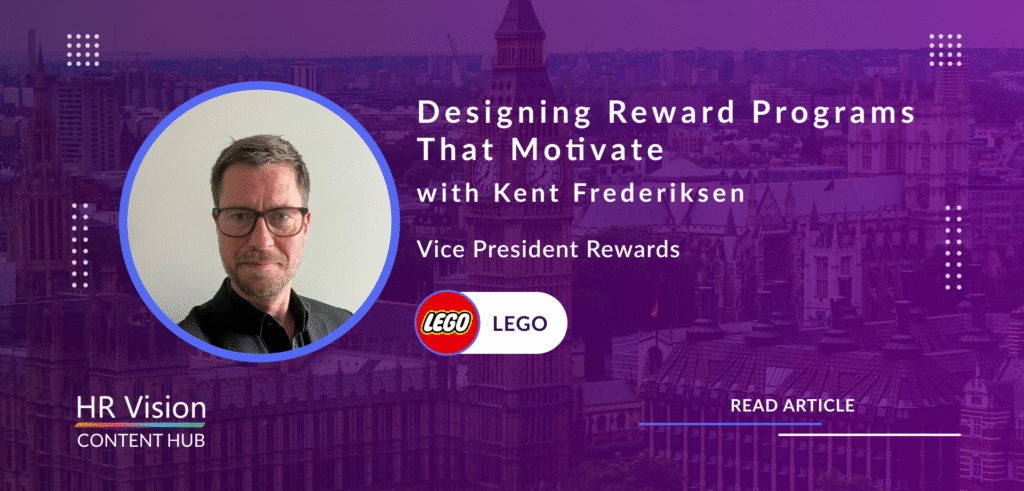
Introducing Kent Frederiksen: An accomplished HR executive with a career spanning over two decades, Kent specializes in crafting Total Rewards solutions that align with business objectives and foster a culture of high engagement and belonging. Since 2018, as VP of Rewards at the LEGO Group, he has championed initiatives integrating reward policies with ESG agendas, location strategy, exceptional employee experiences, and a responsible business travel program. Kent’s expertise in global HR, talent strategy, and employee experience provides practical insights for HR leaders navigating complex, rapidly evolving workplaces.
- With over two decades in Total Rewards and HR Operations, what’s the one trend you think every HR leader should watch right now?
I would pay attention to demographic changes and the overall availability of Talent. Focus on having and setting a clear Talent Strategy that guides the organization in which roles are needed in the future. This sets the tone for which skill and capabilities you need, and from there you adapt the Reward principles/value proposition, location strategy, recruitment strategy, etc. Fundamentally become a skills-driven organization.
- At LEGO, you integrate rewards with ESG goals. How can companies make compensation feel both motivating and responsible?
Ensure rewards are linked to the culture you want. If there is no link, people see through this and lose trust and motivation to make a difference. Communicate frequently about purpose, initiatives, and outcomes.
- Having led Rewards at Danfoss and Johnson Controls, what’s a key lesson from your past roles that shaped how you design reward programs today?
Working for a Danish company (Danfoss) and an American company (Johnson Controls) can be two very different things. At Danfoss, the culture was driven by Nordics values/culture and at Johnson Controls, American values/culture, and of course, being privately owned vs. publicly traded. Private companies can generally move quicker in decision-making and be more driven by family values rather than next month’s or quarterly results and reactions from the stock market. A key lesson has been to ensure we move quickly when there is a need to react to local market needs due to talent shortage.
- Managing global teams across three continents, how do you make reward programs feel consistent yet locally relevant?
We run an Annual Reward Review where all reward elements are reviewed against local peer companies to ensure we stay relevant and are able to attract and retain talent. Here, we also ensure consistency in what and where we implement what. We apply global principles for this and further roll-out global Signature Benefits that are applied to all employees/groups from day one. E.g., paid Parental Leave 26 Weeks for women and 8 weeks for men, 4 weeks fully paid caregiver leave and more. Consistency achieved in working closely with local colleagues throughout.
- You’ve tackled mobility and location strategies with ESG in mind. What advice would you give companies designing flexible or relocation policies responsibly?
What kind of culture do you want? If you want a culture with a high frequency of E.g. remote work, the culture will adapt accordingly. If you want more in-office attendance, the culture will equally adapt. All depends on what you want. More mobility typically comes with a higher cost/budget and hence, if you want more mobility, you have to put more funding towards this.
- You focus on enhancing Employee Experience in hybrid workplaces. What’s one approach that truly keeps people engaged?
Human interaction and a clear understanding of why this is important. Once you decide to have amazing employee experiences in the workplace and manage hybrid work, it comes with choices of eg having nice office locations and hence then you want people to be in the office as it would otherwise be counterproductive. Once you have said A, you have to say B as well.
- As Chair of the Global Works Council, what’s your advice for balancing corporate policy with employee advocacy worldwide?
The world is complicated and complex at times. Having honest and open dialogues help balance corporate vs employee needs. Make sure dialogues are taken seriously and take the time to engage both at the local but also at Executive level. At the LEGO Group, the Executive Leadership Team engages with the Global Works Council members at our annual meeting. This provides a great opportunity to align on local reflections and thinking at a more Strategic level.
- Your philosophy emphasizes simplicity and execution excellence. How do you simplify complex compensation programs without losing impact?
You always have to review offerings in totality and never in isolation, ie, one benefit or compensation element at a time, as many are interlinked. Make sure you think through the whole ecosystem from end to end. We work closely with our Shared Service Center colleagues who act as the first line of contact with employees and leaders. This to ensure that what we think is simplification does not lead to more work in another area of the organization. An example of simplification would be the automation of Merit, where leaders now only need to focus on driving strong development/performance conversations and the merit takes care of itself, automatically. Consistent, fair and on budget. It takes us 1 week to run the annual Merit review.
- Looking back on your career in Total Rewards, what’s the one piece of advice you’d give HR professionals aiming to make a real business impact?
Make sure you are working from key principles. Think things through, align to culture/company strategy/operating Model/Talent Strategy, and stay true to this.
Ready to stay ahead in the ever-changing world of HR? Join us at HR Vision, where top HR leaders gather to explore the future of work, HR trends, and the power of HR analytics and technology.


