“We’re the generation that can’t afford to wait.
The future started yesterday, and we’re already late.”
John Legend
The COVID-19 pandemic is not only a health crisis of unparalleled proportion, it has also turned into a global reset for our economies and societies.
It is changing the experience of being a customer, an employee, a citizen and a human forever. It forces us to fundamentally rethink what it means to be part of a society and community.
Yet the crisis started countless innovations and experiments in all fields and created opportunities to accelerate technology adoption and rapid learning.
This article aims to identify and lay out the renewed perspectives emerging from the pandemic: turning the transformations it is causing in the world of work and in organizations into a proposal for a new enterprise operating system able to thrive in the “never normal” future which is unfolding before our very eyes.
COVID-19 — the Pandemic that Changes Everything
“You never want a serious crisis to go to waste”
Rahm Emanuel
Alienation
For the first time in recent history, we’re faced with a common global enemy, a hostis humani generis. An enemy without an “agenda”, an enemy no one can be blamed for. Yet we know that we all must come together to overcome it. The planisphere substitutes all national country territories. A common global purpose has emerged from a common global threat.
D-Day
Data-Day. Data-gathering and -analytics have become pivotal in coping with a threat that eludes human perception:
- Detection → understanding the dynamics of the crisis using mobile and geo-location data
- Sharing → mitigating risk by frequent broad updates
- Responsiveness → using real-time feedback to guide actions
Data is not the new oil — it’s the new media: only real-time data will allow for the insights needed to decide on the right next step.
Science-Non-Fiction
Administrations and organizations across the globe have formed taskforces in record-time to address the crisis. They pulled together cross-domain scientific and technology expertise, creating both inclusive and diverse decision-making bodies — renewing trust in the power of scientific evidence and the critical value of subject matter expertise as well as diverse collaboration.
Viral Networks
As the pandemic rapidly spreads via connections, it shifts attention to trends rather than any point-in-time, to networks rather than individuals. It’s impossible to understand the plague without discerning its dynamics, as much it is futile to try to cope with it without taking a network perspective: the response has to be “viral” itself. Without conceiving the dynamic interdependency of our business environments and the liquid collaboration networks of our people & communities we will not be able to cope with the complexity of the challenges created by them.
Need for Speed
Prevention of the pandemic impact is a matter of speed given the exponential growth rates it unfolds with. The speed of data sensing and sourcing, analysis and interpretation, and subsequently the speed of decision making and action is vital. Any delay becomes dramatically tangible and immediately measurable. Moving forward any organization will not only need to find ways to operate at new levels of agility and flexibility but also operate with the fact that a decision’s half-life may be as short as the frequency the data will be updated with.
What Got Us Here Won’t Take Us There!
“Fate is the hand of cards we’ve been dealt. Choice is how we play the hand.”
Marshall Goldsmith
R.I.P. Taylor
Too many changes, too fast! Global disruptive events evolving on a daily base. Customer needs, business needs, people needs — all in flux. The traditional physical and metaphysical boundaries defining organizations have blurred into complex ecosystems with ever-changing demand. Conventional approaches to planning, processing and executing work are not designed to cope with fast change, thus turning into roadblocks. Taylor is a victim of COVID-19.
Rework Work
The key response to the change-waves lies in setting up new ways of working: more iterative, cross-functional, human-centered in design, based on decentralized decision making and empowerment of distributed teams. Enabled by process-digitization and value-provision through data and analytics-driven predictive insights: freeing people up from transactional activities and prescribed routines.
Redesign the Workforce
The new ways of working require small, highly responsive, cross-functional teams which are created, adjusted and disbanded on-demand and have seamless access to the expertise they need to execute their work. These teams form a fluid and adaptive workforce turning the organization’s boundaries into permeable membranes whilst redefining employment, powered by digital collaboration technologies.
Break your (talent) supply chains!
Workforce analysis and planning is still following a 20th century Supply Chain model (what do I have, what do I need, identify the gaps, plan the execution, source to fill the gaps) based on
- A stable environment and context
- Mid- to long-term strategic planning
- Top-down decision making
- Systematic break down of strategic plans into layers of sub-components (i.e. workflows)
- Identification of people attributes (i.e. skills) to execute those sub-components
- Linear aggregation of all individual components (sum)
Welcome Talent Agility!
Strategic planning is substituted by frequent strategic iterations and adjustments based on continuous feedback insights — stitched together by a joint common purpose. The workforce needs to adapt with similar frequency and speed levels in which business strategy and objectives adjust acceleration and direction. Organizations must arrange for this iterative strategic loop and nurture an adaptable leadership and workforce keen to own it.
…
SW eats the World
“Once a new technology rolls over you, if you’re not part of the steamroller, you’re part of the road.”
Stewart Brand
Darwin on Steroids
Only those organizations which are able to constantly adapt and transform the change into new opportunities will thrive. Technology plays a pivotal role: AI can detect patterns in complex data sets at unmatched speed and scale; virtualization transforms space & time; algorithms enable automation across domains.
HR becomes SW
Traditional HR tools — still built around manual interventions — cannot keep up with the accelerating pace of change. At their heart, HR organizations have to become SW (algorithms, big data, AI/ML). It is the end of 20th Century HR as we know it and the raise of 21st Century digital-born people-centered organizations, in which people and technology work together in symbiosis, leveraging their unique strengths and unlocking their potential.
Recode the Enterprise Operating System
Deep and embedded agility can be only achieved by “upgrading” to a radically different Enterprise Operating System
- providing adaptive ways to distribute work and attract the right people to collaborate with to get it done
- creating customer and people value faster and more reliably
- informed by the data generated in work interactions between communities, customers, stakeholders, leaders and teams
- developing and driving a transparent and trust-based culture of inclusion, collaboration and creativity
- AI/ML enabled (e.g. decision support, opportunity identification)
Self-Tuning People Strategy
The core of the new OS is a self-tuning engine that ensures network agility (rapid adjustment), adaptation (fast learning through trial and error), and ambidexterity (balanced exploration and exploitation). It creates a self-adapting people strategy utilizing
- Signals — sense and source signals from the environment internal and external to the organization
- Trends — analyze and monitor micro-signals and external macro-factors over time
- Alerts — identify and highlight patterns and provide insights
- Triggers — identify, generate and initiate automated actions
- Orchestration –integrate responses considering multiple variables and contributions
- Feedback loop — teach the algorithm on the decisions taken and the related success and impact
… allowing HR to fulfill its own destiny: leave transactions to a SW platform while focusing on the most human aspects of work.
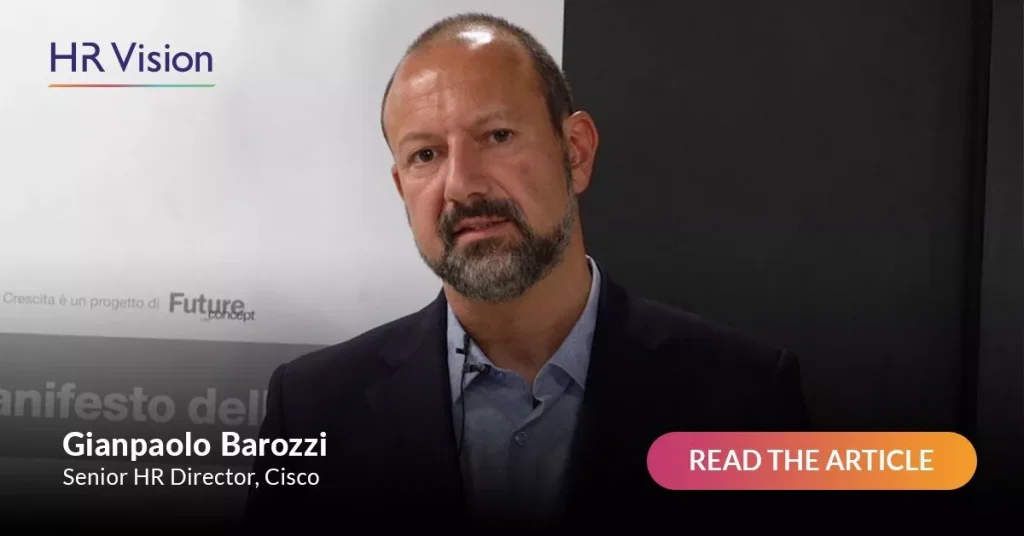
About the Author: Gianpaolo Barozzi is a Senior Director HR at Cisco. He is a Global HR Leader accelerating the intersection of human and digital technology.
Gianpaolo has extensive experience in international corporate environments. He is leading design and development of innovative workforce experiences and solutions in multiple HR areas. He gained wide expertise in Talent Management and L&D by covering diverse roles and responsibilities regionally and globally, functionally and enterprise-wide. His passion is re-defining the future of work in corporations – how talent is identified, leveraged, allocated and engaged, and how work is organized, measured and rewarded – and its implication on people, HR and ultimately the society.
Source: COVID-19: What we have already learned, and what Organizations and HR can start doing now
Attend HR Vision Events and meet Gianpaolo G. Barozzi, T. Lamberty, as well as meet senior HR practitioners, talent acquisition experts, and global executives from large complex organizations, inspired with super insightful HR Strategies earned through decades of professional experience, to learn how to improve employees’ performance, become a Pro at workforce management and aim for the future of work!