Amelia, a new hire on her first day, sat through two orientations back-to-back. The first was a slide deck packed with policies and statistics; by lunch she could recall little more than the dress-code bullet. The second was a ten-minute story from an HR manager about a veteran employee who once bent the rules to rescue a customer—and how that moment crystallized the company’s values. Weeks later, Amelia could retell every beat of that story. She’s living proof of what cognitive psychologists like Jerome Bruner have found: we remember information up to 22 times better when it’s wrapped in a narrative.
Storytelling in HR uses real, human-centered narratives to communicate policies, culture, and strategy—transforming dry facts into emotional, memorable experiences that inspire connection and action.
How Stories Light up the Brain (Oxytocin, Dopamine, Cortisol)
When we receive information in narrative form, our brains don’t just decode language—they release a cocktail of neurochemicals that prime us to care and act. Researchers have shown that a well-told story triggers cortisol to sharpen attention, dopamine to sustain motivation and anticipation, and—most importantly for HR pros—oxytocin, the “empathy molecule” that deepens connection between people. The net effect is a listener who is both emotionally engaged and ready to remember what comes next, something bullet-point slides rarely achieve.
Memory & Meaning: Why Narratives Stick.
Stories scaffold abstract concepts—policies, values, compliance rules—onto characters and conflicts our brains can simulate, activating sensory and motor regions as if we were there ourselves. That multisensory “re-living” gives new information a richer web of associations, dramatically boosting long-term recall of onboarding lessons, safety protocols, or culture codes.
Practical Applications of Storytelling in HR
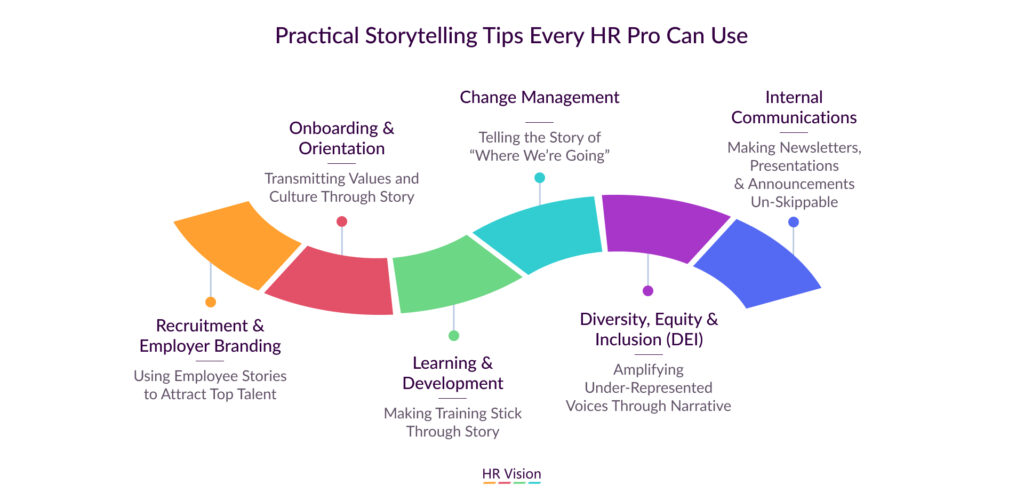
1. Recruitment & Employer Branding — Using Employee Stories to Attract Top Talent
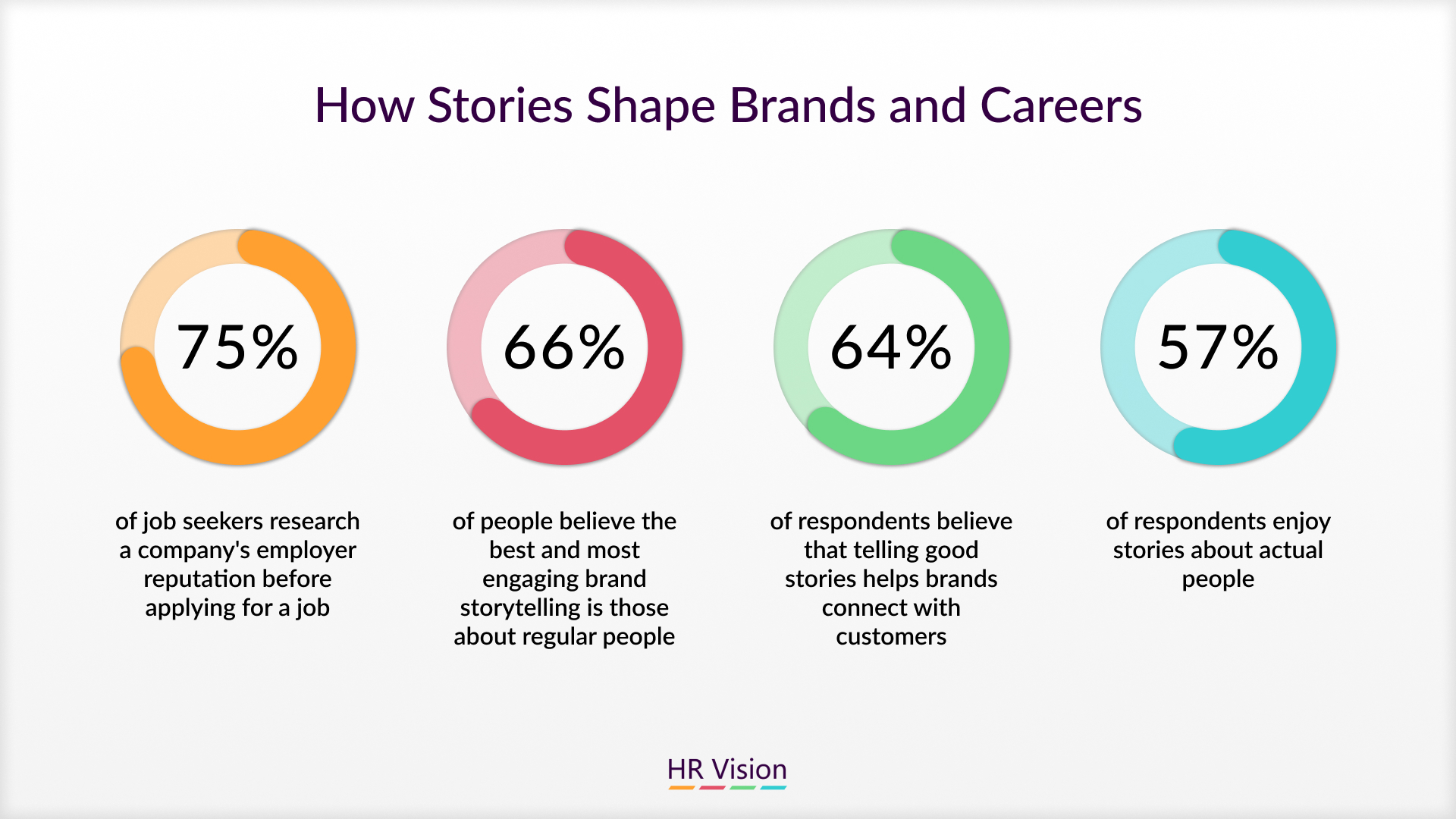
Recruiters rank employer branding as the No. 2 force that will shape hiring over the next five years—just behind quality of hire—and 49 % say it’s rising in strategic importance. At the same time, Glassdoor’s Mission & Culture Survey shows that 77 % of job seekers consider a company’s culture before even clicking “Apply,” and 70 % would walk away if its values don’t align with their own. Stories are the bridge between those statistics and the human hearts they represent: they translate abstract values into lived experiences that candidates can picture themselves inside.
How to Use Employee Stories to Attract Top Talent:
- • Show, don’t tell. Airbnb’s “Belong Anywhere” campaign pivots on host and employee vignettes rather than polished slogans; the authentic footage turned a transactional booking site into a brand rooted in connection and trust.
- • Highlight growth arcs. Patagonia shares tales of activists-turned-product-developers and working parents whose careers flourish alongside on-site childcare. The result? A retail-sector-defying 4 % turnover rate that signals to applicants this is a place where people stay because the story keeps getting better.
- • Empower employee-generated content (EGC). Encourage teammates to post day-in-the-life videos, LinkedIn articles, or podcast cameos. Candidate-tracking data consistently show higher InMail acceptance and application-to-offer ratios when prospects encounter peers’ voices first.
Mini-case: Cisco’s #WeAreCisco. Cisco curates hundreds of first-person blogs and social takeovers where interns, ERG leaders, and frontline engineers tell “a day in my life” stories. The program underpins Cisco’s perennial top-three spot on Great Place to Work lists and feeds Glassdoor ratings that show 90% of employees would recommend the company.

Sharing the Company’s Origin or Mission Narrative
- • Connect purpose to role. Whether it’s Google’s garage-to-global legend or a founder’s kitchen-table prototype, anchor every job description in why the organization exists. Mission stories act as a heuristic; candidates quickly assess “Do I want my career arc woven into this plot?”
- • Cascade purpose through interview stages. Train hiring panels to open with a personal “mission moment” (e.g., “The feature I shipped last quarter helped 2 million users reduce food waste”). This primes value alignment and invites candidates to respond with their own aspirational stories, deepening mutual fit.
- • Re-story your careers site. Swap the sterile “About Us” paragraph for a scrolling narrative timeline: founding spark ➜ pivotal challenge ➜ today’s horizon. Embed short clips of employees recounting how they live the mission in real projects; then close with a call-to-action that positions the applicant as the next chapter’s hero.
How to Embed Storytelling in Recruitment
| Step | What to do | Quick win |
| Collect | Launch a 5-question “Share your proudest moment” survey; mine stay-and-exit interviews. | Build a 30-story content bank in a month. |
| Curate | Map each story to EVP pillars (growth, impact, belonging, flexibility). | Aligns talent campaigns to strategic themes. |
| Produce | Pair a storyteller with a smartphone + subtitle template; authenticity beats studio polish. | Post weekly #Inside[YourCo] reels. |
| Amplify | Syndicate across job ads, LinkedIn Life, referral kits, campus events. | Converts passive followers into active applicants. |
| Measure | Track source-of-hire, time-to-fill, and sentiment lift after story deployments. | Iterate on formats that move the needle. |
2. Onboarding & Orientation — Transmitting Values and Culture Through Story
Nearly one-fifth of new hires decide to leave within their first 45 days, yet companies that invest in a structured, story-rich onboarding experience see new-hire retention jump 82% and productivity climb 70%.
Orientation is a cognitive fire-hose; narrative cuts through the noise. When policies and values are framed as characters, conflicts, and resolutions, people remember them better than bullet points, and 63% of learners can still recount the story versus just 5% who recall a standalone statistic.

Three Narrative “Moments” to Design (Day 0 → Day 90)
- Pre-boarding: Invite them into the plot
Deliver a founder-narrated origin video and an interactive timeline as soon as the offer is signed.
Goal: spark excitement and ensure day-one readiness (paperwork completed, log-ins activated). - Orientation Week: Put the hire in the hero’s seat
Turn flagship customer or employee stories into live simulations—ride-along calls, service labs, value scavenger hunts.
Goal: turn abstract values into lived experience; measure with a short values-quiz and early eNPS pulse. - First 90 Days: Release chapters & mentors
Drip “culture-in-action” anecdotes via Slack or email and pair each new hire with a buddy trained to share personal value stories.
Goal: deepen belonging and mastery; track buddy-meeting completion and 90-day retention.
3. Learning & Development — Making Training Stick Through Story
When employees sit through another slide-heavy workshop, only a fraction of the content turns into action. Add a well-told story—a relatable hero, a real-world problem, a satisfying resolution—and the same information lights up more areas of the brain, triggering emotion, recall, and, most importantly, behaviour change. In other words, story isn’t window dressing for training; it’s the Velcro that helps new skills and concepts stay put.
Quick Wins for L&D Teams
- • Open every module with a mini-story. A 60-second anecdote about a real employee who solved the problem your training addresses will hook attention and set context.
- • Use scenario-based practice. Instead of quiz questions, drop learners into a branching story where their choices shape the outcome.
- • Collect ‘micro-success’ tales. Invite participants to share how they applied last month’s training; spotlight one story at the start of each new session.
- • Pair data with narrative. Show the metric you want (e.g., fewer safety incidents), then tell the story behind the best improvement.
- • Refresh stories annually. As tools and challenges evolve, retire dated anecdotes so content feels current and authentic.
Mini-case: Walmart’s VR Story Scenarios
- • Deployed 17,000 Oculus Go headsets across 4,700 U.S. stores, rolling out 45 story-driven VR modules—everything from Black-Friday crowd control to Pickup-Tower setup.
- • Associates who trained in VR reported higher confidence and retention and scored 10-15 % better on post-training assessments than those in traditional classes.
Bottom line: Bring stories into every workshop, e-learning module, and lunch-and-learn, and you’ll turn passive listeners into motivated learners who actually remember—and use—what you teach.

4. Change Management — Telling the Story of “Where We’re Going”
Roughly 7 out of 10 transformation efforts stall or backslide because employees never buy into the plot line of the change. Most see a slide deck of milestones, but they can’t picture their own role—or the payoff—so momentum drains away. A compelling narrative turns that sterile roadmap into a journey: it gives the change a clear origin, meaningful stakes, and a believable destination, so people feel invited to move rather than pushed to comply.
When leaders frame the initiative as a story of growth, resilience and purpose, three things happen:
- • People can visualise the future. A vivid “from → to” storyline paints a world they want to live in, not just tasks they must complete.
- • Past victories become fuel. Reminding teams of earlier crises they overcame (“Remember how we pivoted in 2020…”) activates a sense of collective efficacy that lowers fear of the next leap.
- • Purpose beats process. By tying every phase of the rollout to a human benefit—customers served faster, carbon cut in half—the narrative converts anxiety into motivation.
Putting the story to work
Start by listening. Hold sessions that uncover people’s real concerns—bring the “villains” of the story to light. Then craft a one-page story that’s easy for anyone to repeat. It should explain the challenge we faced yesterday, the tension we’re experiencing today, the promise of a better tomorrow, and the first brave step we’re taking to get there. Begin sharing this story in live conversations, then reinforce it through videos, town hall anecdotes, team huddles, and weekly emails that mark each new chapter. Treat obstacles and pushback as natural plot twists rather than threats; each problem solved becomes proof that a positive ending is within reach. Track belief as carefully as you track progress—quick pulse surveys that ask, “Can you describe why we’re changing?” often reveal early whether the story is truly connecting.
5. Diversity, Equity & Inclusion (DEI) — Amplifying Under-Represented Voices Through Narrative
A policy can tell people they belong, but a story lets them feel it. Neuroscience shows that when we hear a first-person account of bias overcome or an ally who stepped up, our brains release oxytocin—the same empathy chemical that bonds families—making listeners far more likely to understand, remember, and act. Yet despite a surge of DEI programs, only one in ten employees say they actually feel recognised in “inclusive” workplaces. The gap is not more PowerPoints; it’s more voices.
Five practical ways to weave a story into DEI:
- ERG Story Circles. Give each employee-resource group a monthly 30-minute slot where members trade five-minute personal stories. Record and caption the best clips for your internal library.
- “Origin-Moments” in Town Halls. Open every all-hands with a rotating employee who shares the moment they first felt included—or excluded—at work.
- Manager Allyship Minutes. Equip people leaders with a short narrative prompt (“Tell your team about a time you learned from being called out”) to open staff meetings.
- Story-First Data Drops. Whenever you publish representation or pay-gap numbers, lead with a real voice that embodies the metric’s human impact.
Belonging Pulse + Recall. Ask in quarterly surveys: “Which story about inclusion resonated with you recently?” High recall is an early indicator that the culture work is landing.
6. Internal Communications — Making Newsletters, Presentations & Announcements Un-Skippable
Internal comms competes with 347 billion emails sent every day, and the typical corporate newsletter is lucky to earn a 20-30% open rate (40% is considered exceptional). Meanwhile, disengagement is climbing: Gallup’s latest global survey shows employee engagement sliding from 23% to 21% in 2024—only the second drop in a dozen years.
Stories—and the brain chemistry they trigger—are the fastest antidote to “mark-as-read” fatigue. Replace dense copy with human-scale narrative and you activate oxytocin (empathy) and dopamine (motivation), priming employees to pay attention and remember.
How to Weave Story into Everyday Comms
- • Lead with a face, not a fact. Start newsletters, slide decks, and Slack blasts with a 50-word vignette about a real employee or customer moment. Humans decide in the first eight seconds whether to keep reading; a story buys you those seconds.
- • Give each message a mini-plot. Even a two-paragraph announcement can follow setup → tension → resolution: “We hit record sales → servers strained → here’s the upgrade plan.”
- • Personalize the hero. Use segmentation (role, region, tenure) so each cohort sees themselves in the narrative. Accenture’s “Good Morning Accenture” digest tailors content by location and job family—pushing engagement from 6% to 80%.
Show, then tell. Pair charts or deadlines with a short success story that proves why the numbers matter. A graph of reduced defects lands harder after a line-worker’s “aha” moment. - • Close with a clear next step. Every story needs a call-to-action: click a resource, give feedback, change a behavior. Make it obvious and single-minded.
Mini-Case: Good Morning Accenture
Facing inbox overload, Accenture scrapped 40k one-off memos and launched a thrice-weekly, Netflix-style digest. Each edition pulls from a story bank and personalizes the line-up by role, location, and interests. Result: click-through engagement rocketed from 6 % to 80 %—and the five-person comms team now spends more time curating stories than chasing approvals.

Practical Framework: 5 Steps to Story-Powered HR Communication
Good stories rarely fall from the sky; they’re shaped by an intentional process that turns scattered anecdotes into strategic fuel. Use this five-step cycle as your repeatable playbook.
- Listen & Gather
Sit in on stay interviews, exit interviews, and quick pulse chats, always asking for moments of pride, struggle, or surprise. Capture what people send in open-text survey boxes or drop into a #story-share chat. The aim is to build a living “story vault” that expands every month.
- Curate & Align
Review the raw anecdotes and keep only those that feel authentic, spark emotion, and connect directly to an HR goal—whether that’s hiring faster, boosting belonging, or nudging safety habits. Anything that doesn’t serve a current objective can wait on the shelf.
- Craft the Narrative
Shape each chosen story into five quick beats: setup, struggle, solution, success, and the “so-what” that tells listeners why it matters now. Keep it under three minutes to speak or 300 words to read, rich with concrete detail so anyone can retell it.
- Choose the Right Medium
Match story to channel: live town-hall telling for big culture shifts, short videos or podcasts for recruitment and onboarding, one-paragraph snippets in Slack or newsletter intros for everyday nudges, and narrative captions alongside dashboards so data never stands alone.
- Measure & Iterate
Watch engagement numbers—opens, clicks, video completion—and ask in quick polls which stories people remember. Tie the results to real outcomes like referral rates or time-to-productivity. Refresh or retire stories that lose steam, and double down on formats that move the needle.
Follow these five steps and “storytelling” stops being a one-off talent-show moment. It becomes a disciplined, data-informed practice that powers every HR touchpoint—driving understanding, emotion, and action exactly where your organization needs them most.
Conclusion
When HR teams master storytelling, they see faster hiring, stickier learning, stronger culture scores, and change initiatives that land—returns that routinely outweigh the modest time and tech costs of a story-first approach. So here’s your micro-challenge: before Friday, collect one fresh story that illustrates your values in action and share it with a teammate or in your next team chat. From there, we’ll level up to advanced moves—turning dashboards into data-driven narratives and building interactive stories for hybrid employees who crave connection. Your next chapter starts now.
Ready to turn your HR stories into the next chapter of business impact? Join us at HR Vision for two immersive days with top HR leaders who are rewriting the future of work.