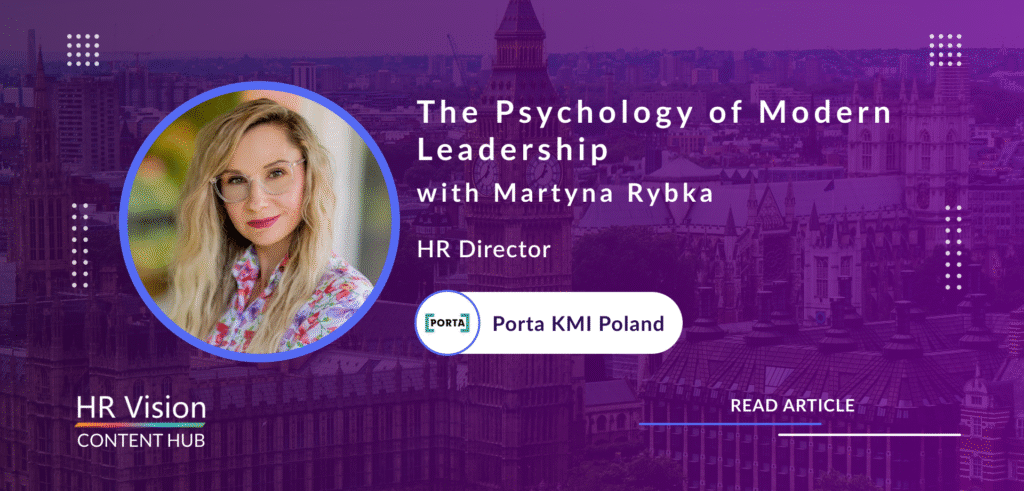
- With your background as both a psychologist and HR Director, how do you think psychological insight enhances leadership and people management in today’s fast-paced corporate environments?
A psychological perspective allows leaders to better understand employee motivations, emotions, and needs, which translates into more empathetic, effective, and informed leadership. In a world of rapid change, uncertainty, and pressure, the ability to build trust, manage stress, and recognize signs of burnout becomes crucial. Leaders with psychological awareness are better able to guide teams through change, strengthening a sense of purpose and engagement.
- What advice would you give to HR professionals aiming to transition from a purely administrative role into a more strategic leadership position?
Start by building your business knowledge – understand the organization’s processes, metrics, and goals. Then learn to speak the language of management: data, impact, ROI. Use HR analytics to demonstrate the tangible results of your actions. Change your mindset: instead of “serving” people, co-create strategy. Engage in cross-departmental projects, be visible in strategic discussions, and develop leadership skills. And above all, be a partner, not just a performer.
- As someone who also serves as a Business Trainer and Coach, what common leadership challenges do you observe among mid-level managers, and how can HR proactively address them?
The most common challenges include:
- • Lack of team management skills during change.
- • Difficulties with task allocation and trust.
- • Immaturity in conflict management.
- • Lack of feedback and a coaching management style.
HR can respond proactively through:
- • Leadership development programs (Leadership Academy).
- • Coaching and mentoring.
- • Communication and emotional intelligence training.
It is important for HR to be close to managers and aware of real operational challenges, rather than operating solely from headquarters.
- You have experience leading EHS (Environment, Health & Safety) functions. What is the role of HR in integrating safety culture into corporate values, especially in industries with high-risk environments?
The role of HR in building a safety culture is absolutely crucial. As an HR director and also responsible for occupational health and safety and environmental protection, I see this very clearly: safety is not just about procedures and regulations. It’s primarily about people, their attitudes, and their daily decisions.
I deeply believe that organizational values begin with the employee experience—how they feel, how they are treated, how much they can trust their workplace. If we want to truly integrate safety culture with company values, we must, above all, listen to people—not from behind our desks, but where they work, where they face real challenges. That’s why my team often organizes workshops, talks, and walks around the facility—not just to observe, but to create solutions together with employees.
In high-risk industries, we cannot afford to distance ourselves. Mental and physical comfort is not a luxury, it’s a necessity. An employee who works in good conditions, with access to information, tools, and support, makes fewer mistakes, acts more confidently, and responds more quickly to threats. But this requires investment—in training, ergonomics, communication, and above all, in a culture of mutual respect and trust.
HR must be the bridge between strategy and everyday life. It must have the courage to ask questions no one else is asking and create a space where everyone—from operator to manager—feels like they have an impact. Only then can safety cease to be an obligation and become a shared value.
- What HR practices have you found most effective when working closely with top executive teams?
A partnership-based, data-driven approach works best. Effective practices include:
- • HR Business Partners with strategic experience,
- • HR reports demonstrating the impact of actions on the business,
- • Involvement in succession planning and organizational transformation,
- • Support in developing leadership and organizational culture,
- • Effective advice on “people” issues.
Management boards value specificity, conciseness, and a proactive approach – HR must understand the business context and be able to propose solutions before a problem arises.
- What trends or disruptions do you foresee shaping the future of HR leadership at the executive level?
- • Artificial intelligence and automation – HR will need to manage the impact of technology on people and work culture.
- • Wellbeing and mental health – not as a benefit, but as part of the strategy.
- • Organizational agility – HR will design organizations that learn and adapt.
- • Data and people analytics – will be essential for decision-making.
- • Diversity, inclusion, and ESG – will be the foundation of responsible HR.
- In your opinion, what’s the most underestimated skill in HR today, and how can professionals at all levels develop it?
The ability to listen and read between the lines. In an age of data and automation, we forget that HR is, above all, about human interaction. Careful listening allows us to detect tensions, warning signs, and needs that don’t show up in Excel.
How to develop?
- • Use a coaching approach.
- • Learn to listen actively.
- • Give space – don’t just ask, but listen without judgment.
- • Observe not only the words, but also the emotions and context – be mindful.
- You’ve balanced a multifaceted career with personal passions. What advice would you give to professionals—especially women—seeking to grow their careers while maintaining personal identity and passions?
- • Don’t choose between your career and yourself – you can combine them, but it requires self-awareness and courage.
- • Define success your own way – don’t copy others’ definitions.
- • Surround yourself with inspiring mentors and partners.
- • Give yourself the right to take breaks and recharge – a well-rested woman is more effective than a burnt-out superhero.
- • Talk about your passions – they give you authenticity, they’re not a hindrance to your career, but its strength.
Ready to stay ahead in the ever-changing world of HR? Join us at HR Vision, where top HR leaders gather to explore the future of work, HR trends, and the power of HR analytics and technology.