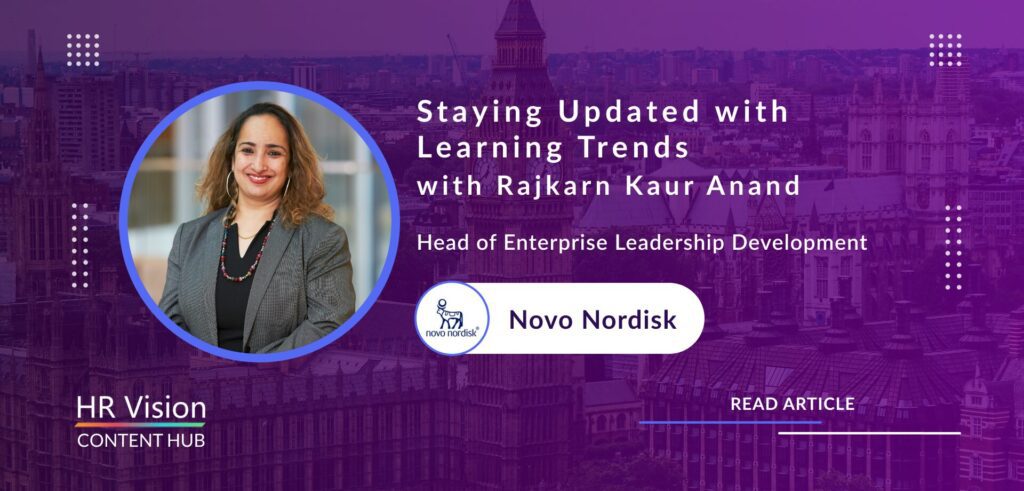
1. With your extensive corporate experience, what are the key factors for building a successful talent factory?
There is a micro and macro view to building a successful talent factory. The micro view is the several key factors such as fostering a culture of curiosity and continuous learning, providing robust structured, social, and on-the-job learning solutions, and creating opportunities for skill development and career growth. These get strengthened with a focus on diversity, inclusion, equity, and belonging along with psychological safety and a clear commitment to individual purpose and well-being.
The macro aspect is the integration of all of these key factors and a clear connection between them as well as to the organisation’s values, strategic aspirations, and cultural ambitions.
2. How do you approach understanding effective learning strategies, given your passion for learning dynamics?
Start with the Why! A clear understanding of the problem or aspiration statement is the critical starting point for developing or selecting effective learning strategies. Simultaneously we need to build an understanding of Who this is for – what are their pain points, goals, needs, hopes, learning styles, environment, and triggers. Clarity on these starting points helps refine the what and how in a much more effective and efficient manner. At this stage it is important to consider learning modality, adult learning principles, psychology, neuroscience, cognitive science, and innovative learning methodologies and designs – this needs a constant commitment to the development of the learning and development teams.
3. What advice would you give HR professionals to align learning initiatives with their organization’s needs, drawing from your capability assessment background?
Notice, Ask, Reflect, Explore, Decide, Do – and keep continuing to do it all
4. Could you share common pitfalls in learning program design and how HR can navigate them?
While this could be a long list, some of the top common pitfalls according to my experience are as follows:
- Focusing on the “What” and “How” before understanding the “Why” and “Who”;
- Not aligning organizational impact with individual needs – often HR colleagues can just be informed by opinion and get into the role of order takers instead of true experts and courageous partners;
- Not tapping into the true value of the learning solution for all parties;
- Trying to do it all – it’s a clear choice between how deep or how broad a solution should be and often less can be more;
- Not thinking about the continuity and sustainability of the learning. We get maximum impact from a design when it is a journey and process informed by science, experience, relevance, and practicality.
5. How can HR foster collaboration through learning initiatives?
HR can foster collaboration first by role-modeling the same and developing collaborative learning solutions. Further, looking at the rich enterprise-wide resources and networks and building them into the design of a solution through several possibilities such as internal mentor/coach networks, leader-led development, reverse onboarding, cross-functional connection
6. What role does technology play in learning strategies, and how can HR maximize its potential?
With the massive rate of change, innovation, and technological development we notice not only the availability but also higher levels of acceptance and engagement with technology. Integrating the relevant learning technology with the overall learning design helps strengthen the impact, increase engagement, expand the dimension of learning, and ensure the sustainability of learning. Further, they provide relevant data and insights to inform the refinement of the design as well as bring people together in a new way. The landscape is vast and includes several choices such as learning management systems, apps, AI, Adaptive Learning, Virtual and Augmented reality, and so much more.
7. Could you share some best practices for HR professionals managing large-scale learning initiatives or organizational change projects?
While managing large-scale learning or change, it is extremely important to look at the bigger picture and the interconnection between people processes, organizational values, and aspirations, leveraging the influencer network, communication and learning platforms, and other organization systems. Knowing that you don’t have all the answers and mobilizing the right resources is an essential part of getting the right energy and results. Additionally, being clear about the vision, direction, authority, support, and measures of success helps to stay on the right track – it is easy to get lost if we are not careful.
8. You’ve expressed a keen interest in exploring different learning apps. Are there any particular apps or tools that you’ve found to be especially effective for professional development or skill enhancement?
I particularly enjoy leveraging LinkedIn, Audibles, Blinkist, Headway, Chat GPT, TED, Deepstash, along with several news, publication, and podcast apps. Of course, there are many options out there but these are my usual “go-to” apps. I also enjoy a lot of our internal Novo Nordisk learning platforms.
9. How do you stay updated with learning trends, and do you have any advice for HR professionals to do the same?
Personally, I am committed to being curious and investing in my own learning in various ways. Maybe it helps to share how I go about it and then I am curious to hear what others do as well. For me, it’s a three-pronged approach:
- Adding to my mental database through sources such as books, research, trends, internal experts, “external breathing (webinars, signing up for publications, coffee connects, podcasts), truly listening, courses, and more.
- Processing the inputs and knowledge through reflection, introspection, writing, discussions, debates, sharing, and more
- Fortifying the learning through experimentation, feedback, practice, coaching, assessing, teaching, and continuing to learn
10. Recently, Great Britain has introduced a pilot project of a 4-day working week. What’s your opinion about it? What advantages and disadvantages do you see both for employers and employees? Would you take part in the experiment, and why?
I think that we should look at it as an experiment and with the openness that any new initiative deserves.
The advantages could be higher productivity, more time for growth, and lower stress levels for the individuals – which, when put together at scale can result in better results for the organizations involved.
The disadvantages could be confusion and short-term productivity strains that a change like this could bring, more competition as some would have a higher appetite and need to work the extra day compared to others, adjustments in salaries, low inspiration around effective use of the extra time and stabilizing the change.
I would personally love to take part in the experiment though at an organizational level this should be a much larger discussion. My motivation is my curiosity and my love for having more time to explore, learn and expand my horizons when I have some extra time.
Ready to stay ahead in the ever-changing world of HR? Join us at HR Vision, where top HR leaders gather to explore the future of work, HR trends, and the power of HR analytics and technology.
Disclaimer: The insights and perspectives shared by Rajkarn Kaur Anand in her engagements are based on her personal experiences and learnings in the field of Learning and Development (L&D). These views are solely her own and do not represent the official stance or opinions of Novo Nordisk. Any information, ideas, or opinions expressed by Rajkarn are independent of her affiliation with the organisation.