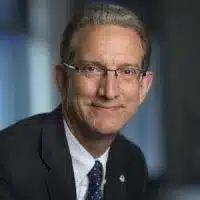
Stephen Pierce
Deputy Managing Director and Chief Human Resources Officer
Hitachi Europe
As Stephen Pierce’s title shows – “CHRO & Deputy MD” – he has fully bridged the gap between HR and the business. In this article he shares his insights into the big issues of HR and what he is working on in 2018
What has been the single biggest change in HR you have seen over the last 5- 10 years?
How employers need to engage with employees & potential recruits, and therefore how we need to build our employer brand. This has been driven by the ongoing digital transformation (e.g. social media and other technologies) both of business and of people’s personal lives, but companies are lagging behind consumers.
What do you expect to be the biggest changes to HR over next 5 – 10 years?
The changing nature of the workforce due to AI & automation, the multi-generational workforce, the gig economy & the expectations of millennials (who will be 75% of the workforce by 2025).
I’m also thinking of Diversity & Inclusion. We are all addressing this, but recent events make it crystal clear that there is much more to be done.
And finally, Brexit. At least for those of us in the UK, in terms of how it will change the talent landscape.
What does it take to get to the very top in HR?
Remember you are a business professional first who happens to bring HR skills. In a recent survey by the University of South Carolina CEOs identified the key weaknesses of their previous CHRO as being a) the inability to develop strong relationships with other members of the exec team, and b) to effectively link the HR strategy to the business strategy.
It is no bad thing if you either don’t come originally from a HR background (although I myself did!) or if you spend some time doing another business function.
Make an effort to be as numerate as a good finance or marketing person would be expected to be. Understand the business in terms of the P&L as well as also understanding the customer and know what keeps the customer-facing business leaders awake at night!
What does it mean to be “digitally minded” in HR?
It means to understand the underlying technologies and how they are changing not just work but life. And this can be a challenge for those of us who are digital immigrants! But perhaps even more important is to become an advocate for that change within the business generally and HR specifically – don’t delegate it all to others because you feel less comfortable with it.
For as long as you must talk about “being digitally minded” you are not there yet. It should be transparent, just part of our business DNA, because doing business digitally just means doing business well! Many companies will be very digitally minded in terms of how the interface externally with the world, so it just makes sense to mirror that internally but that can be more of a challenge to change internal culture and get the investment needed too.
What is at stake for companies that don’t embrace analytics, tech & become digitally minded?
Firstly, the issue will be at an individual level because if you don’t embrace this then you are resisting change, and that is not leadership behaviour that most companies want. Connected with that, there is an authenticity issue – you need to not just be paying lip-service but living being digital.
Companies who lag here will have problems attracting & retaining talent. And they will also have problems understanding their customers.
For HR specifically one of the big wins we have found is that by both harmonising processes and delivering these on a platform that people want to use it has freed up our time from administering processes to spend more time strategizing.
What have you done at Hitachi so far on this journey, and what is still to come?
As a start we’ve built a platform of technologies to help us with the journey. The technologies we have chosen are:
Workday as our people system. We chose it because it fitted our company structure, primarily because it is both flexible and scalable, meaning that we could start with a pilot and then scale up. We’ve also chosen Cornerstone as the e-learning platform for our global ‘Hitachi University’; and also added Taleo as our global recruitment system.
What comes next is moving from the current 40K Workday users to the 300K users we need, which in a complex international company takes time. While we are doing this the world isn’t standing still, so we are also constantly reviewing what other technologies we could or should embrace and leveraging the systems we are using as they evolve. Equally we need to do more to move old traditional activities onto the digital platform – so an obvious example of this is moving performance management onto the Workday platform.
[/text_output][text_output]What is the key to getting people to embrace the new digital ways?
That it is not primarily a technology / system project, it is primarily a culture and change project. Be prepared that some people will resist – and sometimes for odd reasons. For example, one senior exec’s reaction to the self-service elements of Workday was “so Steve, you are trying to get me to do HR’s job”. But the key is to just find a way to get them to start using it because once they have started most people love it and of course they use technology in their personal life all the time. Facebook is perhaps the most obvious example but there are of course many others.
What do you wish you had known when you started?
The size of the challenge of the human change required. Human habit is not your friend at the start of the project! But conversely, I’d advise people not to get too bogged down in trying to plan every possible challenge in advance. Be willing to make mistakes. Plan, but also just get on and do it. Accept that things like HR analytics is difficult to do well and know that you are not alone in not being entirely sure how to use it really well. Again, just get started.
How would you advise someone to get started on this journey?
If you can spend time with any companies that are further down the road then do. For example, I was lucky enough to be part of a group that visited Google and looked at what they are doing.
While consultants can be useful, I wouldn’t start with them. There is a lot of information available online. Do some self-learning first.
I’d then say that some peer learning is a good idea. Go to a conference where you can meet the right people and hear what others are doing (next HR Vision conference is in Amsterdam, 6-7 June 2018, have a quick look here). This is particularly useful when speaking internally – being able to talk about what other companies are already doing often gets more traction than what a consultant says
What was your journey into HR?
I joined a food company as graduate trainee in HR because had a passion for business and a passion for people and HR felt like somewhere where these two came together. In fact, last year I was appointed deputy MD so now it’s official – my role really is both business and HR although I have always tried to be a business leader first and an HR leader second!
What is it about your job that most inspires you?
The ability to use my experience to make a difference: to individuals, to team effectiveness and to the business itself.
Without being modest what do your colleagues think is the most valuable thing you bring to your work?
There’s two things. The combination of business knowledge with practical HR-related insight into what does and doesn’t work with individuals and teams. And secondly, my ability to bring together a fantastic team – because that is what I have. What I achieve I achieve with and through them.
And conversely what is an area where you are less strong that you are focussing on improving in 2018?
To become a digital expert and a digital advocate – I will never stop learning and need those around me who can continually challenge what we do and how we do it.