A fast-paced market space like the FinTech sector requires fast-paced people. Intellect Design Arena Limited went through a “nuclear transformation” to a product-led organization in less than five years with an over twenty-five-year services provider legacy behind it.
Intellect took its first steps in 2014 after a big demerger from the Polaris group and started developing its brand and reach within the market. Major people related measures had to be taken – organic talent acquisition, product mindset training, and global workforce planning to name a few. Measures were taken that laid the foundation for the company today.
With a one-of-a-kind agenda, HR Vision Events provides the perfect opportunity for senior level executives to network and collaborate with peers from all over the world.
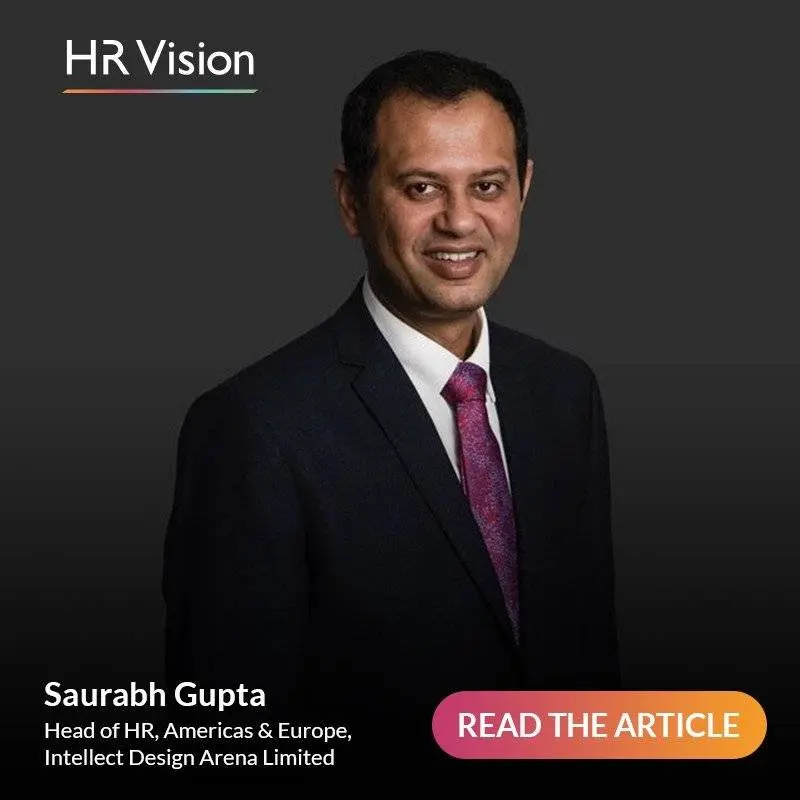
Saurabh Gupta, Head of HR for Europe and Americas, was part of the transformation. Given the fast-growing FinTech sector and the fast-evolving Intellectian workforce, Saurabh has seen first-hand how a company culture can change and what measures can be taken to organically channel it to the right pathways to support business strategy. We discuss with Saurabh, the Intellect journey from the days of Polaris till today and revisit some of the most influential chapters in what today forms the Intellect story.
Q Intellect has grown with a CAGR of 24% from 2014-15 to 2018-19 while shifting its business model from a software services company to a FinTech product company. Tell us something more to put this in context.
It is true that Intellect has grown with a CAGR of 24% over 4 years while maintaining only 8% growth in employees during this period. However, what makes it interesting is that it was not ‘more of the same’ but a complete transformation journey to create a FinTech Product company built on strong beliefs and passion of a great leadership team.
Q What are the factors that propelled this transformation journey? Is there a framework that others can look into and relate while preparing their own journey?
Any business transformation is not a single dimension problem and it is important to understand at least four dimensions, namely: Business, Organisation design to support strategy, Culture and Engagement.
When it comes to business, it is not just imperative to understand a simple business definition of ‘what business you are in’ and ‘who are your customers’ but also to understand ‘what SHIFTS are happening in your business’.
These shifts nowadays often come from technology, government regulations or new competition. With our customers, mainly banks and insurance companies, technology is driving new patterns of customer acquisition, shifting points of revenue generation, and often creating competition from new entrants who might not be your traditional competition at all. For example, can banks be threatened by a social media company as a competition?
Second, the important dimension is to understand how your business strategy would cast demand and constraints on your organization’s design. In our case, Intellect went from software services to a FinTech product company. As a FinTech company, our business strategy was clear – create a desire for our customers to buy our vision of the product and focus on true value creation to even surpass our customers’ own expectations of success. To do this, we have to get the world’s best teams and competencies, wherever they are. We have to redesign a global FinTech product organization closer to the availability of talent. Example, our client could be in northern Europe, while the UX design team could be in Toronto, DevOps implementation team could be in Lisbon and Product Engineering team could be in Mumbai. The organization design is true to support the strategy of ‘building desire, delivering trust’ to our customers with nothing but the very best teams in the world.
Q Interesting, what role can HR plan in such transformations?
HR has a very important role in every successful business transformation. At the top of the house, a true HR Leader can be a catalyst in helping the CEO stating clearly ‘shifts in business model’ and articulating the well-defined strategy. Subsequently, the strategy needs to be transferred into organization design as stated in the example above.
At this point, the first phase of forming the right organization design and structure from the HR strategy is completed. Now, the HR involvement comes in to drive a performance culture and fully engage employees to get their buy-in. These are the other two dimensions of a successful transformation.
When it comes to culture, especially in a global environment, HR needs to play an active role in ensuring that some cultures had to change, while some cultures had to remain constant. Organizations and people can learn about one another’s biases and broaden their belief systems, while the core values have to be protected and retained often with the right contextualization.
In the end, the last but most important dimension is never to lose touch with your people. Engagement comes with deep listening & personal touch.
1) Deep listening is to empower change and to protect the core values.
2) A personal touch to build trust and self-esteem in every employee.
Q What are the lessons for others to learn and avoid any pitfalls?
The important lesson has been that transformation has multidimensional problems, and we often fall into pitfalls of focusing on one aspect of either business shifts, strategy, culture or engagement.
We have to combine the best of existing and new frameworks in addressing ways of working, values, and beliefs while supporting business priorities. Legacy culture can be a unique asset and a hindering influence and we need to strike the right balance.
Q Where does Intellect go from here?
We continue our journey as FinTech leader helping banks to win in the marketplace. It is ingrained in Intellect DNA to observe continuous shifts in business and align our strategy & organization structure every 3-5 years. We actively engage employees through deep listening and evolve a truly global culture while protecting our core values. It is the Intellect Way of Working that constantly challenges us to deliver our client’s and employee’s success.
Attend HR Vision Events and meet senior HR practitioners, talent acquisition experts, and global executives from large complex organizations to choose your own business strategy and learn valuable tips and secrets on ’’how to manage human resources’’ – insights earned through decades of professional experience!