I was speaking at the HR Vision Conference in London, but I also got some great insights from the other speakers. In this article, I will share some of my take-aways.
People are challenging the status quo
After a great opening by Steven Ehrlich who is chairing the conference the first keynote was from Gary Kildare from IBM. I really appreciated the way he challenged us to realise in which context we are working and that an important role of HR is to create social conscience. The work is changing fast and this has an impact on our role and the way we successfully organise work. People wake-up and do not naturally trust a company and its leaders to do the right thing. For example around being good corporate citizens. But this is actually something people find important in choosing an employer. This is challenging for organisations and HR can play a role. HR should be more aware of what is going on in the organisation and its context. Activism is something organisations and especially HR should take seriously. It is happening all around us in countries as well as in organisations. People are taking a stand.
A portfolio approach to Employee Experience
Then we had a very inspiring talk from David Sturt from OCTanner on Employee Experience and leadership. He talked about the culture by design versus culture by default. Organisations should be more consciously shaping their cultures. He shared a lot of insights of research on culture through the eyes of employees (bottom-up). And how many micro experiences they have, shape their experience as employees.
His research shows that positive experiences have a halo effect. It colors the overall perception. The effect of positive experiences lasts for 4 weeks and of negative experiences last only 2 weeks. The funny thing is that many HR initiatives are focusing on taking away negative experiences, but this will probably result in natural experiences, whilst working on positive experiences impact the overall employee experience much more. So his message is to think about the initiatives you work on from an HR perspective. A portfolio approach to the employee experience is needed with a balance between working on negative and positive experiences. Manage the negative stuff in a situation where you are balancing it with positive experiences. Recognition, for example, increases all kinds of positive effects for everyone involved (receiver, giver, observer). These multi-dimensional effects can amplify more positive experiences. There are 6 core dimensions in which to aim our Employee experience initiatives (see picture).
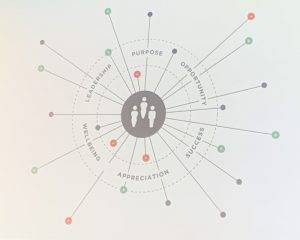
Based on the data of their research putting people on special projects was clearly something that stood out as a positive effect on the dimension of creating an opportunity for example. This is not anymore about traditional career opportunities. Employees care very much about signals of success and being part of that. We can do a much better job of making clear for people ‘what does success look like in your role?’ Appreciation has to do with ‘do they care about what I do’ and wellbeing has to do with ‘do they care about me as a whole person’.
Leadership has reached a tipping point
Leadership as one of the dimensions is only taken seriously if leaders actually have a voice within the team. And then he dived a bit deeper in the subject of leadership and stated that leadership has reached a tipping point. Activism, as mentioned before by another speaker, is all about this. This shift in the needs of modern leadership is happening. Leaders become irrelevant to people in their day to day work. People are more connected to their peers than to their leaders.
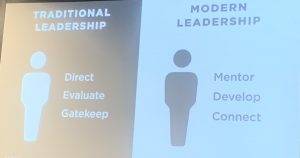
Traditional leadership is often toxic to organisations. Their research shows that 30% of employees dread 1-on-1 meetings where the manager sets the agenda. In modern leadership, we would have equal conversations. On all other aspects, modern leadership has a positive impact as well. And it was not just a minor difference, but the positive impact was totally mirroring the negative impact traditional leadership has.
The big challenge for HR in many traditional organisations is how to help shift from traditional to modern leadership if the latter is the minority. The answer is to talk about it more. Once people understand it, they start doing it. It starts with awareness and showing good practices. By the way: Everybody wants to be lead that way, it is not just a millennial thing.
Rethink HR! Be logical. Be radical.
I really loved the next talk on disrupting HR processes from Robert Neuhauser who works for Siemens. His wish for HR is that all current traditional HR processes should be dead as soon as possible and I couldn’t agree more. He shared some disruptive changes on many HR processes within Siemens after he shared 4 trends that change our playing field as HR. They either make the role of HR more though or they create opportunity. In short, these were the 4 trends:
- Vanishing predictability: e.g also career paths are unpredictable.
- Individualisation technology: this can help HR big time to move to one size fits one approach.
- Quantitative scientific insights: we have tons of studies but don’t act on it and a lot of findings are not strongly correlating. We neglected it because we did not understand. Now science shows it better and we start to understand. We cannot ignore this anymore and can start working more fact-based.
- Changing expectations: new generations are perfectly adapted to what is coming. They want to pilot new things and bring these ideas to them.
So, let’s rethink! Be logical. Be radical. HR is often part of the problem. What a great time to re-invent HR at scale! Are we radical enough? If we accept something is stupid, it probably is stupid….stay human. His call to action: Get out of the boxes of traditional requests to HR.
Goosebumps
The last Keynote was from Dan Riley who works for Kincentric. He shared a brilliant video about how easy it is to put people in boxes, but in fact, we are all humans with common purposes, wishes, challenges and worries, so why not connect on that. In my speech, I talked about HR being the connectors of humans, so I got goosebumps while watching this video: https://youtu.be/jD8tjhVO1Tc
Then he shared his thoughts on People and Culture being a perfect blend with his CCPP-concept of Caring, Courage, Purpose, Passion, which are all ingredients that should be in place and fostered within organisations. He also elaborated on Performance versus Trust and the perfect mix for success. My take-away is that trust is key in building sustainable high-performance teams. Then he closed with a call to action:
Ask yourself two questions every day :
- Did I make a specific meaningful impact today?
- How will I be remembered by the people I worked with today?
So I will end with that as well and hope you liked to read my take-aways of day one of the conference.
Attend HR Vision Events and meet senior HR practitioners, talent acquisition experts, and global executives from large complex organizations who will share their valuable insights earned through decades of professional experience.