

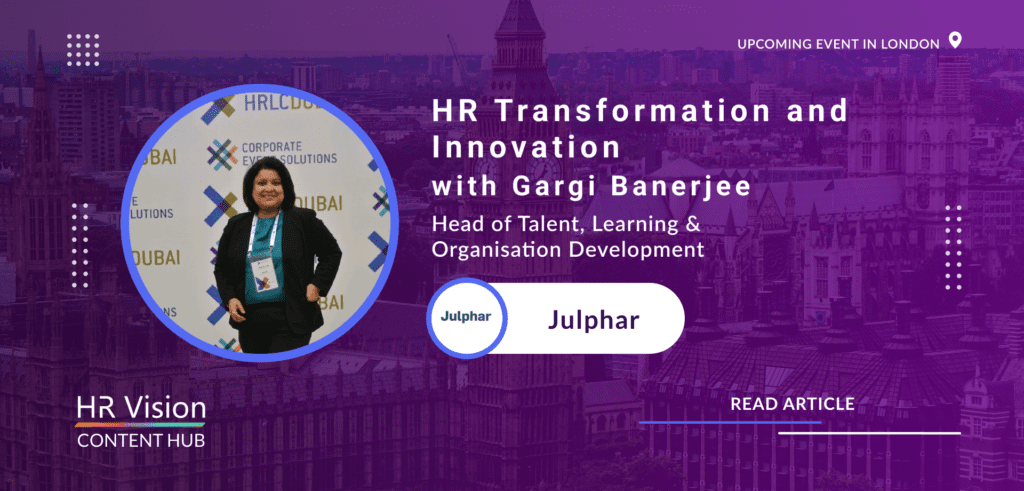
Ms. Banerjee, can you share with us the most significant transformation you have spearheaded within an HR department, and how did it affect the overall organization?
Here are examples of how we achieved this transformation:
- Listening to the employees in a more informal manner.
- Mindset change in HR practitioners from policy proposer to employee champion.
- Two-way Feedback mechanism, business understanding workshops.
- Shop floor work and field trips are conducted to understand “a day in the life” of different employee groups in Sales, Manufacturing, Quality, Research, Finance, and Supply Chain.
- Understanding their challenges, triggers, motivators, and expectations from business managers and HR.
- Slowly build the credibility of HR when you can support them to navigate these challenges a bit more effectively.
How are you leveraging technology to drive HR automation and transformation in your present assignments?
In my previous and current assignments, I have led HR automation in a large, people-intensive manufacturing organization where you can find varying levels of digital maturity across the organization.
For example, some functions, like Quality, primarily work with basic to moderately digitized systems involving SOPs, document control, and validation systems. On the other hand, you have R&D, Commercial, and other manufacturing units using cutting-edge digital technology in their daily work. Therefore, while leading HR digitization, we had to keep things simple for easy understanding and accessibility.
When designing the ESS digital page, my team and I ensured that we thought from the employee’s point of view and how we could provide them with solutions through a digital interface itself, without knocking on the door of HR or their manager. The data suggests that we have reduced more than 80%.
Can you provide specific examples of the technologies you have found most impactful?
For me, the most impactful technology revolves around Talent, Career, and Performance Management for internal employee groups. I am a big fan of employee engagement platforms that connect both office and hybrid working groups across departments.
You’ve worked across industries like Manufacturing, Pharmaceuticals, Medical, and FMCG. How does your strategy differ when managing talent across these diverse sectors?
I believe that Talent Management fundamentals are traditionally the same regardless of industry. However, the strategic practices differ with respect to industries due to a few critical factors: employee demographics and their diversity (age group, generation, educational background, and job functions).
Post-pandemic, there has been a significant shift in how we approach work, talent, and career management. People are bringing their whole selves into their jobs.
So, while performing Talent Management, we have to keep in mind that just career growth won’t excite the new generation. They need more purpose-driven, impactful assignments when considering talent development and engagement
How do you align global talent management with the business strategy of multinational corporations? What are some key challenges you face and how do you overcome them?
The Global Talent Management is a very creative scope to work on. Every country and every multinational company, along with its talent pool, has its own benchmarks. At the same Multinational Organizations running the Center of Excellence model have their own deliverables. What generally drives the success of a global talent management strategy, which I have observed and practiced in my current and previous assignments, are as follows:
- Alignment with the larger organizational strategy.
- A consistent approach to managing internal talent mobility.
- Cultural sensitivity and embeddedness as appropriate for each country or market.
- Balancing both global and local needs.
- A differentiated ‘Employer Branding’ strategy for both external and internal talent.
- Management involvement and patronage.
What is important is to have a helicopter view from both the employee and employer perspectives when working on the Talent Management agenda, both globally and locally. It’s crucial to listen more to employee surveys, focusing on career progression, learning opportunities, diversified exposure, etc., as these are generally the requirements of talents, regardless of industry or geography.
Your work in performance management is well-recognized. What do you think are some emerging trends in this area, and how do they play into the broader picture of HR?
I can very well share, from my own experience, the following emerging trends in the Performance Management Framework. The emerging trends are as follows:
- Digital on-the-go PMS platform/app, where employees and managers log real-time achievements and challenges.
- A community-driven approach where key projects are uploaded to the PMS platform with clear assignments and milestones for each department and individual.
- Visualization, instant recognition, a gamified approach, and greater engagement are enhancing the general performance practices and culture of the company.
- HR’s overall enablement and collaborative communication with department managers play a major role in cascading down this culture.
- Communication and more regular performance feedback discussions are taking place instead of the traditional annual appraisal system worldwide.
- OKR (Objective Key Result) is a new practice that corporations are adopting worldwide.
In the era of digital transformation, how are you navigating the challenges of capability development across an enterprise?
Capability Development is an organizational priority in today’s VUCA world and complex workplaces. This involves:
- Adopting AI for generating interactive videos.
- Implementing microlearning with a gamified approach.
- Promoting significant flexibility for learners through directed self-learning.
- Ensuring real-time application in learning courses to enhance retention and effectiveness.
- Recognizing that learning is no longer an event but has become a communication channel in progressive workplaces.
You have been awarded for your significant work in Cadila Pharma. Could you share the key elements and practices you introduced there which led to such recognition?
There were multiple new initiatives I could take at Cadila Pharma under the big umbrella of Talent & Learning. However, I can share a couple of path-breaking initiatives:
- Assessment & Development Centres for the Commercial Function
- To institutionalize the ‘Talent Strategy’ by developing in-house talent.
- Structured Career Path with individual development plans for high performers/high-potential talent.
- Introduction of a ‘Management Graduate’ program from top-tier academic institutions to build a steady talent pipeline.
Given your role as a guest faculty at various top-rated academic institutions, how do you see the next generation of HR professionals changing the landscape of HR management in the coming years?
The next-generation HR professionals are quite exposed to complex scenarios. COVID-19 has certainly changed the way we perceive the world of work. Today’s HR folks are more conversant with managing hybrid workers, ensuring better employee engagement even in remote work settings with the help of technology.
Another area that has seen significant improvement is ‘Inclusivity’ in the workplace. Therefore, the new generation of HR leaders is much more open to embracing a diverse talent market.
Join us at HR Vision to embrace the future of HR and explore transformative practices for growth and innovation with top HR leaders.


