


In an era defined by data-driven decision-making, the realm of Human Resources is undergoing a profound transformation. The strategic role of HR has evolved beyond traditional administrative tasks, taking on a pivotal role in shaping organizational success. A key driver of this transformation is the growing prominence of People Analytics, a dynamic and forward-looking discipline poised to play an even more crucial role in the HR landscape in 2024.
Organizations are actively seeking professionals for people analytics jobs to harness the power of data and make informed HR decisions. The demand for these roles is evident, and as the future of work continues to evolve, HR teams will increasingly rely on people analytics jobs to drive strategy.
The Importance of People Analytics in HR
The significance of People Analytics in HR cannot be overstated, and the statistics corroborate this. More than 9 in 10 (94%) business leaders say that people analytics elevates the HR profession, highlighting its transformative impact on HR practices. This overwhelming consensus among business leaders underscores the crucial role that People Analytics plays in reshaping the HR landscape. Additionally, 71% of HR executives who use people analytics report that it is essential to their organization’s HR strategy.
From a recruitment perspective, People Analytics helps in identifying the most effective sources for talent acquisition, streamlining the hiring process, and predicting which candidates are most likely to succeed in a given role. Moreover, by analyzing employee turnover and identifying patterns and potential causes, People Analytics equips organizations to proactively address retention issues. Overall, the utilization of People Analytics not only enhances HR efficiency but also contributes to the overall health and competitiveness of the organization.
People Analytics Software
People analytics software play a pivotal role in shaping a comprehensive people analytics strategy within organizations. HR professionals, including HR data analysts, are equipped with the necessary tools to gather and analyze data efficiently.
Platforms like IBM Watson Talent Insights and Visier are prime examples of people analytics software that offer predictive analytics to guide people analytics strategy decisions regarding hiring and succession planning. Simultaneously, HRIS (Human Resource Information Systems) software such as Workday and SAP SuccessFactors streamline personnel management, providing the foundation for a well-rounded people analytics strategy. Moreover, tools like Tableau and Power BI enable organizations to visualize their HR data, revealing vital patterns and trends that can significantly influence their strategy. In essence, these tools and software are essential for businesses aiming to develop a comprehensive people analytics strategy that optimizes human capital, boosts productivity, and fosters employee satisfaction.
Emerging Trends in People Analytics for 2024
In 2024, several emerging trends are set to shape the landscape of People Analytics, each offering its own unique contribution to HR strategy and decision-making.
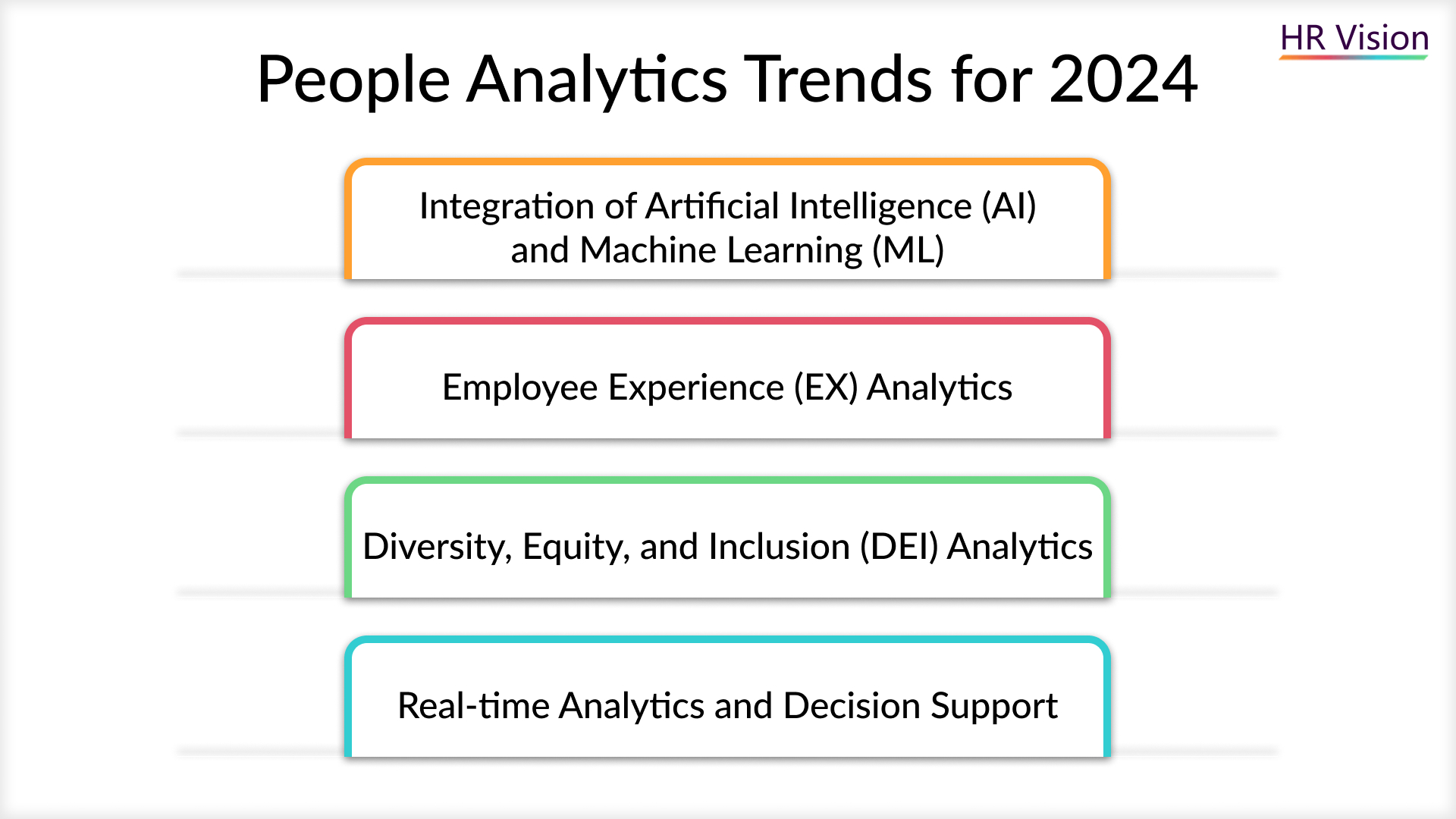
- Integration of Artificial Intelligence (AI) and Machine Learning (ML)
As we march further into the digital age, the integration of Artificial Intelligence (AI) and Machine Learning (ML) is becoming increasingly indispensable in the realm of People Analytics. These technologies have the power to transform how HR professionals analyze data and make informed decisions. AI and ML can rapidly process vast amounts of information, allowing HR teams to uncover patterns, predict employee behavior, and optimize HR operations.
AI-driven tools can assist in resume screening, making recruitment more efficient by identifying the best-fit candidates more accurately. Machine Learning algorithms can predict employee attrition, enabling HR, led by HR data analysts, to take proactive steps to retain valuable talent. Moreover, AI chatbots and virtual assistants are being used to enhance employee engagement and support by providing instant answers to common HR queries. In 2024, the symbiosis of AI and ML with People Analytics is set to be at the forefront of HR technology.
- Employee Experience (EX) Analytics
Employee experience (EX) is a term gaining prominence in HR circles, and for a good reason. An engaged and satisfied workforce contributes to higher productivity, lower turnover, and an overall healthier organizational culture. EX Analytics involves measuring, analyzing, and improving the various touchpoints of an employee’s journey within an organization.
By harnessing EX Analytics, HR professionals, including HR data analysts, can pinpoint areas of concern, enhance onboarding processes, and identify trends affecting employee satisfaction. This trend is expected to gain traction in 2024 as businesses recognize that understanding and optimizing the employee experience is a strategic imperative for attracting and retaining top talent.
- Diversity, Equity, and Inclusion (DEI) Analytics
Diversity, equity, and inclusion (DEI) are no longer merely buzzwords but essential pillars of a forward-thinking workplace. Organizations are under increasing pressure to foster diverse and inclusive environments, and DEI Analytics provides the tools to measure progress and identify areas for improvement.
In 2024, DEI Analytics is expected to play a crucial role in shaping HR strategies, ensuring that organizations are not only diverse but also equitable and inclusive. By analyzing data related to hiring, promotions, pay equity, and employee experiences, HR teams can track their progress toward a more inclusive workforce and address disparities that may exist.
- Real-time Analytics and Decision Support
In the fast-paced world of business, the ability to make real-time decisions is invaluable. Real-time People Analytics is emerging as a trend that empowers HR professionals to address issues and opportunities as they happen. Whether it’s identifying potential employee issues, monitoring the impact of a new HR initiative, or adjusting workforce planning in response to changing market conditions, real-time analytics and decision support tools are set to become standard in 2024.
These tools provide HR with immediate insights, allowing them to take swift, data-driven action. Whether it’s reacting to employee sentiment shifts, adapting to remote work trends, or addressing sudden talent shortages, real-time analytics will keep HR at the forefront of organizational responsiveness.
The Future of People Analytics
Looking beyond 2024, we can anticipate People Analytics becoming increasingly predictive and prescriptive. Advanced machine learning algorithms will evolve to the point where they can forecast workforce trends with remarkable accuracy. HR professionals will rely on these predictions to proactively address issues such as talent gaps, attrition, and performance fluctuations, ultimately enabling organizations to take preventive measures rather than reactive ones.
In 2024, the field of people analytics jobs is poised for remarkable growth and evolution. As organizations increasingly recognize the value of data-driven decision-making in managing their workforce, the demand for professionals in this field is expected to surge. People analytics specialists will find themselves at the forefront of HR and talent management, utilizing advanced technologies and predictive analytics to optimize employee recruitment, retention, and development. The future of people analytics jobs in 2024 is undoubtedly shaped by a dynamic landscape, where the synergy between human resource management and data science is driving innovation and efficiency across various industries.
Moreover, the integration of augmented reality (AR) and virtual reality (VR) technologies into People Analytics tools could revolutionize the way HR professionals interact with and understand their workforce. These immersive technologies may provide insights into employees’ experiences within the digital workplace, offering new dimensions of understanding that were previously inaccessible. Additionally, blockchain technology might find applications in People Analytics, particularly in the validation of credentials and skills. HR teams could use blockchain to securely verify and manage qualifications, streamlining the hiring process and ensuring the accuracy and authenticity of candidate credentials.
The future of People Analytics is intertwined with the evolving role of HR professionals themselves. Beyond 2024, HR teams are expected to become even more strategic partners within organizations. They will be instrumental in guiding data-driven decision-making processes that span the entire employee lifecycle. The traditional HR role as administrative support is giving way to that of a strategic influencer, shaping not just HR strategies but also business strategies at large.
Do you want to stay at the forefront of HR’s data-driven transformation? Join us at HR Vision and learn from top HR leaders about the future of work and the evolving trends in HR.


