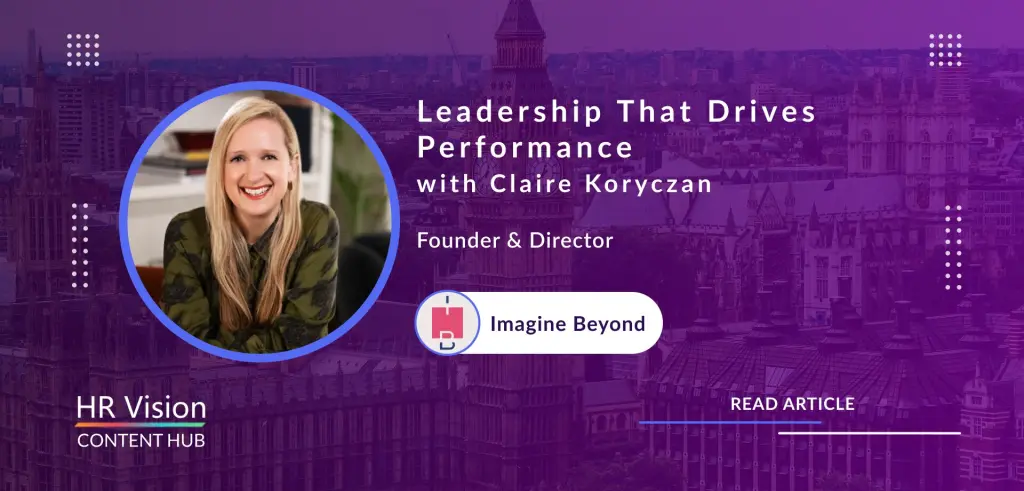
- You specialise in creating environments that promote high performance and productivity. What are the first steps you take when helping a business foster a culture of performance?
The first step is understanding the business’s values and priorities, hearing the context in which the organisation operates, the nuances of that environment, and what makes it special.
We then ask questions like, how does your organisation define performance, and what does success look like? What are the cultural norms? This allows us to learn about the expectations and the goals that are important to fostering high-performing teams – and these ingredients are unique in every organisation.
From this insight, we design, create and curate programmes to sustainably strengthen and build a high-performance culture. Recognising that, at the heart, it’s about enabling talent to excel in their unique environment, building resilience and identifying what energises and motivates them to succeed.
- How do you approach leadership development in founder-led businesses, where personal vision and business goals are closely intertwined?
Leadership development within founder-led businesses is a highly collaborative process that starts with understanding the founder’s vision, organisational goals, and objectives to ensure that all leadership development aligns and builds towards this.
Then, we identify the current gaps and opportunities and any challenges we need to overcome by working in partnership with the people team to define and decode these. From this, we design bespoke programmes that build and strengthen the desired future skills and behaviours and ensure each programme created is as relevant and impactful to the leaders and the organisation context as possible. We are not a one-size-fits-all approach.
- What are the most effective strategies for improving collaboration across different departments or functions?
One of the most effective strategies for improving collaboration across different departments and functions geographically is collaborative learning experiences. Workshops are intentionally designed to not only provide enriching learning experiences, but also create the space for peer-to-peer problem-solving, shared experiences and learning about each other which builds trust and enhances collaboration.
This approach breaks down barriers by fostering psychological safety in a non-competitive environment. It helps to dispel conflict and create a level playing field where everyone is encouraged to speak up, share ideas and suggest solutions whilst supporting and listening to each other.
- What do you consider the most important skills for leaders to develop in today’s fast-paced business environment?
At Imagine Beyond, we often talk about the most important skills for leaders being an entrepreneurial mindset to foster innovation, and create opportunities for growth, whilst managing and leading people brilliantly. All of which are essential for a competitive advantage, especially now.
Accessible entrepreneurial skills and behaviours include curiosity to explore new ways of working, agility, the ability to pivot, customer centricity, seeing the internal and external perspectives, and the creativity to find new solutions whilst viewing challenges as opportunities.
- Given your experience with FTSE100 and Fortune 500 companies, how does the approach to leadership differ in large corporations compared to smaller, founder-led businesses?
Often, founder-led businesses have a greater appetite for experimenting, testing and learning, with less resources and can be more resourceful and creative. Corporates benefit from their scale, processes, resources and structure, which can also mean that change takes longer to implement.
The common thread between organisations of all sizes is that the leadership and direction set a precedent for the wider business and impact an organisation’s potential success or failure – no matter its size. While the specific pressures may vary for a founder-led business vs a senior leader within a larger organisation, the potential outcomes of success or failure are often the same.
- How can organisations balance the need for continuous innovation with the demands of day-to-day operations?
At a macro level, Generative AI can help organisations prioritise the need for continuous innovation by finding areas to streamline processes, foster collaboration, and spotlight opportunities to accelerate innovation and drive productivity. As a result, output increases by automating many of the day-to-day operations.
Leaders who look for ways to continuously improve, whether that be processes, team performance or ways of working are driving innovation, even if it’s incremental and internally focused. Adopting the Japanese concept ‘Kaizen’ which means continuous improvement, creates a culture of innovation by its nature, and enables leaders to balance the here and now, whilst capitalising on practices that create a culture of innovation.
- What role does emotional intelligence play in the leadership development programs you design?
Emotional intelligence and self-awareness are core threads in leadership development at Imagine Beyond. Knowing your impact as a leader, especially under high-pressure has a direct influence on the people you lead and manage and this can either be positive or negative.
Leaders who are in tune and aware of their behaviours and actions, able to respond rather than react, create environments where they are better able to engage, influence and motivate their teams, which results in greater productivity, performance and output. On the flip side, leaders who are inconsistent and react to their triggers by ‘shooting from the hip’ without considering the impact of their actions and behaviours unsettle teams, evoke the fight, flight, freeze response in their people which, as we know from neuroscience, has a direct impact on cognitive functioning and is never going to result in people doing their best and most innovative work.
- What common mistakes do leaders make in their professional development, and how can they avoid them?
A common mistake a leader can make is having a fixed mindset, thinking that they know everything and have all the answers.
The best leaders are open to being challenged and encouraging new ideas, and we have seen a real shift in this within many organisations as new, more vocal generations enter the workforce and technological innovations challenge current processes. A leader open to exploring new ideas and innovations is incredibly powerful.
Due to competing demands, leaders often put their personal growth and learning on the back burner. But it is so important to challenge and stretch ourselves at every point of our career paths. Working on yourself is often the greatest advantage you can create in business.
Ready to stay ahead in the ever-changing world of HR? Join us at HR Vision, where top HR leaders gather to explore the future of work, HR trends, and the power of HR analytics and technology.