According to LinkedIn, candidates trust a company’s employees three times more than the company itself when deciding whether it’s a great place to work. In other words, people believe people—not polished slogans or glossy career pages. When an engineer shares a behind-the-scenes post about flexible hours, or a customer-success rep tweets about real growth opportunities, that authentic signal cuts through the corporate noise and shapes how outsiders see your organization.
Yet many HR leaders still lump employer branding (the story you craft) and employee branding (the story your people tell) into one catch-all bucket. Think of employer branding as the stage set—your Employee Value Proposition (EVP), recruitment ads, and awards that frame the performance. Employee branding is the live production: the improvised, human moments that bring the script to life for every would-be applicant scrolling LinkedIn or reading Glassdoor at 11 p.m.
What Is Employer Branding?
Employer branding is a company’s deliberate, long-term effort to shape how current and future employees perceive it as a place to work. Think of it as the reputation layer that sits alongside your consumer brand—only this one targets talent instead of customers.
Who Owns It?
Although employer branding touches every corner of the business, it’s typically spearheaded by HR, Talent Acquisition, and Marketing. HR frames the culture and benefits; talent acquisition translates that into recruiting messages; and marketing ensures that the look, feel, and tone align with the wider brand story.
Core Building Blocks
- Employee Value Proposition (EVP) – the promise you make to employees about growth, purpose, and reward.
- Careers Page & Microsites – digital storefronts showcasing culture, benefits, and success stories.
- Recruitment Messaging – job ads, social posts, videos, and events that translate the EVP into action.
- HR Campaigns & Awards – from “Best Place to Work” submissions to onboarding swag, every touchpoint reinforces the narrative.
Why It Matters
Three out of four job seekers ( ≈ 75 %) look up an employer’s reputation before they even start an application, and the single biggest obstacle they report is “not knowing what it’s like to work there.” When that information is missing or negative, companies pay a literal price: research shows organizations with weak employer brands end up spending about 10 % more on salaries to persuade candidates to join.
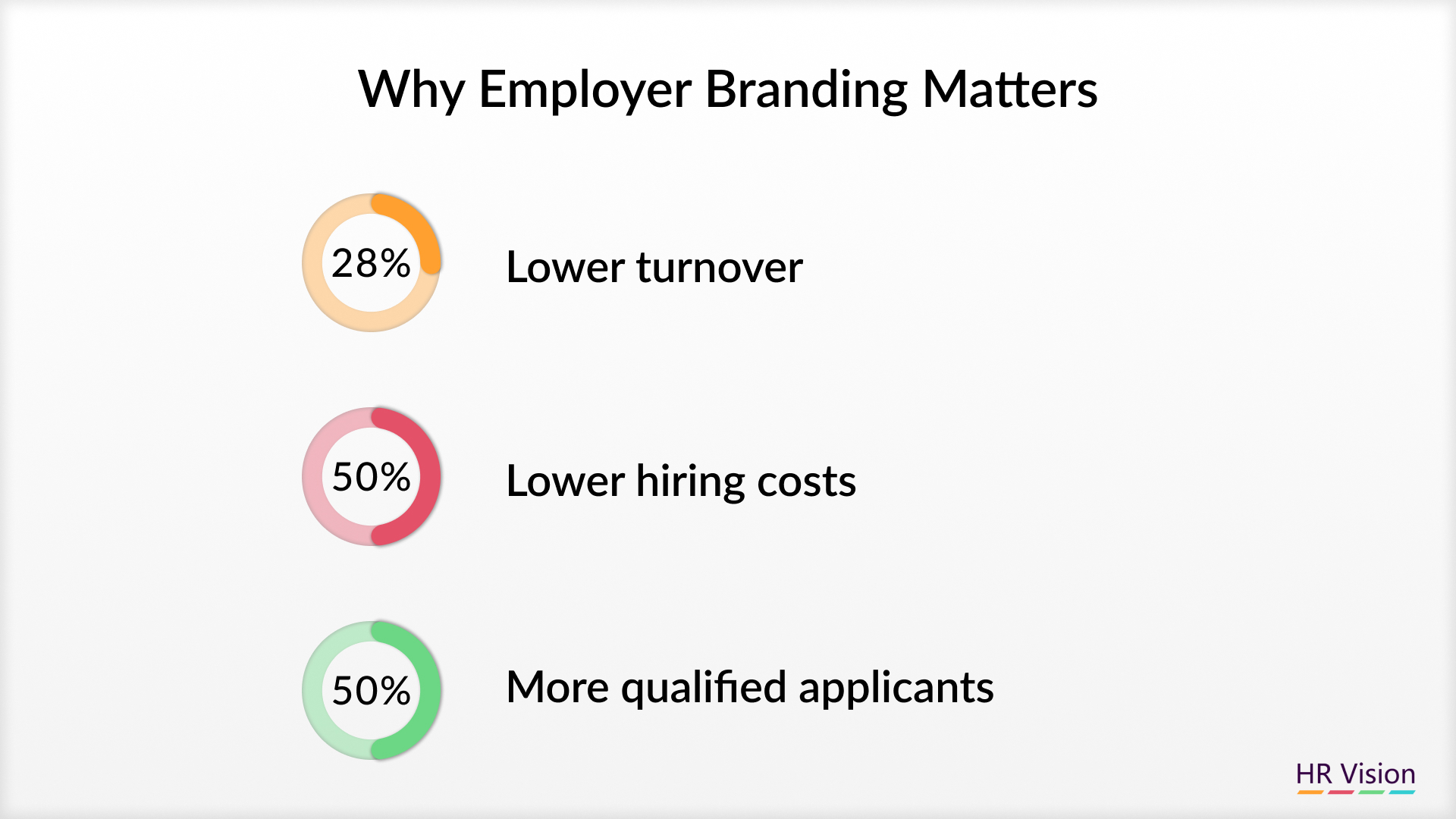
Conversely, companies that invest in a solid employer brand see tangible returns: LinkedIn research shows it can trim turnover by 28 percent, cut hiring costs by half, and attract about 50 percent more qualified candidates—savings and pipeline gains that compound with every new requisition.
What Is Employee Branding?
Employee branding is the everyday way your people, through words, actions, and social footprints, broadcast what it really feels like to work for your company. Instead of polished taglines, it’s the candid Slack screenshot a designer shares on LinkedIn or the honest Glassdoor review an intern leaves after their summer. Those micro-moments form a public, human narrative that no corporate brochure can match.
Powered by People
HR and Communications can supply guidelines and inspiration, but genuine employee branding is owned by employees themselves. The more inclusive your culture and the clearer your guardrails, the more confidently staff will post, speak at meet-ups, and refer friends—turning personal networks into brand loudspeakers.
You’ll see it in a developer’s conference talk about your tech stack, a customer-success rep’s TikTok about career growth, peer referrals on LinkedIn, and five-star on-boarding shout-outs on Glassdoor. Each touchpoint—social post, online review, panel appearance, or casual coffee chat—extends your brand story far beyond official channels.
Why It Matters
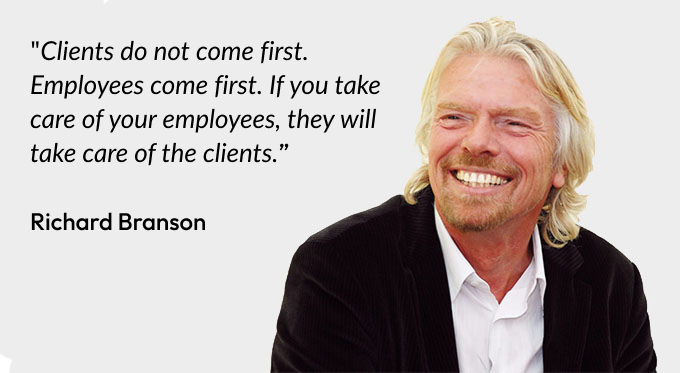
Authenticity scales only through real voices. Research compiled by Speakap shows that 76% of people trust content shared by individuals over companies, and employee-generated posts earn eight times more engagement than branded content. Similar 2025 findings highlight the same 8× engagement lift and trust premium. When that trust compounds across hundreds or thousands of employee networks, reach and credibility skyrocket, often at zero media cost. As Virgin Group founder Sir Richard Branson sums up, “Clients do not come first. Employees come first. If you take care of your employees, they will take care of the clients.”. In other words: empower your people, and the market will listen.
Key Differences at a Glance
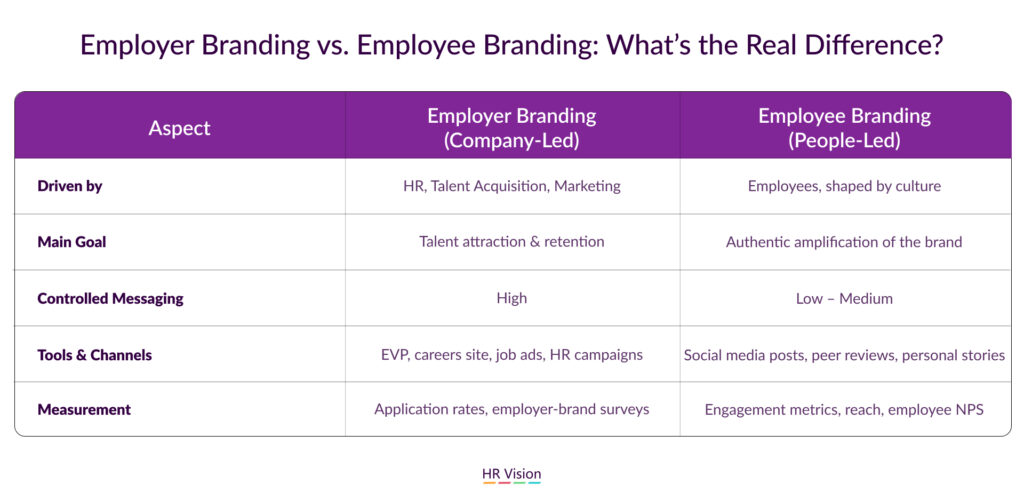
Although employer branding and employee branding ultimately work toward the same destination—a credible, attractive reputation—they travel very different routes to get there. Employer branding is company-led: HR, Talent Acquisition, and Marketing craft a carefully controlled narrative, roll it out through an EVP, careers site, recruitment ads, and award campaigns, and then track classic funnel metrics such as application volume, quality-of-hire, and periodic brand-perception surveys. By contrast, employee branding is people-led and unfolds in real time across individual networks. Employees decide what to share—an authentic LinkedIn post, a candid Glassdoor review, a conference talk—and the company’s role is largely to provide cultural guardrails and encouragement, not scripts.
Because of this split in ownership, the primary goals diverge. Employer branding focuses on efficiency in talent attraction and retention: the promise must be clear, consistent, and repeatable so candidates know exactly what to expect. Employee branding, however, trades control for credibility; its purpose is to amplify that promise through unfiltered human stories, lending a layer of trust that polished campaigns alone cannot achieve.
| Aspect | Employer Branding (Company-Led) | Employee Branding (People-Led) |
| Driven by | HR, Talent Acquisition, Marketing | Employees, shaped by culture |
| Main Goal | Talent attraction & retention | Authentic amplification of the brand |
| Controlled Messaging | High | Low – Medium |
| Tools & Channels | EVP, careers site, job ads, HR campaigns | Social media posts, peer reviews, personal stories |
| Measurement | Application rates, employer-brand surveys | Engagement metrics, reach, employee NPS |
Control over the message is therefore asymmetrical. In employer branding the narrative is tightly managed—logos, tone of voice, and talking points all follow brand guidelines. Employee branding accepts variability: tone is personal, anecdotes are specific, and authenticity trumps uniformity. That looseness is a feature, not a bug, because audiences perceive it as more believable.
Finally, measurement shifts to match each approach. Success for employer branding appears in hard recruiting KPIs—shorter time-to-hire, lower cost-per-hire, higher offer acceptance rates, and periodic reputation polls. Employee branding relies on social and sentiment metrics: engagement and reach of employee posts, referral volumes, earned media mentions, and Employee Net Promoter Score (eNPS). Taken together, these complementary data points reveal whether the company’s stage-managed promise and its lived employee stories are in harmony, or if a credibility gap is beginning to open.
How Employer & Employee Branding Work Together
- One Flywheel, Two Forces
Employer branding lays the tracks—your EVP, career site, and recruitment campaigns create a clear promise—while employee branding supplies the engine that pulls that promise around the internet in real time. When the two are aligned, every polished message the company publishes is echoed (and sanity-checked) by hundreds of individual voices, giving candidates and customers the “inside view” they crave.
- Framework + Freedom
The company’s role is to set the framework—values, visual identity, social-media guardrails—then step back. Employees need freedom to translate that framework into their own language: a quick LinkedIn shout-out about mentorship, a conference talk on the tech stack, a candid Glassdoor review. Because those micro-stories are unscripted, they’re perceived as far more trustworthy: studies show employee-shared content generates 561 percent more reach and 8× more engagement than the same content pushed from brand channels.
- Empowering Everyday Ambassadors
Practical enablers include:
- • Advocacy platforms or Slack channels with pre-approved story prompts
- • Storytelling workshops on LinkedIn, TikTok, or speaker skills
- • Recognition loops—leaderboards, spotlight awards, referral bonuses
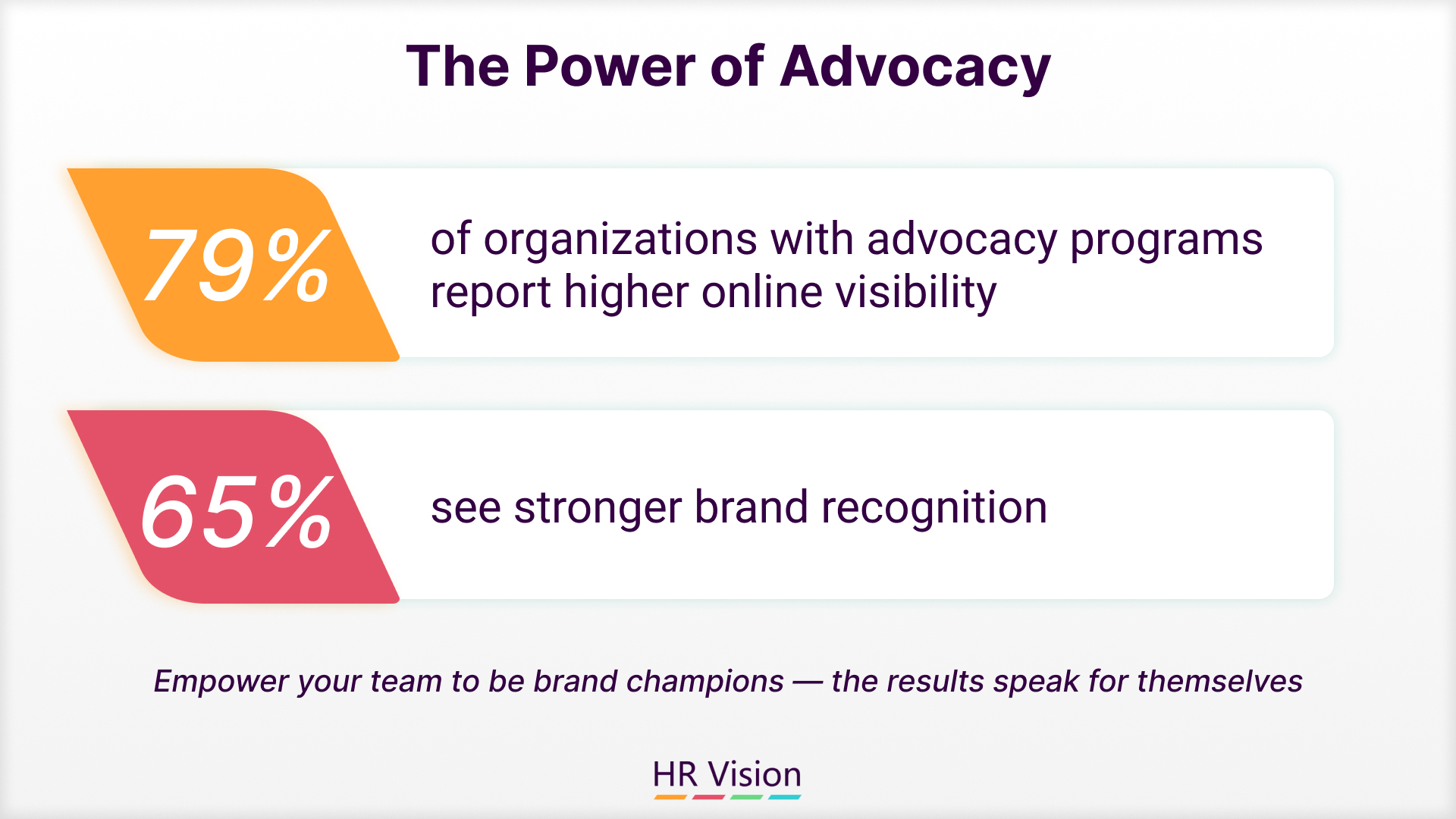
When companies invest here, the payoff is measurable: 79 percent of organisations that encourage advocacy report higher online visibility and 65 percent see stronger brand recognition.
- Case in Point – EA Insiders
Electronic Arts turned its workforce into a marketing powerhouse with the EA Insiders program. Employees earn points for sharing content and take part in friendly leader-board competitions; the result is tens of thousands of social shares every month, reaching a network of more than one million people—reach the corporate handle could never buy on its own.
Starbucks, meanwhile, calls its staff “partners” and gives them dedicated social accounts for life-at-Starbucks stories, keeping brand tone consistent without stifling personality.
Best Practices for Building Both Brands
- Craft a Magnetic EVP—Then Say It Loud
Start with a crystal-clear Employee Value Proposition that answers, “Why build your career here instead of anywhere else?” Publish it on the careers site, weave it into job ads, and repeat it internally until it becomes shorthand for your culture. Companies that prioritise employee experience and articulate a strong EVP see turnover rates up to 51 % lower than industry peers—proof that clarity keeps talent anchored.
- Fuel Storytelling & Social Sharing
Give employees fresh stories to tell and the freedom to tell them. Launch an advocacy hub stocked with behind-the-scenes photos, bite-size success stats, and suggested hashtags, but leave tone and timing to the individual. The payoff is exponential: employee-shared content earns 8× more engagement than the same post from a corporate handle and reaches networks money can’t buy.
Want hands-on guidance? Check out our article “Practical Storytelling Tips Every HR Pro Can Use” for step-by-step prompts, post templates, and real-world examples.
- Skill-Up Your Storytellers
Even the most passionate colleagues hesitate if they’re unsure what “good” looks like. Offer short LinkedIn or TikTok clinics, speaker-prep workshops for conference hopefuls, and micro-courses on brand guidelines. A two-hour session can transform silent admirers into confident ambassadors who post consistently and credibly.
- Spotlight People Who Live the Brand
Recognition is rocket fuel. Feature employee posts in company newsletters, create a rolling “Top Advocates” leaderboard, and tie referral bonuses or small perks to branded storytelling milestones. Public praise signals that advocacy isn’t extra work—it’s valued work—and inspires fence-sitters to join in.
- Close the Feedback Loop
Treat employee sentiment as your quality-control lab. Pulse surveys, eNPS scores, and Glassdoor reviews reveal where the lived experience drifts from the promise. Feed these insights back into EVP wording, onboarding content, and leadership messaging so the employer brand evolves with reality, not aspiration.
Execute on all five fronts and you create a virtuous cycle: a compelling promise attracts talent, empowered employees validate that promise in their own voices, and their stories feed fresh credibility back into the brand—no costly ad spend required.
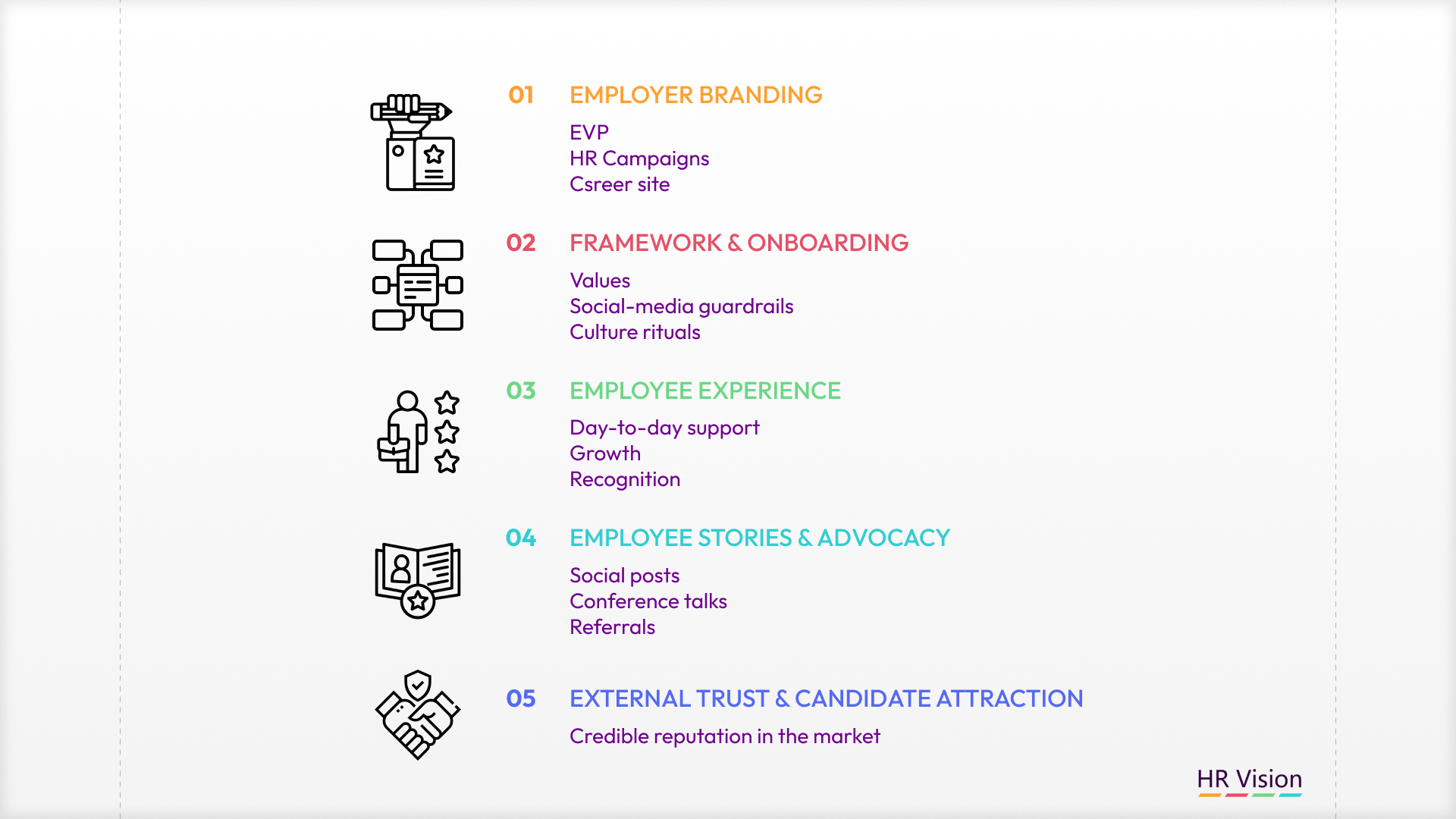
Branding Funnel — From Company Promise to Employee Voice
To illustrate how a company’s employer brand flows naturally into employee advocacy, here’s a simple visual funnel mapping the stages from top-down messaging to grassroots amplification.
Conclusion
Employer branding and employee branding might share the same destination—trust and talent—but they take deliberately different paths. Employer branding is the company’s scripted promise: the EVP you publish, the campaigns you run, the awards you showcase. Employee branding is the unscripted proof: the stories your people tell, the reviews they leave, the conversations they spark in their own networks. When both operate in harmony, they create a credibility loop—company messages set expectations, employee voices validate them—driving faster hiring, lower turnover, and a culture candidates can see before they ever walk through the door.
The strongest brands therefore cultivate reputation from the inside out. They invest in clear values and a compelling EVP, then empower employees to live and share those values authentically. The result isn’t just a bigger talent pipeline; it’s a workforce that feels trusted, heard, and proud to represent the badge.
Want to explore how authentic branding and employee advocacy are shaping the future of talent attraction? Join us at HR Vision — a two-day gathering of top HR leaders sharing real-world strategies for navigating today’s evolving workplace. Don’t miss the conversations redefining the future of work—register now.