

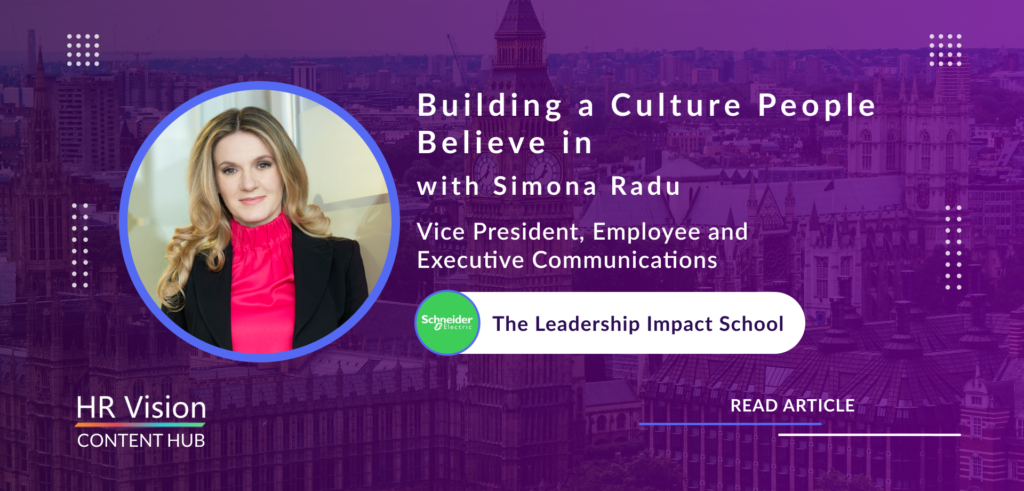
- Simona, you’ve been at Schneider Electric for nearly two decades, now leading global employee and executive communications. What keeps you motivated in this work?
What keeps me going is working for a company with a bigger purpose in the world. At Schneider Electric, we’re driving sustainability and energy efficiency—and that mission matters. But just as important is the privilege I have to grow and develop people. Whether it’s helping employees see their career paths more clearly, empowering my team to lead with confidence, or enabling leaders to connect with authenticity, I get to shape experiences that truly matter. Communications is how we bring our culture to life, and that’s what makes the work so meaningful.
- You’ve said that feedback is instant in employee communications. Can you share a time when it changed your approach?
What I love about employee communications is that you’re speaking to colleagues—people who share your experience and understand the culture. There’s trust in that, and it means feedback is immediate and honest. People tell you what worked, what didn’t land, what felt unclear—and we thrive on that.
A great example is our annual all-employee digital event. The live chat and post-event feedback shape how we design the next one. We have a process to gather insights and evolve the experience year after year. It’s a real-time pulse on what matters to our people.
- You often talk about executives being the strongest vectors for engagement. What should leaders be doing differently today?
Employees want to hear from their leaders—not just about objectives, but about topics that move the needle on culture. Leaders are the most trusted and preferred communication channel for their teams. People look to their managers to understand the essentials, to feel the emotion behind the message, and to engage in real dialogue.
That means leaders need to go beyond cascading information. It’s about personalized messages, sharing one’s own experiences, and creating space for interaction. When leaders communicate with clarity, empathy, and consistency, they become connectors—linking individual growth to organizational purpose. In a world of constant change, that connection is what drives engagement and trust.
- Internal comms sometimes get treated as a “nice to have.” How do you show it’s actually strategic?
We are fortunate, at Schneider Electric, to have treated and positioned communications as a driver of transformation for years now. Whether it’s enabling career mobility, supporting change initiatives, or building future-readiness, we show how strategic messaging makes a difference. We work closely with HR and business leaders to ensure communications are embedded in the employee experience—not just layered on top. When done right, internal comms (or how we call it, employee comms) becomes a strategic enabler of growth, trust, and performance.
- Schneider Electric is huge and global. How do you make messages feel personal, not corporate?
We start with people. We use storytelling to bring our culture to life, we localize content to reflect regional realities, and we personalize messages using digital tools. But most importantly, we make space for employee voices. When people see themselves in the story—whether through a peer’s journey or a leader’s reflection—it stops feeling corporate and starts feeling real.
- You lead a global team. How do you develop and empower your own people?
I believe in leading with trust and clarity. I give my team room to grow, take risks, and lead initiatives that stretch them. We invest in learning, share knowledge across borders, and celebrate diverse perspectives. Empowerment also means connecting each person’s work to our broader purpose—when people understand the “why,” they bring energy and ownership to the “how.”
- Trust is a big theme in communications. What’s one thing leaders can do right now to build more of it?
Be transparent—and consistent. Trust isn’t built in big moments alone; it’s earned through everyday actions. Leaders who communicate openly, acknowledge challenges, and follow through on commitments create a culture where people feel safe to grow, speak up, and take initiative. That’s the foundation of a thriving workplace.
- Finally, if HR and communications leaders could focus on just one thing in 2025–2026 to make the biggest impact, what would you suggest?
Focus on connection. In a world of digital noise and constant change, what makes communication memorable is authenticity—being clear on what makes us different and telling that story in a way that feels real. Employees don’t just want information; they want to feel something. When we communicate with heart and connect through shared values and lived experiences, we build trust and belonging.
And none of this works in isolation. The partnership between communications and HR is critical. No message can truly land if the process behind it isn’t there. It’s just words on a poster unless it’s lived every day. When we align storytelling with real employee experiences, we create communications that inspire action—and that’s where the real impact happens.
Ready to stay ahead in the ever-changing world of HR? Join us at HR Vision, where top HR leaders gather to explore the future of work, HR trends, and the power of HR analytics and technology.


