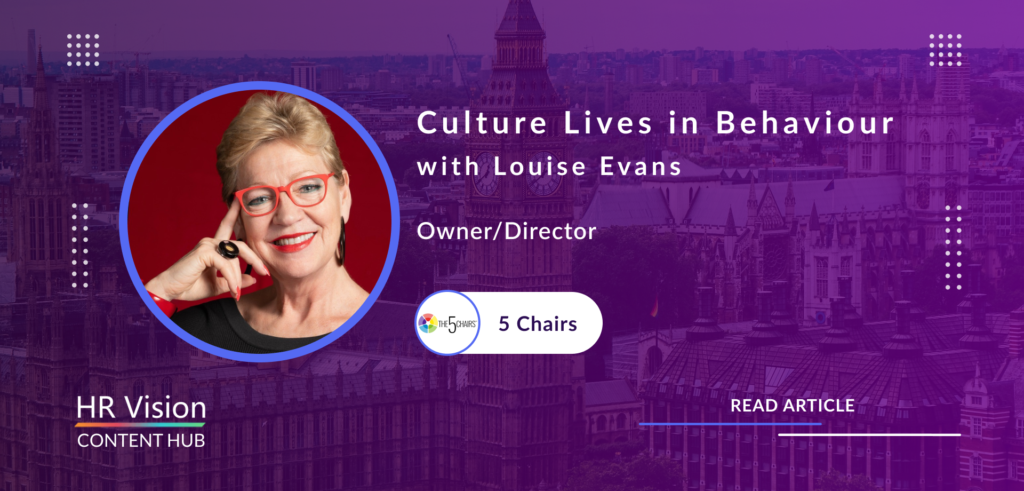
- Louise, you’ve spent 30 years helping people and organizations grow. What first drew you to focus on the human side of business?
From the very start of my career, I’ve been fascinated by why people behave the way they do — especially under pressure. I realised early on that technical skills and strategies only go so far; what truly determines success is how people show up — how they speak, listen, collaborate, and handle conflict. The human side of business is where everything either flourishes or falls apart. I wanted to help people bring more self-awareness and emotional maturity into their daily interactions so that workplaces could become healthier, more humane, and ultimately more productive.
- You created The 5 Chairs® model. In simple terms, how does it help leaders and teams become more effective?
The 5 Chairs® is a behavioural intelligence methodology that makes the invisible visible. Each Chair represents a mindset and behaviour pattern that we all use every day — from the Red Chair of judgment and blame, to the Purple Chair of empathy and connection. By learning to recognise which Chair we’re sitting in, we gain instant awareness of our reactions and the power to choose better ones. This transforms how leaders communicate, how teams collaborate, and how cultures evolve — not through theory, but through real, lived behavioural choice.
- Behavioral agility can sound abstract. How can HR translate it into everyday actions that actually improve team performance?
Behavioural agility is simply the ability to pause before we react. HR can encourage this by creating micro-practices that help people check in with themselves before responding. For example, before a meeting or email reply, ask: “Which Chair am I in right now?” This one-second pause rewires behaviour — turning reactivity into responsiveness. Over time, this builds trust, reduces drama, and dramatically improves collaboration and decision-making. It’s small daily shifts that lead to large cultural transformations.
- You work with children through The 5 Chairs as well. What lessons from teaching kids do you think apply to adult workplace behaviour?
Children remind us that learning emotional intelligence doesn’t have to be complicated — it just has to be practised. Kids learn through play, repetition, and visual anchors — and adults aren’t so different. When we make behavioural learning tangible and engaging, it sticks. I’ve seen senior executives light up when using The 5 Chairs in exactly the same way children do. It’s about creating safe spaces to experiment with behaviour, make mistakes, and try again — with curiosity rather than judgment.
- Inclusion and conflict management are often challenges for HR. What’s one simple mindset shift that can make a big difference?
The shift is from “Who’s right?” to “What’s needed?” When we stop defending our position and start listening for what the situation actually requires, the tone changes completely. This is the essence of the Giraffe Chair— stepping into empathy, big-picture thinking, and courage. Inclusion grows naturally when people feel heard and valued, and conflict becomes an opportunity for growth instead of division.
- Emotional intelligence is more talked about than practiced. What’s one small exercise HR can introduce to develop it in teams?
End every meeting with a simple reflection round: “Which Chair were you sitting in most today?” This helps people notice their own behavioural patterns and encourages accountability in a light, non-threatening way. It builds collective awareness — a team culture where people talk about behaviour openly, not defensively. Over time, it strengthens emotional intelligence more effectively than any lecture or e-learning module ever could.
- Your work draws on mindfulness and inner focusing. How can these practices be integrated into a busy workplace without feeling “soft” or optional?
Mindfulness doesn’t need incense or silence — it needs presence. A 10-second breathing pause before a meeting or a mindful check-in at the start of the day can change the energy of an entire team. When leaders model this, it stops being “soft” and becomes smart — a performance enhancer. Mindfulness, at its best, is the art of noticing what’s happening in the moment so we can respond with intention rather than impulse. That’s leadership maturity in action.
- In your view, what’s the most common blind spot in leadership that holds back organisations?
It’s the assumption that awareness equals change. Many leaders know what good leadership looks like, but under stress, they revert to old habits. The real work is embodying what we know — moment by moment. This requires courage, humility, and practice. The leaders who thrive today are those willing to look in the mirror, own their impact, and make conscious behavioural choices. That’s the new frontier of leadership — and it’s exactly what The 5 Chairs helps them do.
Ready to stay ahead in the ever-changing world of HR? Join us at HR Vision, where top HR leaders gather to explore the future of work, HR trends, and the power of HR analytics and technology.