- Why do you believe the conversation is one of the most overlooked yet impactful leadership skills in today’s organisations?
In our increasingly AI world, human connection has never been more vital. The messenger matters far more than the message. People judge the same feedback from two people completely differently depending on how the conversation is conducted. Those person-to-person interactions are critical to how hard people will work, and the results they achieve.
- You’ve observed thousands of performance conversations firsthand. What are some of the most common mistakes even experienced leaders make when leading tough conversations—and how can they avoid them?
I’ve worked in over 40 countries, and the most common mistake is the same everywhere. Leaders don’t ask enough questions. They are busy people, and it’s quicker to tell someone what to do than ask for ideas. But new generations joining the workforce are demanding a greater say. To get better at tough conversations we have a brilliant new tool for leaders, an avatar that lets you practice tough conversations in private, without fear of repercussion. Try out the words you want to use, receive your personalised report with suggestions, then simply run it again. I will be demonstrating this at HR Vision in London in November, come and see!
- Your book, “NOW You’re Talking!”, offers step-by-step frameworks and real conversation openers. Why is it so important to equip managers with specific language and not just broad principles?
Managers need two essentials for a successful conversation. The first is a constructive structure to navigate by. It doesn’t need to be rigid—in fact, it’s essential that it’s flexible—but if you don’t know where you’re going, you may not get there.
The second essential is knowing what to SAY, at least at the very beginning! Examples of real-life phrases and questions that have been proven to work will give you some clues, and can then be adapted to your own style.
- What’s one simple framework that any manager could start using today to improve the quality of their next difficult conversation?
I am, of course, going to strongly recommend the CEDAR feedback steps here! They aren’t just ‘dos and don’ts’, they are your step-by-step pathway to navigating the conversation successfully. CEDAR answers the five key questions of any feedback conversation:
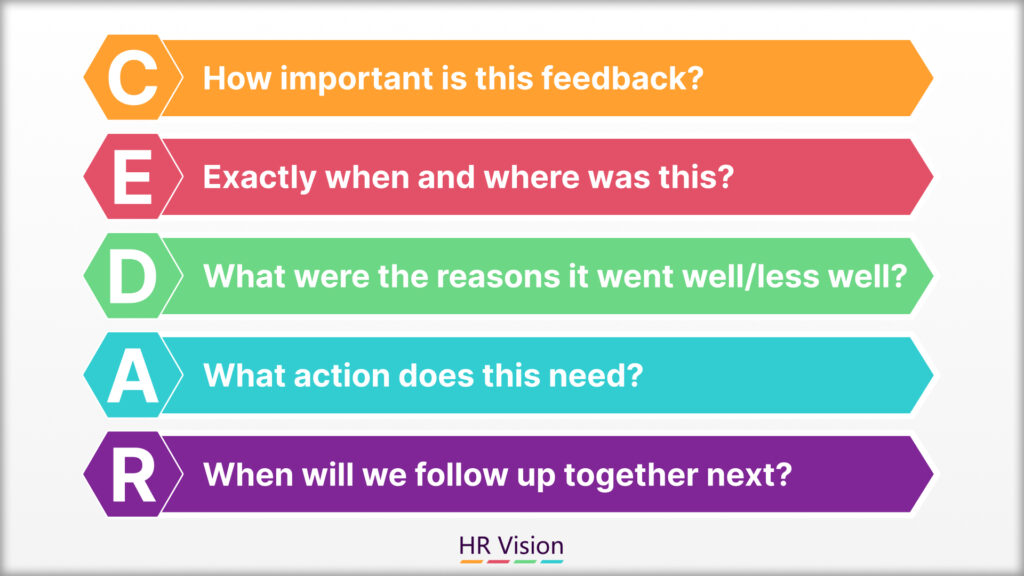
By the way, as many of these steps as possible need to be led by the feedback receiver, NOT the leader.
- What are three phrases you believe every manager should retire immediately—and what should they say instead?
When people make needless mistakes, it can be so tempting to let off steam. In fact, using a few choice words even has its own medical term, Lalochezia. Of course, although this feels good, it’s just going to make things worse. Here’s three to retire:
“You ruined my entire weekend.” (or similar). It’s better to use, “This required a lot of effort to recover”.
“Here’s what you should do…”. Better to use, “What do you think would be good to do next?”
And my personal least-favourite, “We think you are X” as in we-the-organisation. This distances the feedback giver from the message and is a diversion tactic. Instead, it’s better to use, “Here’s where you are”.
- What are your top tips for keeping a conversation constructive when emotions are running high on both sides?
Great question! This demands a lot of composure from the manager. A fantastic first step is to acknowledge the challenges on both sides. The second step as the manager is to know your boundaries and be able to explain them calmly. If someone is overstepping a limit, you’ll need to give them the reasons why this limit exists. And third, stay focused on your join intent to achieve a positive outcome. Say something like, “Understanding where to go with this will help us to…”.
- What are the signs that a company’s culture is avoiding tough conversations—and what are the long-term risks if nothing changes?
In the short term, avoiding tough conversations can seem like a good idea, avoiding upset. But it can backfire badly. First, unaddressed issues affect everyone. If someone is ignored when they fail to deliver on their commitments or when they behave in an unacceptable way, it pulls everyone down.
Second, your credibility as a manager suffers. Overlooking a problem will earn you the reputation of being an “easy touch.” It also sets a new low in terms of expectations for performance. I was a boot camp instructor in the Royal Navy many years ago and we had a saying, “The standard you walk past is the standard you accept.”
Another reason is silence and secrecy breed anxiety. If you’ve developed a reputation for hiding information, people will always be on edge, wondering what you haven’t told them, even when there’s nothing for them to be concerned about. Next, the longer a problem goes on, the harder it is to correct. People won’t thank you for not guiding them sooner. And finally, as the leader you can’t expect your team to step up if you don’t.
A tough conversation is never easy to hold, but it’s vital to develop the competence and confidence to lead them.
- What strategies work best when trying to embed great conversation habits across an entire organization, not just at the leadership level?
I’m going to pick out one single strategy here because it’s so critical. Lead collaborative conversations. Conversations where your team member explores how best to take action as much or more than you. The more employees are involved in their own performance conversations, the more they are likely to take responsibility for their results.
- What’s one shift you believe HR leaders must make in how they think about communication and performance conversations in the next five years?
One critical shift HR leaders must make is to help their people leaders move from transactional, compliance-driven communication to a more continuous, empathetic, and coaching-oriented approach. Rather than viewing performance conversations as box-ticking exercises, it’s going to be essential to foster a culture where ongoing dialogue is not just the norm but understood as a primary driver of results.
Ready to stay ahead in the ever-changing world of HR? Join us at HR Vision, where top HR leaders gather to explore the future of work, HR trends, and the power of HR analytics and technology.