
Did you know that a staggering 75% of employees believe feedback is valuable and critical to their work? Moreover, over a third (33.4%) of employees express a desire for more feedback from their managers. These statistics paint a clear picture of the significance of feedback in the workplace. Feedback isn’t just a casual interaction or a mere formality; it’s a potent tool that can profoundly impact an individual’s personal and professional development.
Importance Of Feedback In Personal And Professional Development
At its core, feedback is a two-way communication process that provides information about an individual’s performance or behavior. It serves as a mirror, reflecting strengths and weaknesses, guiding us to refine our skills and attitudes.
In the professional arena, feedback is instrumental in guiding employees towards better performance. Constructive feedback helps individuals identify areas where improvement is needed, setting the stage for growth. It provides clarity on expectations, allowing employees to align their efforts with organizational goals. Positive feedback, on the other hand, boosts morale and motivation, reinforcing behaviors and accomplishments worth celebrating.
In personal development, feedback is equally indispensable. It fosters self-awareness, enabling individuals to recognize their strengths and areas requiring development. When we receive feedback from friends, family, or mentors, we gain fresh perspectives on our actions, habits, and decisions. This external insight can be a catalyst for change, helping us make better choices and enhance our relationships.
Feedback is crucial, not only for personal and professional growth but also for organizations:
- It motivates and enhances productivity. Companies practicing continuous feedback have employees 3.6 times more likely to be highly motivated and deliver exceptional work. (Gallup)
- It reduces turnover. Continuous employee feedback can decrease turnover by nearly 15%, positively impacting a company’s bottom line. (Gallup)
- It drives employee engagement. With little or no feedback from managers, 98% of employees become disengaged. (Gallup)
Understanding Negative Feedback
Negative feedback is an essential component of personal and professional growth, as it provides individuals with valuable insights and opportunities for improvement. While negative feedback may initially evoke feelings of discomfort or defensiveness, understanding its types, psychological impact, and common reactions can help individuals embrace it as a catalyst for progress.
Types of Negative Feedback
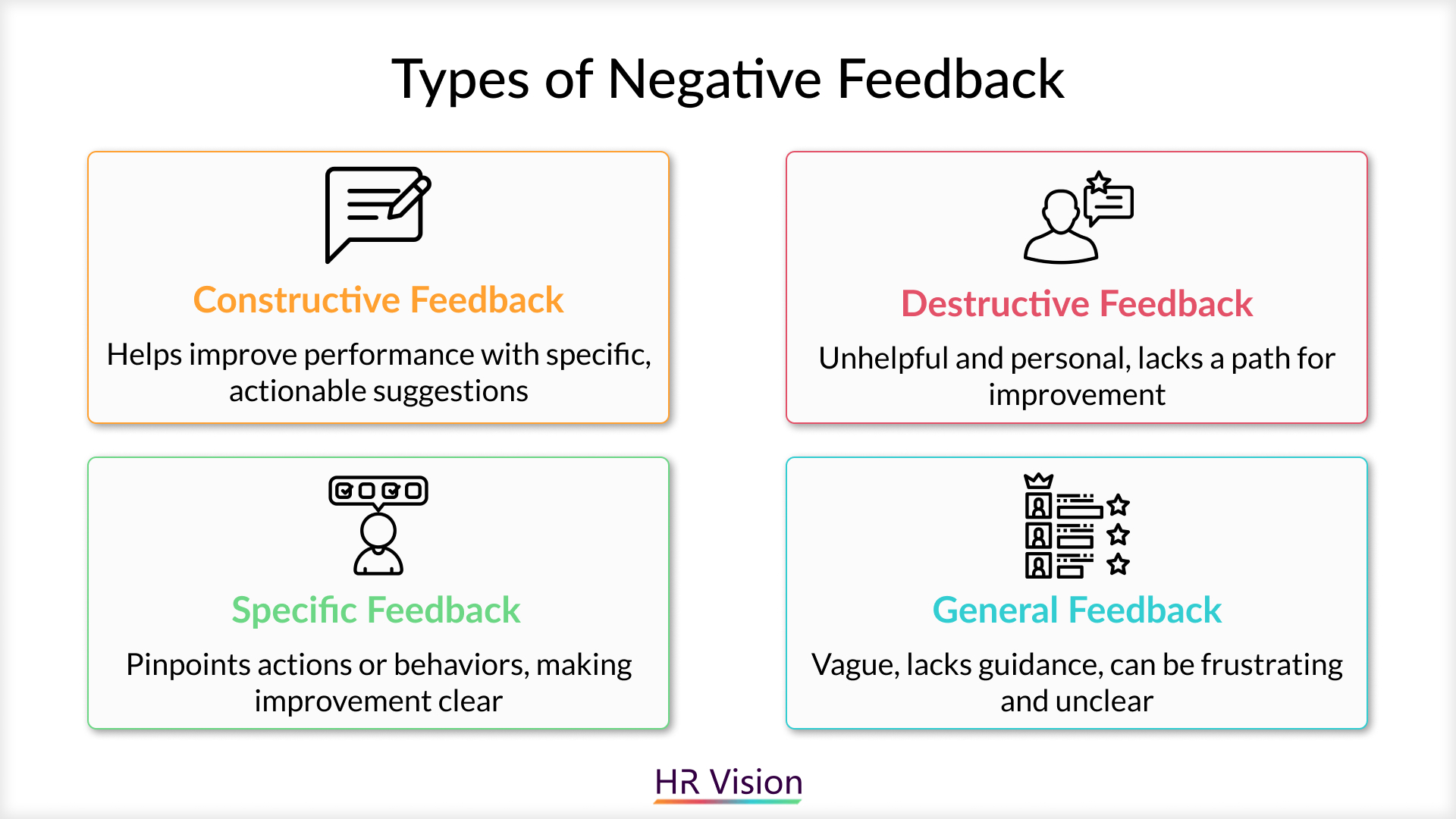
1. Constructive vs. Destructive Feedback
Feedback can be broadly categorized into two types: constructive and destructive.
➤ Constructive Feedback. This type of feedback is aimed at helping individuals improve their performance or behavior. It focuses on specific issues and offers actionable suggestions for enhancement.
➤ Destructive Feedback. In contrast, destructive feedback is unhelpful and can be damaging. Destructive feedback tends to focus on personal attributes rather than behaviors and rarely provides a path for improvement.
2. Specific vs. General Feedback
Another important distinction in negative feedback is between specific and general feedback.
➤ Specific Feedback. This type of feedback pinpoints particular actions, behaviors, or outcomes. It helps individuals understand precisely what they did or didn’t do well, making it easier for them to take targeted steps to improve.
➤ General Feedback. General feedback, on the other hand, lacks specificity and is vague. It may include statements like “You need to do better” or “This isn’t good enough.” While such feedback signals an issue, it doesn’t offer clear guidance on how to address it, which can leave individuals feeling frustrated and unsure of how to proceed.
Common Reactions to Negative Feedback
Understanding how people commonly react to negative feedback can help both givers and receivers navigate these interactions more effectively.
1. Defensive Responses
Many individuals react defensively when faced with negative feedback. They may deny the feedback’s validity, deflect blame, or counter with examples of their successes. This reaction is a natural defense mechanism but can hinder personal growth.
2. Acceptance and Growth
Some individuals are more open to feedback and view it as an opportunity for self-improvement. They acknowledge their shortcomings and work on addressing them constructively.
3. Ignoring or Dismissing Feedback
In some cases, people may choose to ignore or dismiss negative feedback altogether. This can be detrimental, as it prevents them from leveraging valuable insights for improvement.
How to Turn Negative Feedback into Positive Growth
However, the key to transforming negative feedback into a force for positive change lies not only in how it is received but also in how it is given.
Let’s explore strategiesto help turn negative feedback into an opportunity for positive growth.
1. Choose the Right Time and Place
Feedback should be delivered in an appropriate setting and context. Ensure that you provide negative feedback in a private and comfortable environment, allowing the individual to absorb the information without feeling embarrassed or defensive. Timing is crucial as well; choose a moment when the person is receptive and not overwhelmed by other concerns.
2. Be Specific and Objective
Negative feedback should be specific, clear, and backed by concrete examples. Avoid vague statements or generalizations. By providing specific instances where improvement is needed, you give the individual a clear understanding of the issue, making it easier for them to address it.
3. Focus on Behavior, Not Personality
It’s essential to emphasize that negative feedback should target behavior or actions, not the individual’s personality or character.
Instead of saying, “You’re lazy,” say, “Your recent work missed some deadlines, and it’s affecting the team’s progress.” This approach helps prevent defensiveness and keeps the focus on improvement.
4. Use the “Feedback Sandwich” Technique
The “Feedback Sandwich” technique involves sandwiching negative feedback between positive comments. Start with a positive aspect, deliver the negative feedback, and end with another positive note. Instead of saying, “You’re always making mistakes,” say, “I’ve noticed a few errors in your work, and I think we can work together to improve accuracy.” This approach can help soften the impact of negative feedback and make it more palatable.
5. Encourage Self-Reflection
After providing negative feedback, encourage the individual to reflect on their actions and behavior. Ask open-ended questions such as, “How do you think you could approach this differently in the future?” This promotes self-awareness and takes the focus away from blame.
6. Offer Support and Resources
To turn negative feedback into an opportunity for growth, offer support and resources. Suggest training, coaching, or additional resources that can help the person improve in the areas where they received criticism. This demonstrates your commitment to their development.
7. Establish Clear Goals and Action Plans
Work together to establish clear goals and action plans for improvement. These should be specific, measurable, achievable, relevant, and time-bound (SMART). Setting goals provides a roadmap for the individual to follow as they work towards improvement.
8. Provide Ongoing Feedback
Negative feedback should not be a one-time event. Continue to provide feedback and check in regularly to monitor progress. Ongoing feedback ensures that the individual stays on track and has the opportunity to make consistent improvements.
9. Recognize and Acknowledge Progress
When you notice improvements or positive changes, make sure to acknowledge and recognize them. Positive reinforcement can motivate individuals to continue their growth journey and build confidence.
10. Foster a Culture of Open Communication
Lastly, create a culture of open communication where feedback is welcomed and encouraged. When individuals feel safe sharing their concerns and receiving feedback, negative feedback becomes less intimidating and more productive.
Creating a culture where feedback is valued and encouraged is crucial. When feedback is seen as an opportunity for growth rather than as criticism, it fosters a more collaborative and productive work or personal environment. Encourage open dialogue and honest communication within your team or social circle to facilitate this culture of constructive feedback.
Don’t miss the opportunity to delve deeper into the world of HR, where growth and transformation are at the forefront. Join us at HR Vision, where we bring together top HR leaders to discuss the best HR practices for navigating this transformative time.