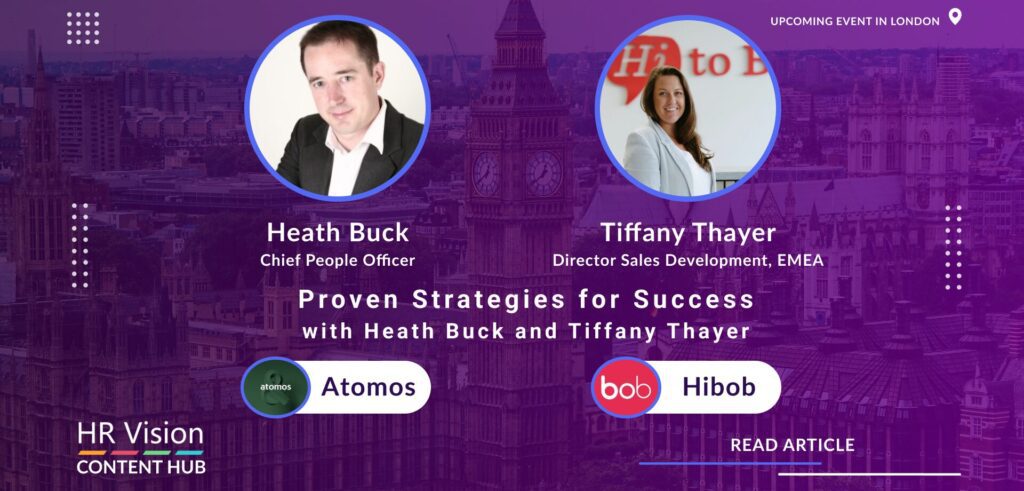
In this Q&A article, we delve into the insights and experiences of two distinguished professionals: Heath Buck, Chief People Officer renowned for his transformative HR strategies, and Tiffany Thayer, Director of Sales Development, EMEA, with a proven track record in driving sales excellence.
1.Heath, you have an impressive track record, showcasing an increase in engagement each year. How do you sustain and enhance employee engagement over the long term?
Be honest in your dialogue. I was in the unfortunate position of doing a large-scale restructure. We weren’t letting people go. But there was a wholesale change in how we organised the jobs and what each job entailed people.
I went into the lion’s Den of a collective consultation with 50 mostly annoyed people staring at me and one person shouted “This sucks”. I looked straight back and said, “Yes it does, it sucks a lot, and I’d rather not be doing it”. Here’s my question: “Do you want things to stay the same?” –“No, it’s awful”. “So here’s the deal, a process that sucks and lands in a better place”.
During that restructuring, engagement increased. If I’d denied the fact that restructures “suck”, no one would have trusted the journey was worth the outcome. Always be honest in your dialogue, people will understand and the good ones will be there for the journey.
2.Tiffany, you’ve demonstrated exceptional leadership in sales development. What fundamental principles do you credit for fostering such a high-performing team?
It all starts with Hiring. Bringing in the right talent who are intrinsically motivated to succeed, have a growth mindset, are wildly curious, hungry and possess a team spirit is where it all starts. Then drive accountability for their output which in turn drives results. Other core fundamentals include listening to your people and making changes where possible. Being adaptable and agile, building a culture of collaboration where people can thrive, learn from their peers, have fun and be recognised.
3.Heath, can you elaborate on the strategies or initiatives you implemented to achieve such significant retention improvement?
The most unusual case I had was a high attrition rate due to a lack of career paths. Conventional wisdom was saying we therefore needed to open career paths. Upon reviewing onboarding and exit data and a few targeted interviews the root cause was over-hiring. We hired people who over-qualified and promised progression that didn’t exist. A quick refocus of the recruitment team and a metric of first-year attrition, and within 6 months our retention rate had plummeted.
It was a key reminder data trumps conventional wisdom almost every time.
4.Tiffany, as the leader of the top sales team for years, how do you consistently innovate and motivate your team during challenging times?
Focus on the end goal and company vision on what we’re aiming to achieve, then set clear expectations and objectives to create focus. Clear and constant communication is also imperative to my Manager group and BDRs. Career Development for BDRs is a huge driver so we use this to aid motivation and engagement. Aside from this, ensuring that they have a collaborative, warm, inviting, inclusive environment to work in.
5. Heath, as a Chief People Officer, you highlight leadership, culture, engagement, talent acquisition, and performance. What area do you think organizations often overlook, and why is it crucial?
As a people leader, my problems are around the management of talent. I can halve my problems if I start with great people, so never underestimate the benefits of hiring better. You do need to hire experience, but in a trade-off “potential” soon overtakes “experience”, so where possible hire for future gains not for today’s crisis.
6. Tiffany, as a sales leader, what strategies do you employ to foster a culture of continuous learning and development within your team?
In collaboration with our People and Culture team, I created a career path for BDRs moving into Sales, for clear visibility on what needs to be achieved both from the results and skill set perspective and are currently looking to broaden this out to other cross-functional departments. We are lucky at HiBob to be supported by Sales Enablement and have a library of resources to encourage continuous learning. We also hold focus groups or team sessions to gain feedback and set actions. Knowing what motivates and drives individuals also allows us to create and mould specific training for individuals.
7. Heath, you’ve successfully reduced the time to hire by two weeks within three months. What advice would you offer HR professionals aiming to streamline their recruitment processes without compromising quality?
- Use a manager-friendly ATS.
- Have an honest chat with managers about what adds value.
I’ve never seen evidence more than 3 stages deliver different outcomes, so invite people requesting stages 4 and 5 to join stage 2 or 3 – it’s about added value, not ego!
Only start recruiting when managers are ready to assess. No candidate should be uncertain for more than 2 weeks. A slow recruitment for me is an application to offer within 6 weeks. When you meet a near-perfect candidate accelerate to offer. Why risk an amazing candidate to get through a bunch of less likely prospects?
8. Tiffany, building and maintaining a high-calibre network is crucial in sales development. What strategies do you employ to expand and nurture your professional network?
Attend networking and industry events, engage and comment on articles of interest and connect with other like-minded Sales Leaders.
9. Heath, how do you ensure that company values are effectively communicated and embraced throughout the organization, especially during periods of change?
The trick is to keep the list of values small to that which distinguishes your firm from others. You don’t need to list everything generic, things like “respect” should exist everywhere, does it need to be said? (only if you have behavioural issues with respect). Once you have your value set deploy them frequently in small but repeated contact points so they become part of the DNA of the organisation (e.g. inductions, company newsletters, Town Halls). People should be living the values, not just engaging once at the beginning.
10 . Tiffany, what motivates you to continuously strive for excellence in sales development, and how do you inspire that drive within your team members?
To be the best team globally! And to continuously learn and grow myself, to be the best leader. I have high personal expectations of success and also drive this throughout the team. We need to be constantly evolving our thinking and our GTM to set ourselves up as a key player in the marketplace, so review, tweaking and evaluation are critical. I show up every day with a positive, upbeat attitude, and boost people and the environment we work in.
11. Recently, Great Britain has introduced a pilot project of a 4-day working week. What’s your opinion about it? What advantages and disadvantages do you see both for employers and employees? Would you take part in the experiment, and why?
Heath: No, but I would consider an early Friday. There has been mixed success of the pilot scheme from working well to being cancelled early. In essence, if you ask people to compress 5 days of work into 4 days they have to work with 125% more intensity or do longer days. In peaks of workload, you will likely lose discretionary output and you could easily increase stress and reduce time for informal collaboration. It will depend on your industry and sector, but for context, my career is in professional industries where work is primarily a set of tasks not strict hours.
An offer to finish early on a Friday is more achievable as you can see the productivity drop, it gets to a point where rest might be a better gain than dragging the work out.
Ready to stay ahead in the ever-changing world of HR? Join us at HR Vision, where top HR leaders gather to explore the future of work, HR trends, and the power of HR analytics and technology.