Q What are the TOP 3 challenges you face at work?
Isobel Mckenna, IWG: 1) The first challenge is to both drive and stay ahead of the rate of change in this industry. The flexible office market is evolving at a ferocious pace, largely due to the fact that flexible workspace is becoming a key building block of the wider Real Estate/Workplace strategy rather than simply a solution for project or swing space. The demand for new, creative workplace solutions is astonishing and our organisation is taking on a more consultative role to help support our client’s strategic imperatives.
2) Recruitment – as our business (and industry) continues to change, so the calibre and competency level of our desired employees changes. Finding individuals with the necessary skills plus industry experience is almost impossible thus our focus is to recruit great people outside our immediate industry and get them up to speed as soon as possible.
3) Employee Training – due to the evolution of this industry and the dynamic, entrepreneurial nature of our company, we are constantly redefining our product, communication and customer engagement strategies – this results in us constantly having to rethink our employee induction strategy to ensure we have individuals fully equipped and up and running as soon as possible.
Cara Sugrue, Steelcase: 1) Speed of work – the speed of work for everyone has shifted substantially over the last decade and especially for those of us at Steelcase. Managing flow of information from multiple sources + the speed of which information shifts has meant a new way of working and managing priorities.
2) Communicating globally – in the past few years, our teams have become more globally integrated and therefore, more matrixed. Influencing others to work with you towards a common goal while battling different times zones and organizational structures requires tons of patience and good communication skills. And above all – empathy and a sense of humour!
3) Finding time to focus and reflect – Steelcase and others who are in the same industry are always publishing great new insights or articles into how the workplace will change according to the new expectations/shifts of work and workers. I really have to be purposeful to carve out the time to read new research and think through how it applies to my clients.
Q What is the model of working with your business partners that helps you benefit and contribute the most out of your function?
Isobel Mckenna, IWG: We are very dependent on partners to educate and grow the flex-space market. As such we invest a lot of time in building great relationships, listening to requirements, understanding motivational drivers to enable us to establish best in class, win-win partnerships. The key then is to nurture and evolve these relationships so each party achieves a very balanced outcome and expectations are immaculately managed.
Q What workplace issues you help the companies to solve and how do you manage them?
Cara Sugrue, Steelcase: This is a really exciting time for those of us focused on helping organizations think through their workplaces. The office is in the midst of a renaissance where workplaces are becoming something very different than before. The conversation is shifting from “what’s the most efficient space I can create?” to “how can my workplace support and enable our organizational goals while fostering higher levels of employee engagement?” With this in mind, some of the more prevalent issues popping up in our conversations today with clients are often around:
- How do we bring people together to collaborate and innovate in order to drive the business forward?
- How can we foster collaboration and still allow people to focus and concentrate?
- How does the workplace affect employee engagement?
- How can we better embed technology into the workplace to help people work better?
- How does the expectation of the workplace change from one culture to another one?
- How do we design physical spaces that support processes such as agile or design thinking?
Q You have a proven track record of building and developing extremely loyal, committed teams, over-performing new functions & departments. Could you share your strategies for successful team/departments management?
Isobel Mckenna, IWG: Goodness – this is a big question!! I would say that the first step is to provide inspirational leadership – you need your team to be extremely motivated and passionate about their roles and the value that they contribute both personally and professionally. I take leadership really seriously – ultimately my decisions, guidance and support should not only focus on the achievement of business goals but should help each individual achieve their unique set of personal goals, allowing them to move up the career ladder. Recruiting well at the get-go, then providing leadership that is transparent, fair, empowering and is respectful of individual aspirations, seems to be my recipe to ensure a diverse, loyal, over-performing team.
Q For over 100 years, Steelcase has experience in creating places that unlock the human promise of their people. What are the insights of creating a successful workplace culture?
Cara Sugrue, Steelcase: Why we go to the office has changed over the past decade. It used to be we went to the office because our computer was there (before laptops) or because we had to be seen in order to show commitment to the company. With mobile technology and a rise in the adoption of flexible working, we now often hear from our clients “how can I get people to want to come to the office and while here, have a work experience that is seamless, productive and helps them feel connected to the company?”
We also hear that companies want a culture of innovation, collaboration, and dynamic, fast-paced teams, as well as a change of leadership style, from a more hierarchical to the one that empowers employees.
In order to build a culture of great collaborative work amongst colleagues and teams, we know that a workplace is one of the enablers. It needs to foster interaction and trust amongst colleagues, enhancing a culture of belonging. It also needs to recognize an individual by allowing people to break away from contemplation and focused work.
One way to think through a workplace is as if it’s a pyramid of needs.
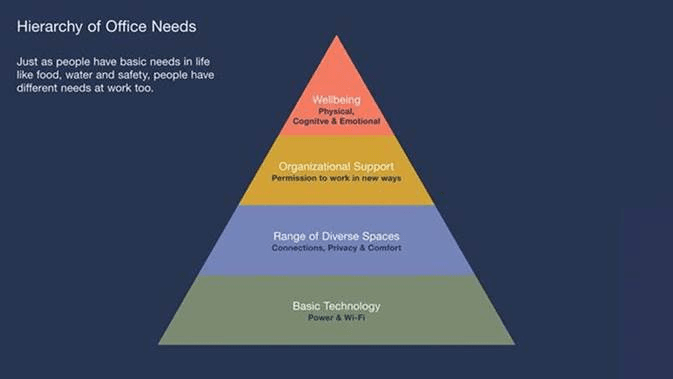
Composed as an ecosystem of spaces designed to adapt and evolve over time.
Attend HR Vision in Upcoming HR Conference