- Your experience spans diverse industries like aerospace, fashion, and technology. What common challenges do these industries face in fostering collaboration, and how can they overcome them?
Yes, I’ve worked across a fascinating range of industries, and the truth is, no matter the sector, people are people. The most important factor in fostering collaboration, whether it’s on a factory floor, a design studio, or a remote tech team, is Psychological Safety.
Without psychological safety, there’s no foundation for trust, clear communication, or the free flow of ideas. Employees won’t take risks, share innovative thoughts, or even voice concerns if they fear judgment or blame. The challenge is helping teams stay open, engaged, and vulnerable without feeling like they’re walking a tightrope.
Humans are hardwired with a negativity bias, so we naturally anticipate judgment. My work focuses on flipping this mindset to a more positive and collaborative one using Purposeful Play. Through structured yet fun activities, employees not only feel safe to express themselves but also start to see their teammates as collaborators rather than competitors.
- How do experiential training methods improve communication and productivity in organizations?
Experiential training, especially methods rooted in Purposeful Play, brings humanity back into the workplace. These activities engage employees as people first and colleagues second. That shift alone breaks down walls and opens up avenues for real connection.
When teams play together, they step into the “thrill of uncertainty,” where obstacles transform into exciting challenges rather than roadblocks. Play fosters trust and shifts perspective—suddenly, the colleague who was “difficult” becomes a teammate, a collaborator, or even a friend. This not only strengthens communication but also fuels productivity because people who trust and enjoy working together create better, faster, and more innovative results.
- What are the key steps to creating a work environment that balances productivity with stress reduction?
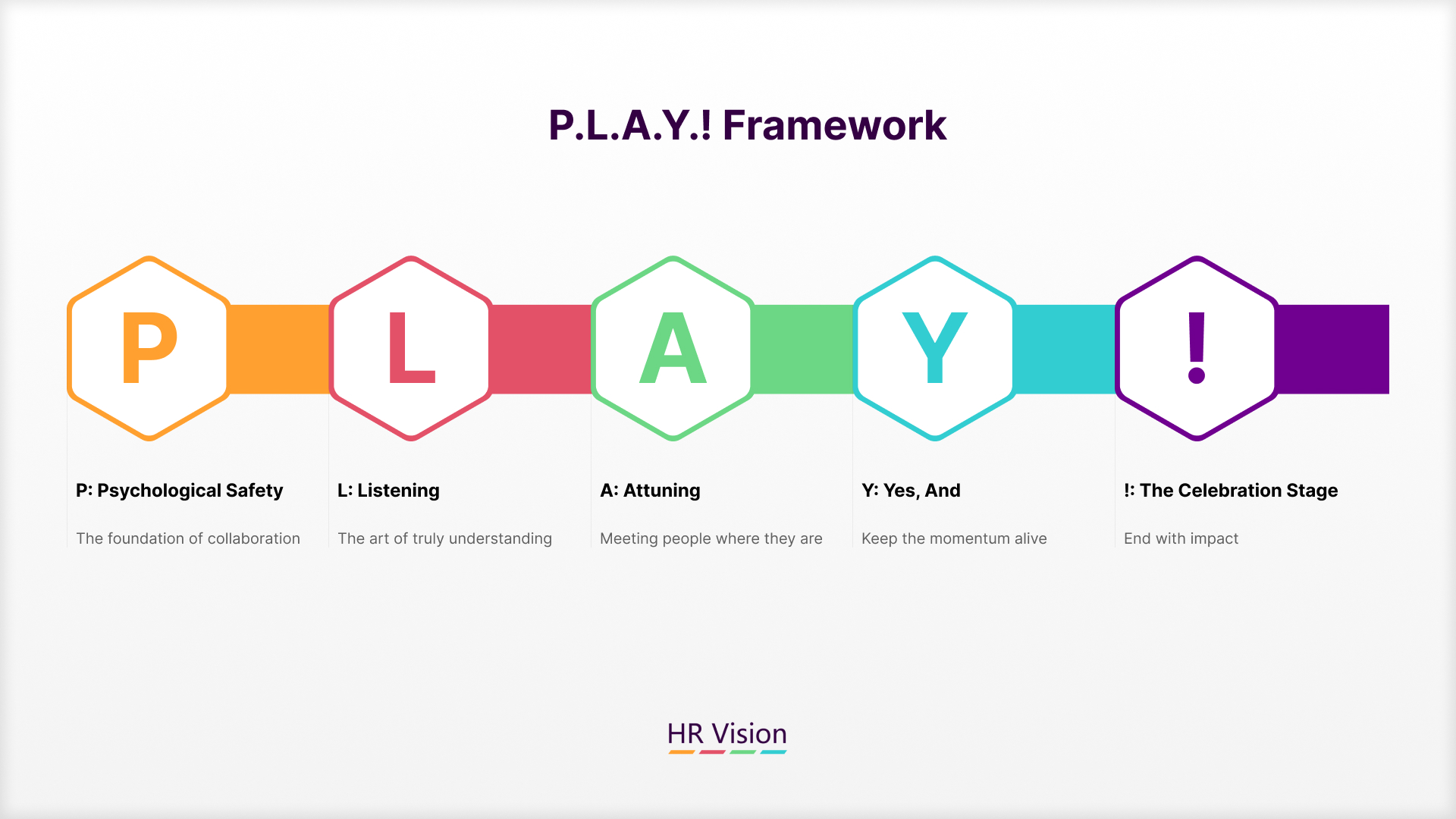
This is where my P.L.A.Y! framework comes in—it’s a five-stage process (and soon to be a book!) designed to improve creativity, communication, and productivity. Here’s the breakdown:
- P: Psychological Safety is the foundation—it’s what allows team members to give feedback, disagree, and share ideas without fear.
- L: Listening is a skill we often overlook. As many of us know, active listening isn’t just hearing—it’s understanding and making space for others to share their feedback and ideas without interrupting or shutting them down.
- A: Attuning means meeting others where they are, emotionally and mentally. This builds stronger relationships and prevents misunderstandings.
- Y: Yes, And—borrowed from improv—is about embracing ideas and moving the conversation forward, rather than shutting it down.
- !: The “mic drop” or celebration stage. Every project, discussion, or initiative needs closure that leaves everyone feeling seen, valued, and successful.
- In your work with government and non-profit organizations, how do cultural and operational constraints influence team development strategies?
Government and non-profits each have their unique challenges, but there’s also a lot of overlap. Government organizations often face rigid regulations and hierarchical structures, while non-profits deal with limited resources and a relentless focus on mission-driven work. Both can lead to burnout, communication silos, and difficulty in fostering collaboration.
What I’ve found, though, is that people are people, regardless of the rules they work under. Whether it’s government employees navigating bureaucracy or non-profit staff juggling multiple hats, the need for trust, engagement, and creativity is universal.
Purposeful Play helps cut through those constraints by giving people a chance to connect authentically. Structured activities create a safe space to bypass the usual operational hurdles and focus on building strong team bonds, which ultimately improve productivity and morale—even within those constraints.
- What are some practical ways for organizations to improve employee retention through effective communication?
This begins at the very first interaction—during interviews and onboarding—and should continue throughout an employee’s journey. Managers and HR leaders who model vulnerability, transparency, and trust set the tone for a culture where people feel safe to engage fully.
Trust-building is an ongoing effort. It requires HR leaders to be intentional about understanding team dynamics and fostering environments where everyone feels seen and valued. One of my favorite tools is what I call the “High, Low, and Wildcard” check-in, where team members share one “win”, one challenge, and one surprising insight from their week. This simple exercise humanizes communication and builds a culture of openness and connection.
By incorporating Purposeful Play into regular interactions, organizations can ensure that communication doesn’t just happen, it flourishes. Employees who feel heard, valued, and connected are far more likely to stay and grow within the company.
- How do you help companies measure the ROI of team-building and collaboration initiatives?
Measuring the ROI of team-building initiatives is part art and part science. While traditional metrics like employee retention rates, engagement surveys, and productivity data are important, I always encourage organizations to consider qualitative measures too.
For instance, after a Purposeful Play session, we ask employees how they feel about their team dynamics using a quick emotional pulse survey. Are they more energized? Do they feel more connected? These insights are as valuable as hard numbers. I also have a more in-depth online questionnaire I use with managers and leaders, first, seeing where they think issues are. It breaks down challenges into 9 areas of issues that might arise.
Longer term, I work with organizations to track how these initiatives impact innovation metrics or time-to-solution for team challenges.
- How can smaller organizations implement experiential training on a limited budget?
Small organizations have the advantage of intimacy—they can weave experiential training into their culture without breaking the bank. One of my favorite strategies are “micro-doses” of play.
Instead of a full-scale training event, consider short, engaging activities during team meetings. A simple improvisation game can teach adaptability. A five-minute reflection where team members share their “most creative moment of the week” builds innovation and appreciation for others’ points of view.
Another budget-friendly tip is peer-led training. Empower team members to take the lead in facilitating playful activities—they know the team dynamics best and can create experiences that are highly relevant and personal. With a little creativity, experiential learning doesn’t require a big budget—just a commitment to infusing intentional playfulness.
- Finally, what’s your vision for the future of HR in fostering innovative and resilient workplace cultures?
The future of HR is all about nurturing workplaces where humanity thrives. It’s about recognizing that the best ideas and the strongest resilience emerge when people feel psychologically safe, valued, and free to think outside the box. (that being said, I hate the term “Box.” There should never be a box…or a bag….or a suitcase, for that matter!)
I see HR professionals stepping into the role of “culture architects,” designing environments where employees are not only motivated but truly inspired. Purposeful and Attuned Play will play a key role in this future—helping teams navigate uncertainty with creativity, communicate with empathy, and bond through shared joy.
As automation and AI transform workflows, it’s our uniquely human qualities—imagination, curiosity, and collaboration—that will become even more essential. HR has the power to lead this charge by embedding play into the heart of workplace culture, creating resilient teams that embrace change and drive innovation.
Ready to stay ahead in the ever-changing world of HR? Join us at HR Vision, where top HR leaders gather to explore the future of work, HR trends, and the power of HR analytics and technology.