

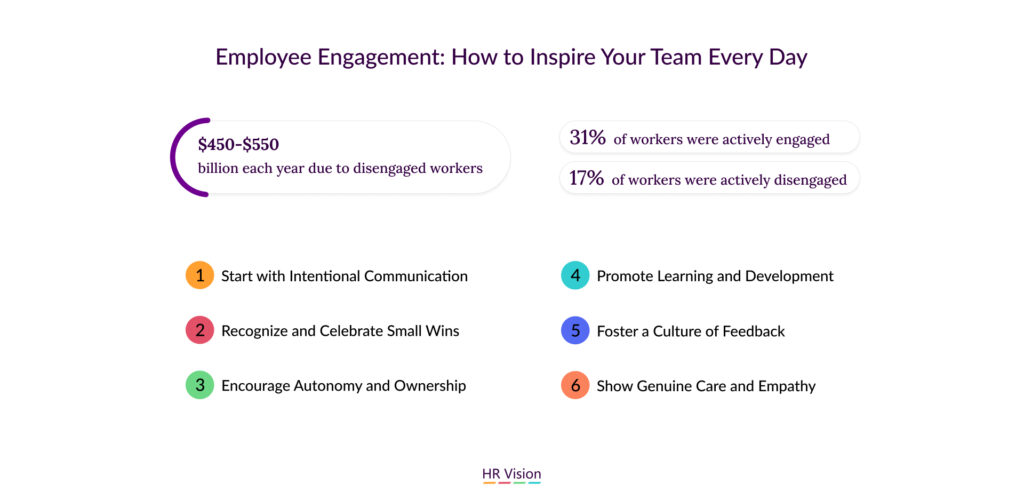
Did you know that companies with highly engaged teams are 21% more profitable and 17% more productive? Yet, only about one-third of employees feel truly engaged at work. That’s a huge gap—and a big opportunity for improvement.
This article explores how leaders and HR professionals can bridge that gap, not through grand gestures, but by inspiring their teams in small, intentional ways every single day. Daily engagement efforts, when consistent and authentic, help create a culture where employees feel valued, motivated, and aligned with the company’s mission.
Why focus on daily inspiration? Because engagement isn’t a one-off initiative—it’s a daily relationship. Just as trust is built over time through consistent actions, so is the emotional commitment employees have to their work.
What Is Employee Engagement?
Employee engagement goes beyond job satisfaction or surface-level happiness at work. While a satisfied employee may enjoy their job, an engaged employee is emotionally invested in their work and committed to the organization’s goals. They don’t just clock in and out—they bring energy, creativity, and purpose to their roles. Engagement is about connection: to the company’s mission, to team success, and to one’s own growth.
Why Employee Engagement Matters
Engagement is more than a “nice-to-have” HR metric—it’s a powerful driver of organizational performance. Research consistently shows that engaged employees:
- ◘ Are more productive: They contribute greater discretionary effort and are more likely to exceed expectations.
- ◘ Stay longer: High engagement reduces turnover, especially among high-performing employees.
- ◘ Fuel innovation: Engaged employees are more proactive, open to change, and eager to offer new ideas.
- ◘ Create better customer experiences: Their enthusiasm is contagious and often felt by clients and customers.
Companies that prioritize engagement not only perform better financially but also build cultures that attract and retain top talent.
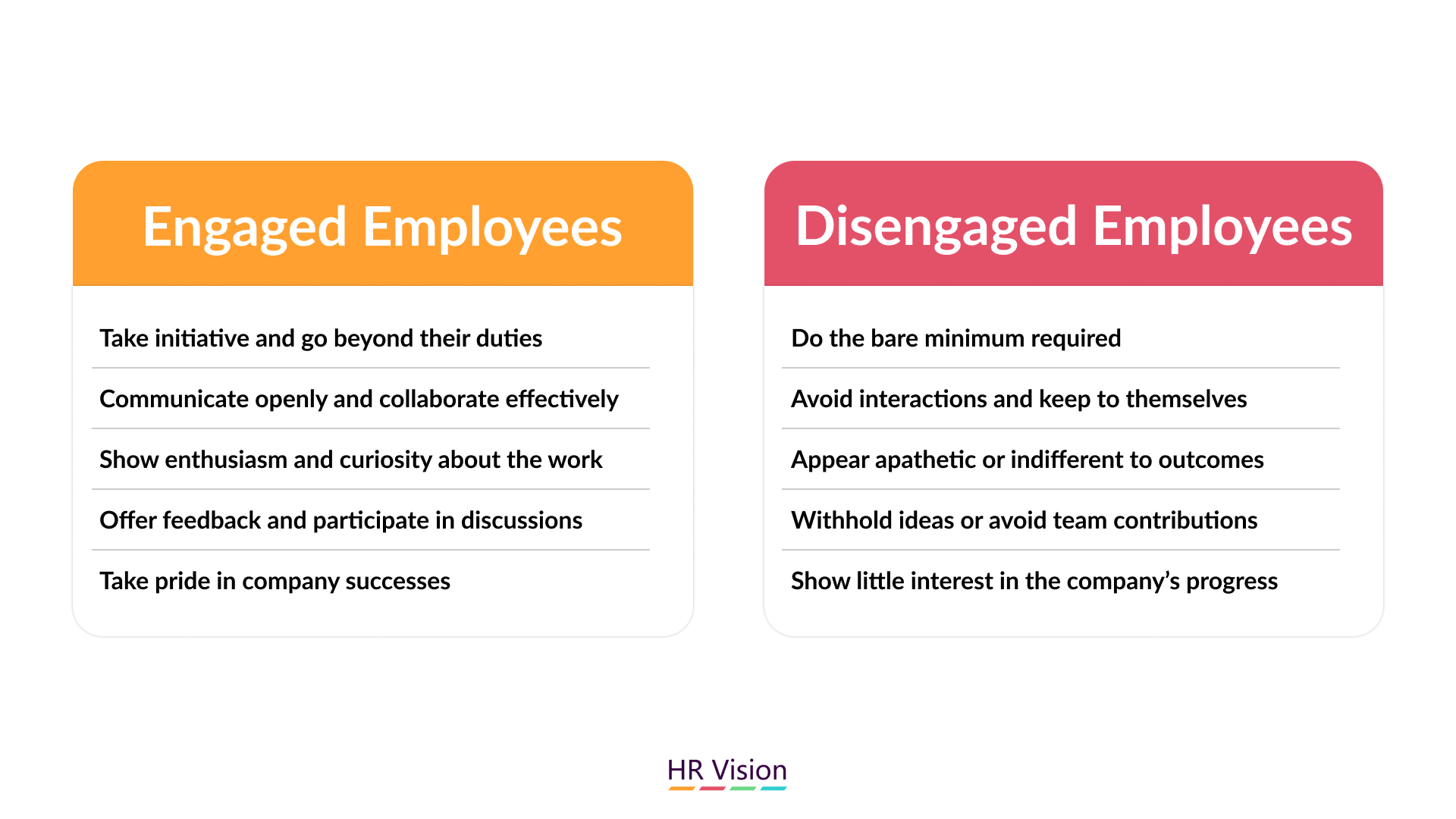
Signs of Engagement vs. Disengagement
To understand where your team stands, it’s important to recognize the behavioral indicators of both engagement and disengagement.
What are the Benefits of Employee Engagement?
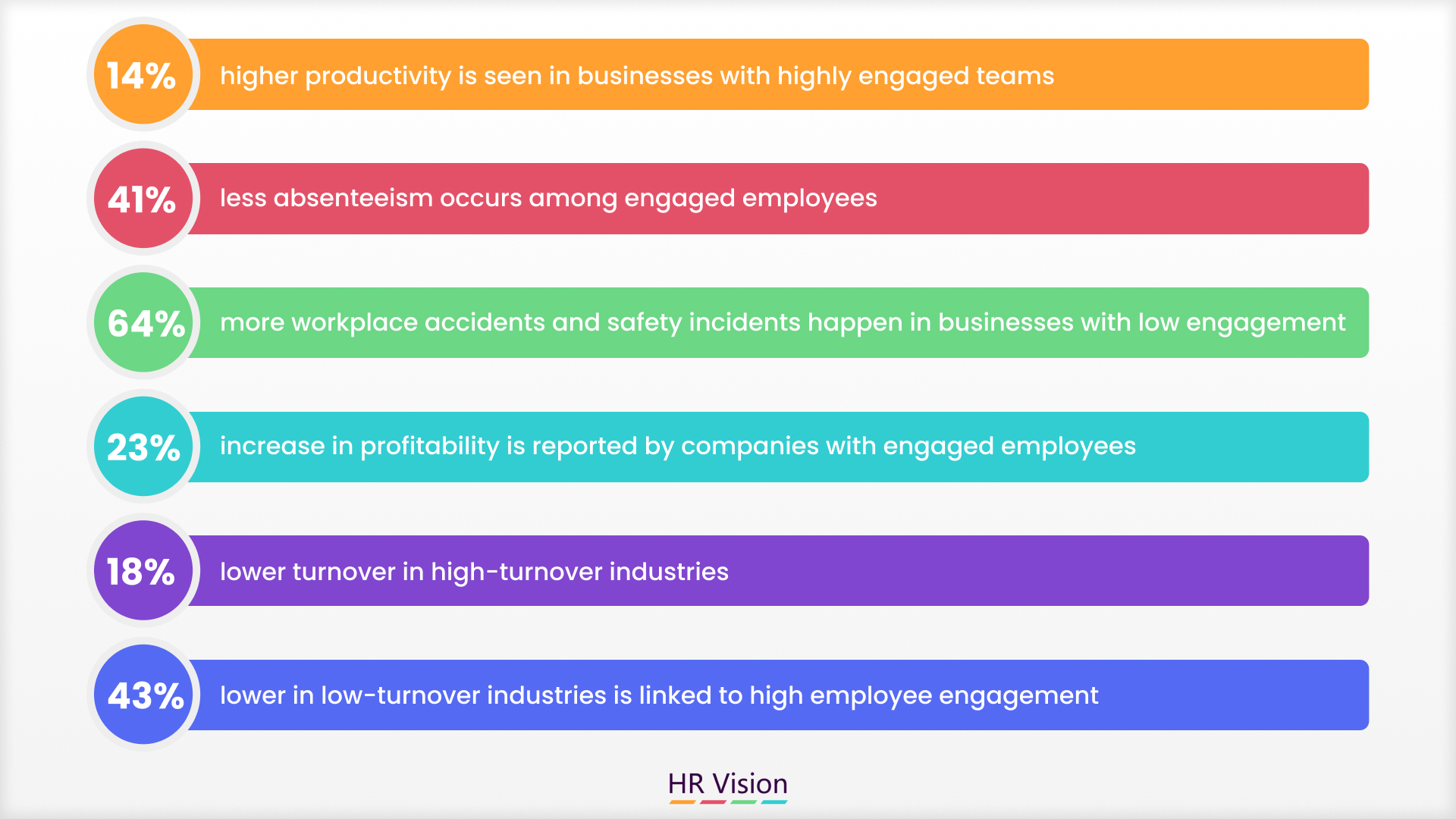
Employee engagement delivers a wide range of tangible and intangible benefits that directly impact an organization’s performance, culture, and long-term success. Here are the key benefits of employee engagement:
- Increased Productivity: Engaged employees are more focused, motivated, and committed to delivering high-quality work. They take initiative, solve problems proactively, and often exceed expectations.
Companies with high employee engagement see up to 17% higher productivity.
- Higher Retention Rates: Engaged employees are more emotionally connected to their roles and less likely to seek new opportunities. This reduces turnover and the associated costs of recruiting, onboarding, and training.
Organizations with high engagement experience up to 59% lower turnover.
- Improved Customer Satisfaction: Engaged employees are more likely to go the extra mile for customers, leading to better service experiences, stronger relationships, and increased loyalty.
Happy employees often create happy customers.
- Enhanced Innovation and Creativity: Engagement fosters a culture of curiosity and openness. Employees feel safe to share ideas, take calculated risks, and challenge the status quo—key ingredients for innovation.
- Stronger Team Collaboration: Engaged team members are more likely to communicate effectively, support one another, and work toward shared goals. This leads to better team performance and problem-solving.
- Better Workplace Morale and Culture: High engagement leads to a positive, energized atmosphere. Employees feel valued and appreciated, which contributes to stronger workplace morale and a sense of belonging.
- Greater Profitability: Engaged employees drive performance metrics across the board. Increased productivity, better retention, and customer satisfaction translate into higher financial returns.
Companies with engaged workforces are 21% more profitable on average.
- Reduced Absenteeism: When employees are engaged, they’re more likely to show up and be fully present. Absenteeism drops, and overall attendance improves.
- Enhanced Employer Brand: A reputation for having an engaged workforce helps attract top talent. Candidates are drawn to workplaces where people feel empowered and inspired.
- Better Adaptability During Change: Engaged employees are more resilient and adaptable. They’re more likely to support organizational changes and help lead transformations rather than resist them.
The Psychology of Daily Inspiration
Understanding how to inspire employees every day starts with understanding what truly drives human behavior at work. It’s not just about perks or paychecks—sustained engagement stems from psychological needs being met consistently.
- Motivation Theories: What Really Drives Us
While extrinsic rewards (like bonuses or promotions) can boost short-term motivation, long-term engagement relies on intrinsic motivation—the internal desire to do something because it is meaningful or satisfying.
Two foundational theories help explain this:
- Self-Determination Theory (SDT): According to SDT, people are most motivated when three core needs are met:
- ○ Autonomy – the feeling of control over one’s work and decisions
- ○ Competence – the sense of being effective and capable
- ○ Relatedness – the feeling of connection and belonging with others
- ○ Autonomy – the feeling of control over one’s work and decisions
- Herzberg’s Two-Factor Theory: This theory separates factors into:
- ○ Hygiene factors (e.g., salary, policies) that prevent dissatisfaction, and
- ○ Motivators (e.g., recognition, meaningful work) that actively create satisfaction and engagement.
- ○ Hygiene factors (e.g., salary, policies) that prevent dissatisfaction, and
Leaders who understand these frameworks can better shape daily interactions to meet these deeper needs—not just manage tasks, but truly motivate people.
- Emotional Connection: The Heart of Daily Engagement
Inspiration doesn’t come from mandates—it comes from emotionally intelligent leadership that builds trust, fosters belonging, and provides a sense of purpose.
- ◘ Trust: Employees are more engaged when they trust their leaders and believe in the fairness of the workplace.
- ◘ Belonging: Feeling accepted and valued by colleagues and managers nurtures a sense of inclusion and psychological safety.
- ◘ Purpose: Connecting daily tasks to a larger mission gives employees a reason to care. Purpose fuels persistence and pride.
These emotional elements are subtle but powerful. A team that feels safe, seen, and significant is far more likely to stay engaged.
- Micro-Moments of Influence
Inspiration doesn’t require grand gestures. In fact, it’s the small, consistent actions—what we might call “micro-moments”—that create the strongest impact over time. Examples include:
- ◘ A manager saying, “Great idea—can you explore that further?”
- ◘ A shout-out during a morning meeting for a job well done
- ◘ Taking 2 minutes to ask, “How are you doing today, really?”
- ◘ Giving employees the freedom to shape how they approach a task
These moments compound. They send a message: You matter. Your voice counts. Your work has meaning. Over time, they build engagement far more reliably than sporadic events or one-time rewards.
In essence, daily inspiration is about understanding the human side of work—what drives people, what connects them, and how leaders can intentionally nurture those drivers every day.
The Psychology of Daily Inspiration
Understanding how to inspire employees every day starts with understanding what truly drives human behavior at work. It’s not just about perks or paychecks—sustained engagement stems from psychological needs being met consistently. This section explores the motivation theories and emotional levers that influence daily employee engagement.
1. Motivation Theories: What Really Drives Us
While extrinsic rewards (like bonuses or promotions) can boost short-term motivation, long-term engagement relies on intrinsic motivation—the internal desire to do something because it is meaningful or satisfying.
Two foundational theories help explain this:
- Self-Determination Theory (SDT): According to SDT, people are most motivated when three core needs are met:
- ○ Autonomy – the feeling of control over one’s work and decisions
- ○ Competence – the sense of being effective and capable
- ○ Relatedness – the feeling of connection and belonging with others
- Herzberg’s Two-Factor Theory: This theory separates factors into:
- ○ Hygiene factors (e.g., salary, policies) that prevent dissatisfaction, and
- ○ Motivators (e.g., recognition, meaningful work) that actively create satisfaction and engagement.
Leaders who understand these frameworks can better shape daily interactions to meet these deeper needs—not just manage tasks, but truly motivate people.
2. Emotional Connection: The Heart of Daily Engagement
Inspiration doesn’t come from mandates—it comes from emotionally intelligent leadership that builds trust, fosters belonging, and provides a sense of purpose.
- ◘ Trust: Employees are more engaged when they trust their leaders and believe in the fairness of the workplace.
- ◘ Belonging: Feeling accepted and valued by colleagues and managers nurtures a sense of inclusion and psychological safety.
- ◘ Purpose: Connecting daily tasks to a larger mission gives employees a reason to care. Purpose fuels persistence and pride.
These emotional elements are subtle but powerful. A team that feels safe, seen, and significant is far more likely to stay engaged.
3. Micro-Moments of Influence
Inspiration doesn’t require grand gestures. In fact, it’s the small, consistent actions—what we might call “micro-moments”—that create the strongest impact over time. Examples include:
- ◘ A manager saying, “Great idea—can you explore that further?”
- ◘ A shout-out during a morning meeting for a job well done
Taking 2 minutes to ask, “How are you doing today, really?” - ◘ Giving employees the freedom to shape how they approach a task
These moments compound. They send a message: You matter. Your voice counts. Your work has meaning. Over time, they build engagement far more reliably than sporadic events or one-time rewards.
Daily Strategies to Inspire Your Team
Big-picture engagement starts with daily actions. The most effective leaders don’t rely solely on quarterly surveys or annual retreats to boost morale—they inspire consistently, through habits and behaviors that build trust, motivation, and connection. Here are six proven, daily strategies to help you inspire your team and foster lasting engagement.
- Start with Intentional Communication
Communication is the foundation of engagement. But it must go beyond status updates—it should be purposeful, human, and two-way.
- ◘ Daily stand-ups or one-on-ones provide a rhythm for regular interaction, allowing leaders to check progress, remove roadblocks, and celebrate momentum.
- ◘ Pulse checks—quick check-ins on mood or workload—help leaders stay connected to how employees are really feeling.
- ◘ Active listening and open-door policies show that leadership is accessible, empathetic, and responsive—not just directive.
When communication feels intentional rather than transactional, employees feel heard and respected.
- Recognize and Celebrate Small Wins
Recognition doesn’t need to wait for a promotion or project milestone. In fact, the smaller, more frequent the praise, the more motivating it can be.
- ◘ Encourage peer-to-peer recognition so praise flows laterally, not just top-down.
- ◘ Offer real-time praise when you see effort, creativity, or collaboration. A quick “Well done!” or public shoutout goes further than a delayed review.
Celebrating progress, not just outcomes, keeps energy high and builds momentum.
- Encourage Autonomy and Ownership
Micromanagement stifles creativity and motivation. People feel most inspired when they have control over how they work.
- ◘ Give team members control over how they approach tasks or structure their day—this signals trust and builds confidence.
- ◘ Set clear goals and expectations, but allow flexibility in how those goals are achieved.
When employees own their work, they bring more initiative, accountability, and pride.
- Promote Learning and Development
Stagnation is one of the fastest paths to disengagement. Growth, on the other hand, creates energy and ambition.
- ◘ Incorporate microlearning—short, focused learning moments—into the daily routine.
- ◘ Encourage skill-sharing within teams, creating a learning culture where employees teach and learn from each other.
Investing in development signals that you care about your team’s future, not just their current output.
- Foster a Culture of Feedback
Feedback is a catalyst for growth, but only when it’s frequent, honest, and safe to give and receive.
- ◘ Normalize constructive, timely feedback so it becomes part of the everyday culture—not a dreaded formality.
Lead by example by asking for feedback yourself. When leaders are open to improvement, it creates psychological safety across the team.
A feedback-rich environment drives clarity, performance, and trust.
- Show Genuine Care and Empathy
Inspiration isn’t just about goals—it’s about people. Teams thrive when they know their leaders see them as humans first, employees second.
- ◘ Make personal check-ins a habit. A sincere, “How are you really doing?” can make a big difference.
- ◘ Support work-life balance and mental health, whether through flexibility, wellness resources, or simply by respecting boundaries.
Empathy isn’t a soft skill—it’s a leadership strength that drives loyalty and engagement.
Measuring the Impact of Engagement Efforts
Inspiration without insight can quickly lose direction. To ensure your engagement strategies are working, it’s essential to track progress using meaningful, actionable data.
Start by implementing regular engagement surveys—these could be in-depth quarterly assessments or quick pulse surveys delivered weekly or biweekly. The key is consistency and responsiveness: ask the right questions and follow through on what you learn.
In addition to surveys, monitor key performance indicators (KPIs) that correlate with engagement, such as:
- • Turnover and retention rates
- • Absenteeism trends
- • Productivity metrics
- • Internal promotion rates
To get real-time insights, consider using digital engagement platforms that allow employees to share feedback, recognize peers, or check in on mood and workload. These tools help HR and managers spot trends early and intervene before issues escalate.
Ultimately, tracking progress ensures that engagement isn’t just a feel-good initiative—it’s a measurable, strategic investment in your people and performance.
Conclusion
Employee engagement isn’t built overnight—and it’s not the result of a single program or initiative. It’s cultivated through consistent, intentional actions that inspire people to bring their best selves to work every day. From effective communication to recognition, autonomy, and empathy, the strategies we apply daily can have a powerful, lasting impact.
As an HR leader or manager, you don’t need to overhaul your entire system to make a difference. Choose just one strategy from this article—perhaps recognizing a small win, offering real-time feedback, or simply checking in more personally—and commit to doing it consistently this week. Small actions, repeated with care, lead to major change.
Want to dive deeper into the strategies that drive daily employee inspiration and long-term engagement? Join us at HR Vision. Connect with top HR leaders as we explore the future of work, evolving leadership practices, and the latest innovations in employee engagement and HR Tech.


