“I’m exhausted.” “I just can’t keep up.” “Maybe it’s time to leave.”
If those phrases are echoing across your Slack channels, you’re not alone. Burnout has gone from the quiet grumble of a few overworked high-performers to a full-blown culture killer—and the numbers prove it. Gallup reports that nearly 60 % of employees feel burned out at least once every single week. That’s more than half of your workforce teetering on the edge of disengagement every Friday afternoon.
For HR, the stakes couldn’t be higher. A burned-out employee is 31 % more likely to job-hunt, 23 % more likely to visit the doctor, and far less likely to delight customers—a triple hit to retention, productivity, and employer brand. Glassdoor reviews turn sour, star talent ghosts recruiters, and team morale evaporates faster than PTO balances at year-end.
So, what’s the play? Flashy perks and mindfulness apps won’t cut it. To reclaim energy and performance, organizations need a systemic approach that tackles burnout at its roots and turns well-being into a strategic advantage.
The Cost of Burnout: What’s Really at Stake?
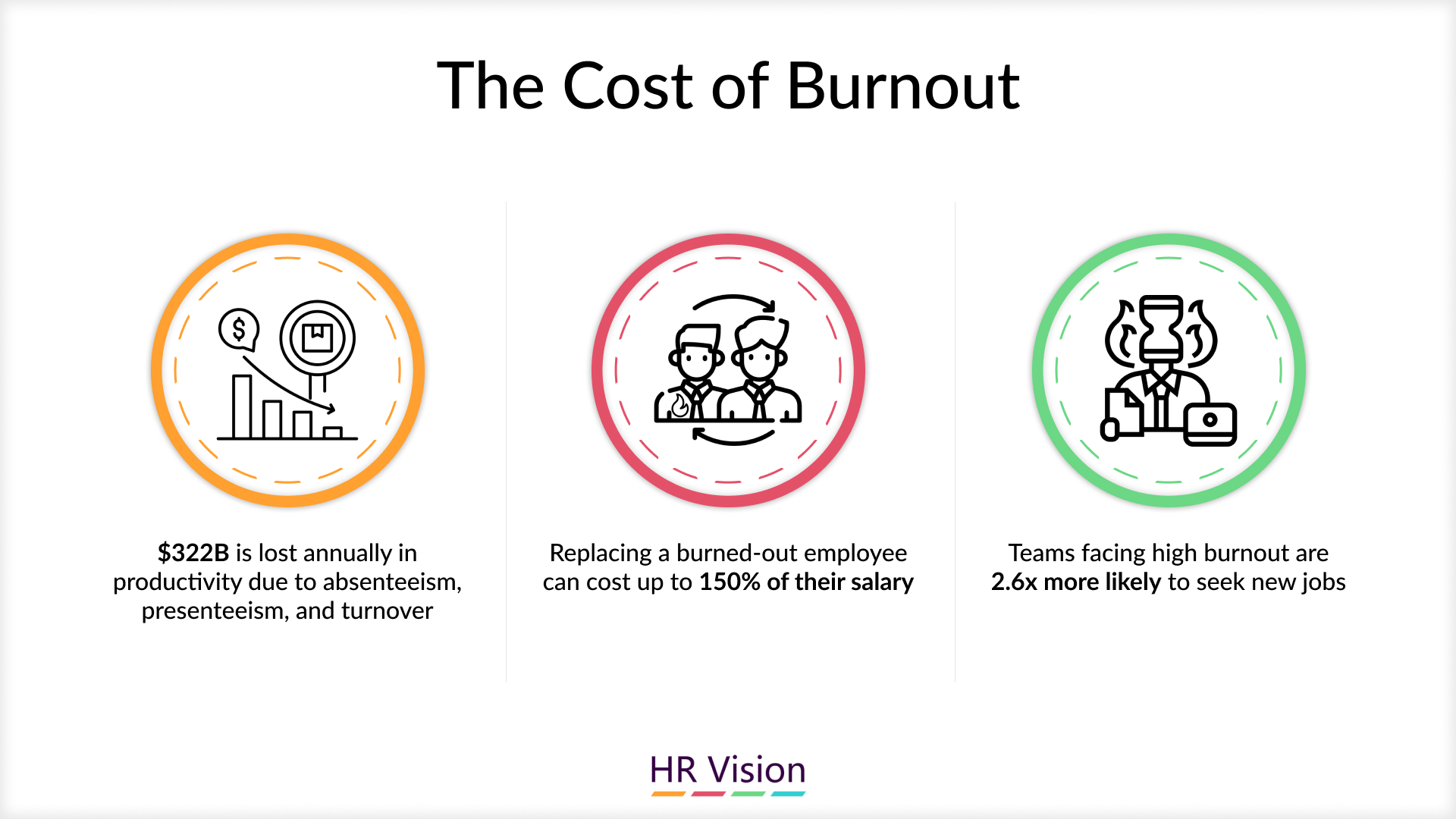
Unchecked burnout is bleeding organizations on three fronts—financial, cultural, and reputational—and the math is brutal. Globally, lost productivity linked to absenteeism, presenteeism, and turnover now carries an annual price tag of about $322 billion. Every time a burned-out employee walks out the door, the bill spikes again: replacing a mid-level professional typically runs 100–150 percent of their salary, once you add recruitment fees, ramp-up time, and lost tacit knowledge.
Yet money is only half the story. Burned-out teams are 2.6 times more likely to be actively job-hunting, a revolving-door effect that drags engagement down with each exit and erodes the trust people need to collaborate. High-potential talent senses the fatigue and votes with its feet, leaving managers to back-fill roles instead of driving innovation.
Reputation takes a hit as well. Negative Glassdoor reviews spread fast, and younger workers notice: recent surveys show that 83% of Gen Z frontline employees report feeling burned out, higher than the 75% average across all frontline staff, and 36% say they would quit any job that harms their physical or mental well-being. With a generation this attuned to workplace health, employers tagged with a “work-till-you-drop” image will struggle to attract and keep emerging talent.
Step 1: Diagnose the Real Drivers of Burnout
Burnout can look like late-night e-mails or a spike in sick days, but the real culprits hide deeper in systems, workflows, and culture. Before launching perks or wellness apps, HR needs a clinical diagnosis—one that tells you where fatigue is flaring up and why.
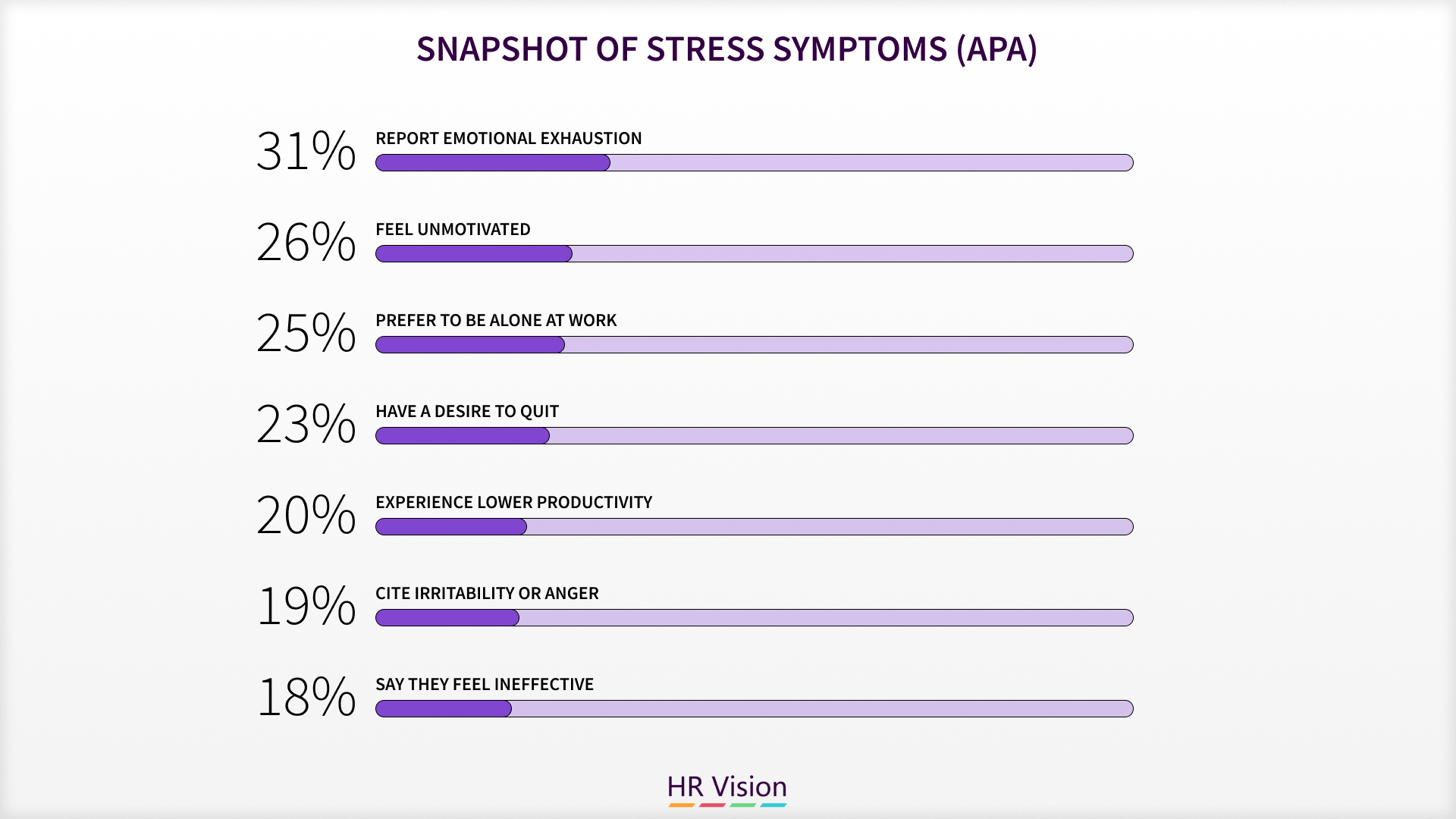
These numbers show burnout is multidimensional—touching motivation, retention, and performance—so your diagnosis must be, too.
- Collect Multi-Source Evidence
- • Pulse & eNPS Surveys (monthly): Ask five-to-seven questions mapped to the six classic burnout drivers—workload, control, reward, community, fairness, values.
- • Stay and Exit Interviews: Compare why people stay energized with why others walk away; the gap reveals hidden stressors.
- • HRIS & Productivity Metrics: Overtime hours, weekend log-ins, unused PTO, and “meeting-load” data offer quantitative warning lights you can track over time.
- Spot Leading Indicators
Don’t wait for resignations. Cross-reference early signals—overtime, PTO deferral, or meeting overload—with engagement dips one quarter later. Pattern-spotting turns the vague “people seem tired” into a predictive dashboard that managers can act on.
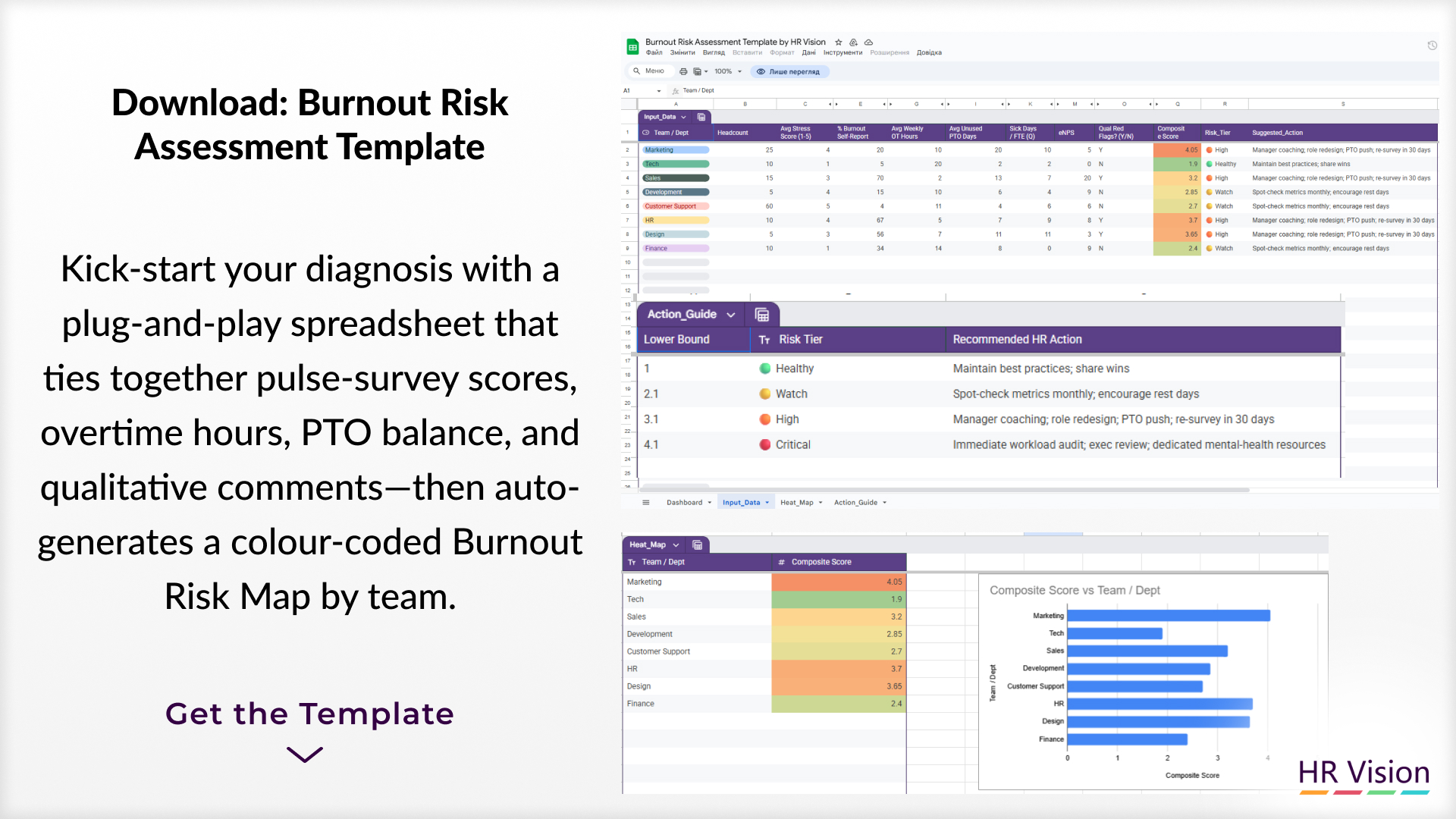
- Build a Burnout Risk Map
Convert your findings into a colour-coded heat map by department or location: red for critical, amber for rising risk, green for healthy zones. Paste one anonymized employee quote next to each red block—leaders act faster when they read a real voice, not just numbers. Share the same view with executives and frontline managers; transparency turns burnout prevention from an HR policing exercise into a shared mission.
- Dig for Root Causes
If Marketing glows red while Engineering stays green, ask why: relentless campaign cadence? role ambiguity? chronic understaffing? Target the specific system flaw instead of prescribing generic “self-care” fixes.
To make diagnosis easier, we’ve built a ready-made tool.
Get the Template
Step 2: Normalize the Conversation Around Mental Health
Silence is still the default reaction to stress in many workplaces, even though most people agree the topic belongs on the table. A recent NAMI/Ipsos poll found that 74% of employees believe it’s appropriate to talk about mental health at work, yet only 58% feel comfortable doing so. When employees don’t feel safe speaking up, the organisation pays: in teams with low psychological safety.
- Start with visible vulnerability.
When senior leaders share their own stress stories—taking a mental-health day, using therapy benefits, or admitting overwhelm—it sends an unmistakable message that wellbeing talk is career-safe. Back those moments with clear language in one-to-ones and stand-ups: swap “How’s the project?” for “How’s your workload feeling this week?” and make a brief wellbeing check-in a standing agenda item, not an afterthought.
- Equip managers to listen, not diagnose.
Short “mental-health first-aid” workshops give frontline leaders the confidence to notice early warning signs and steer conversations toward professional resources. Provide simple conversation guides so they know what to say, when to refer, and how to protect confidentiality.
- Offer multiple low-friction channels.
A private Slack peer-support space, quarterly town-hall Q&As with external psychologists, and an always-on digital “Wellbeing Hub” (EAP links, counselling stipends, meditation apps) ensure that help is never more than a couple of clicks away—no permission slip required.
- Reward the right behaviours.
Spotlight teams that balance workload sustainably and recognise managers who proactively adjust deadlines or redistribute tasks. Tie a slice of leadership performance reviews to psychological-safety scores so caring for mental health is viewed as a core competency, not a passion project.
When employees see leaders modelling openness, managers responding skillfully, and resources within arm’s reach, talking about burnout becomes normal office dialogue.
Step 3: Redesign Roles and Workflows for Sustainability
Diagnosing hot spots and opening dialogue only go so far if day-to-day work still pushes people past their limits. The third step is therefore architectural: re-engineering roles, schedules, and collaboration patterns so that “peak season” is an exception, not the norm.
Begin with role clarity and capacity math. Vague job descriptions and ever-expanding “other duties as assigned” make overload inevitable. Work with managers to define the core 70% of each role, reserve 20% for stretch or innovation projects, and leave 10% unallocated for the inevitable surprises. When the numbers don’t add up, shift tasks, add headcount, or phase projects rather than asking people to bend time.
Next, attack the structural time thieves. Replace recurring status meetings with asynchronous updates, batch similar tasks to reduce context-switching, and cap meeting-heavy days so deep work has protected space on the calendar. Where work allows, pilot true flexibility—core hours, compressed weeks, or hybrid schedules—so employees can align effort with their natural energy peaks instead of the clock. The most successful pilots start small (one team, one quarter) and scale only after productivity and wellbeing data confirm the gains.
Sustainability also depends on restorative time-off practices. Setting generous PTO limits means little if people feel punished for using them, so pair the policy with visible executive modeling—leaders who book full breaks and actually unplug. Encourage teams to nominate a “time-off back-up buddy,” publish clear hand-off checklists, and close whole departments in low-demand periods to eliminate the temptation to check in “just in case.” Quarterly “recharge days” or meeting-free Fridays give the nervous system a mini-reset without denting annual leave banks.
Finally, make workload balance a living KPI. Track overtime hours, weekend log-ins, and PTO usage alongside revenue and customer metrics in leadership dashboards. When spikes appear, treat them as process failures, not individual heroics. Over time, this re-engineering turns sustainable pace into a cultural default—protecting energy, retaining talent, and creating the conditions for the next two steps in the strategy to flourish.
Step 4: Invest in Manager Enablement
Even the best-designed workflows will buckle if line managers can’t spot—or don’t know how to address—early burnout signals. Because managers sit closest to the daily realities of workload, they are simultaneously the first alarm system and the first line of defence. Yet surveys routinely show that fewer than half feel confident discussing mental-health concerns, and only a third believe they have the authority to reshape roles when people are overstretched. Closing that capability gap is therefore mission-critical.
Start with skills, not slogans. Replace generic “people leadership” courses with focused micro-learning on burnout warning signs: chronic lateness, rising error rates, sudden quietness in meetings, or excessive weekend e-mail activity. Pair those red flags with a simple decision tree—listen, probe, triage—so managers know whether to adjust workload, escalate to HR, or tap the employee-assistance programme.
Next, arm managers with conversation scaffolding. Provide a short script for opening 1-to-1s—“I’ve noticed you’ve logged extra hours three weeks running; how are you coping?”—followed by coaching questions that uncover root causes without judgement. Supplement scripts with a digital toolkit: capacity-planning templates, role-redesign checklists, and a live directory of mental-health resources. When the tools are friction-free, managers are far more likely to act in the moment rather than postponing a tough talk.
Authority matters as much as ability. Signal from the top that reshaping deadlines, reallocating tasks, or approving a mental-health day is not weakness but good leadership. Tie part of the manager scorecard to well-being indicators—burnout-risk survey items, PTO utilisation, psychological-safety scores—so supportive behaviour is rewarded alongside revenue or project delivery.
Step 5: Measure, Iterate, and Evolve the Strategy
A burnout-reduction plan is only as good as the evidence that it works. Just as Finance scrutinises margins every quarter, HR must treat well-being data as a living P&L—reviewed, debated, and refined in a continuous loop.
Start with a balanced dashboard. Blend three data streams:
- Engagement and pulse-survey scores (sentiment, eNPS, psychological-safety items).
- Hard outcomes such as turnover, absenteeism, overtime hours, and unused PTO.
- Wellness-programme signals—EAP utilisation, counselling uptake, and participation in mental-health workshops.
Tracking these together reveals whether sentiment shifts are translating into real behavioural change. For example, a jump in PTO usage combined with a drop in weekend e-mails suggests that workload reforms are sticking.
Set review cadences that mirror business rhythms. Many organisations run a light monthly check (pulse results + HRIS alerts) and a deep quarterly dive, presenting the burnout dashboard alongside financials in the senior-leadership meeting. This positioning makes well-being a standing business KPI, not a side conversation.
Let the data steer rapid-cycle experiments. If exit-interview themes show that new parents are leaving, pilot a 32-hour week in one division and watch both retention and productivity metrics. If overtime spikes every product launch, test a rotating on-call roster and measure weekend e-mail volume. Each small-scale experiment produces fresh evidence to scale—or scrap—the idea quickly.
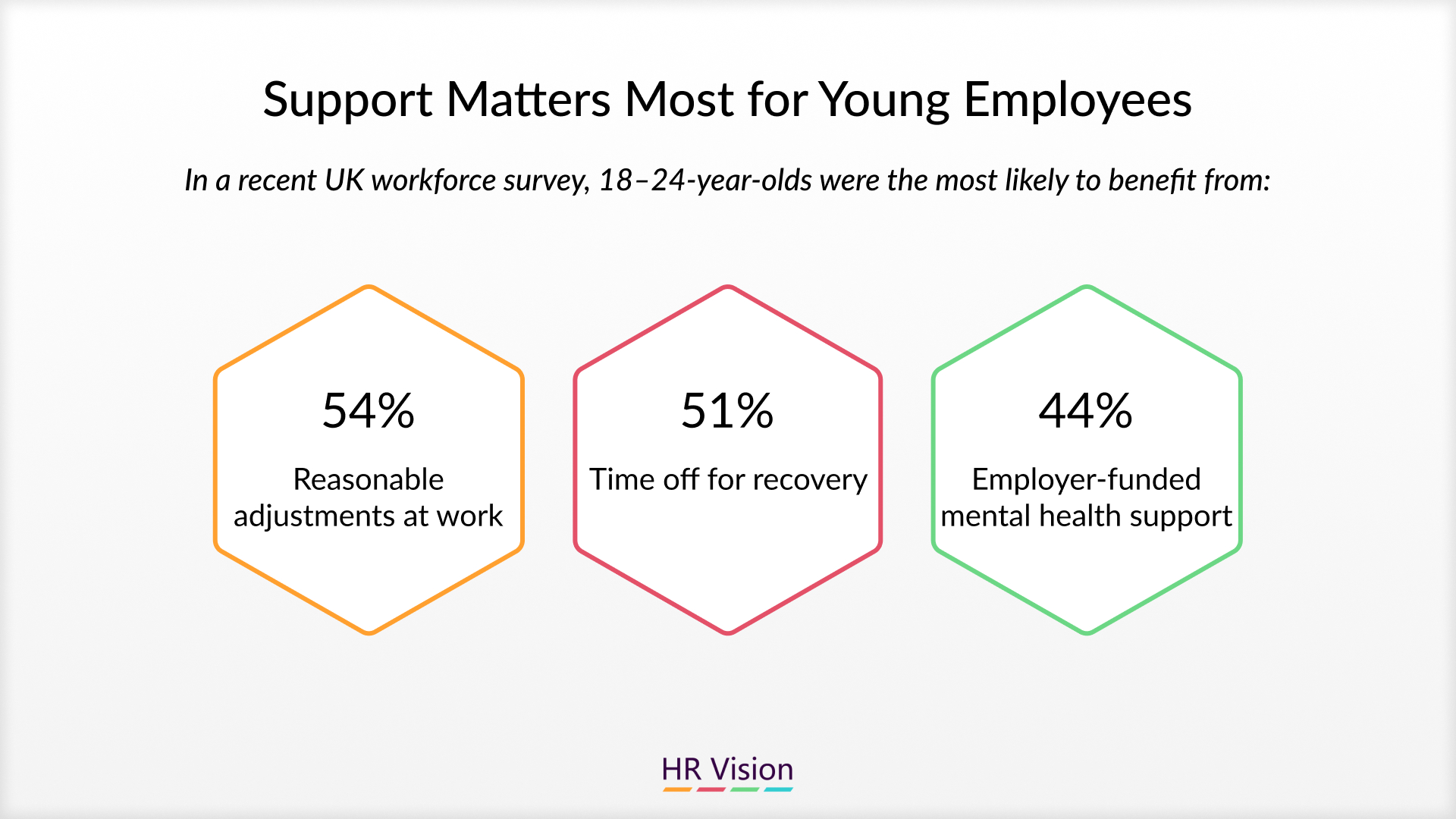
Pay attention to generational signals. A recent UK workforce survey found that 18- to 24-year-olds are the group most likely to benefit from reasonable adjustments at work (54 %), time off for recovery (51 %), and employer-funded mental-health support (44 %). Those numbers give HR a clear starting point for targeted interventions: flexible scheduling, protected rest days after peak periods, and subsidised therapy can yield outsized returns for early-career talent that might otherwise churn.
Case Study – Buffer’s Four-Day Week
The trigger. A 2020 pulse survey showed workload overload was Buffer’s No. 1 stressor.
The fix. Leadership piloted a company-wide four-day, fully paid week and streamlined workflows—async status docs, only blockers discussed live. Managers got permission to adjust deadlines without extra approvals.
The outcome (after 12 months).
- • Burnout self-reports fell to near zero.
- • 73 % of employees felt more energised; 99 % reported lower stress.
- • No drop in output or customer satisfaction.
Results from the largest 4-day workweek experiment ran in the UK:
— DelyanneTheMoneyCoach ® (@DelyanneMoney) February 27, 2023
Productivity increased by 22%, job applications are up 88%, absenteeism is down by 66%, their carbon footprint is down with people driving less & employees are less tired and happier.
92% of companies said…
Why it worked. Buffer tackled root workload mechanics, empowered managers, and reviewed a “Well-Being Scorecard” each quarter—proving that structural change beats wellness perks in curbing burnout.
Conclusion
Burnout has shifted from a personal hardship to an enterprise-level risk—costing hundreds of billions in lost productivity and eroding retention, engagement, and employer brand in a single blow. The numbers are clear, and so is the mandate: HR cannot afford a wait-and-see approach.
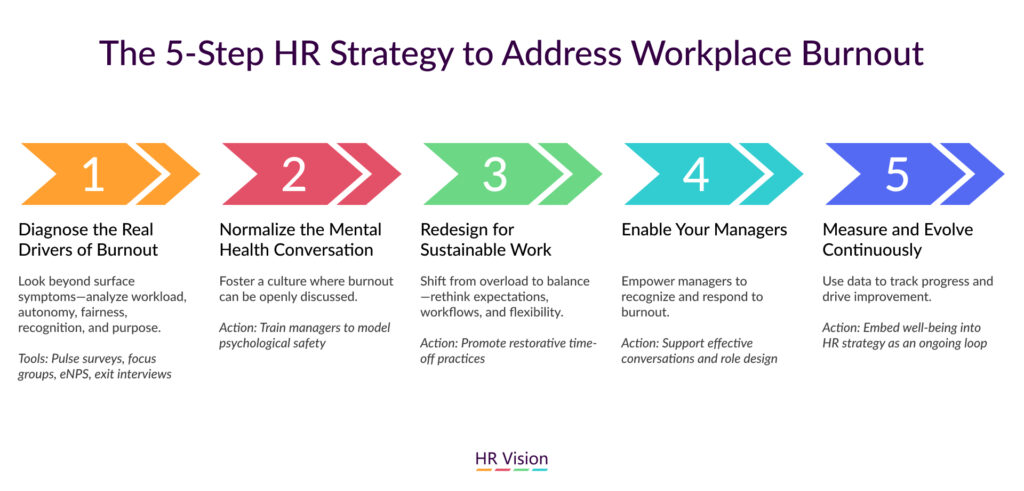
This five-step strategy—diagnose root causes, normalise mental-health dialogue, redesign roles for sustainability, equip managers as first responders, and continuously measure and iterate—turns burnout prevention into a repeatable business process rather than a wellness side project. Each step builds on the last, creating a self-reinforcing loop where data informs action, action reduces stress, and reduced stress improves both culture and performance.
Want to explore how top HR leaders are tackling burnout and rethinking people strategies? Join us at HR Vision for two days of expert insights on the future of work and workplace well-being.