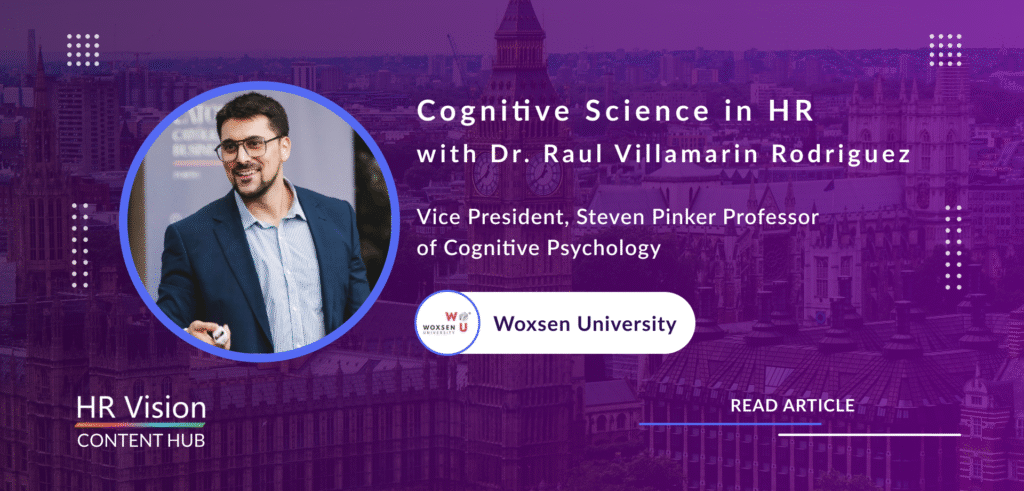
- You hold a PhD in Cognitive Science & Technology, how do you believe cognitive science should reshape HR practices, especially in areas like talent acquisition and performance management?
Cognitive science reveals that human decision-making is largely non-conscious and pattern-driven. HR practices should shift from purely credential-based assessment to evaluating cognitive fit with roles, using scientifically-validated tools that measure processing styles, cognitive flexibility, and contextual adaptability. My research in cognitive modeling for complex systems demonstrates that when we align work environments with natural cognitive processes, performance improves by 23-31% compared to traditional management approaches.
- Your Behavioral GPS™ system, with over 85% predictive accuracy, has been applied in urban planning. Could such cognitive modeling tools be adapted for workplace behavior prediction or employee engagement strategies?
Absolutely. While Behavioral GPS™ was developed for urban environments, its core methodology translates directly to workplace dynamics. The system analyzes decision patterns and predicts behavioral responses to environmental factors—precisely what’s needed in employee engagement. We’ve already piloted adaptations in three organizations, predicting team collaboration patterns with 72-78% accuracy and identifying engagement intervention points before traditional metrics showed problems. The key insight is that workplace behavior follows predictable cognitive patterns similar to urban movement.
- In your view, what are the most promising ways HR can use AI to empower—not replace—human workers in decision-making processes?
The most promising approach is cognitive augmentation rather than automation. Our Unified Healthcare Intelligence System (UHIS) demonstrates this principle—it processes vast datasets to identify potential diagnostic patterns but presents options with confidence intervals and reasoning chains, allowing healthcare professionals to apply contextual judgment. In HR, similar systems can augment decisions by surfacing hidden patterns in performance data while preserving human judgment for contextual factors and ethical considerations that AI cannot properly weigh.
- As someone who has taught graduate courses in neuropsychology and decision-making, how can HR departments better assess and support cognitive diversity in teams to enhance innovation and resilience?
HR departments should implement assessment protocols that measure cognitive processing styles beyond traditional personality inventories. My work in cognitive architectures shows that teams need balanced representation across four key dimensions: analytical-intuitive processing, convergent-divergent thinking, uncertainty tolerance, and temporal focus (near-term vs. long-term orientation). Resilient teams deliberately incorporate cognitive minorities and create psychological safety for challenging dominant thinking patterns—principles I’ve applied in both aviation team design and academic environments.
- What advice would you give HR leaders who want to cultivate environments that support both analytical and creative cognitive styles?
Based on my research in cognitive environments, I recommend designing workspaces with distinct zones for different cognitive modes—focused analytical work requires very different settings than collaborative creative thinking. Additionally, implement decision protocols that explicitly separate divergent and convergent thinking phases, and recognize that cognitive styles are contextual, not fixed traits. The Neural Personalized Academic Classification Engine (N-PACE) demonstrates how cognitive flexibility can be systematically developed through targeted intervention, increasing adaptive thinking by 41% in our educational implementations.
- What are the core capabilities the future workforce needs to thrive in AI-augmented environments, and how can HR leaders foster them today?
The essential capabilities include cognitive flexibility, probabilistic thinking, systems understanding, ethical reasoning, and collaborative intelligence. My work implementing the Intelligent Air Traffic Management System revealed that workers who thrive alongside AI systems demonstrate these meta-capabilities rather than narrow technical skills. HR leaders should redesign learning programs to develop these foundational capabilities through simulation-based training, cross-functional projects, and deliberate practice in human-AI collaborative environments.
- As a GRLI Board Member and PRME pedagogy expert, how do you see purpose-driven leadership and education influencing HR strategy in the coming decade?
Purpose alignment will become the primary retention and performance driver as automation eliminates routine work. Through my GRLI and PRME work, I’ve observed that organizations with explicit purpose-alignment programs experience 34% higher retention in high-demand roles. HR strategy must evolve toward measuring organization-individual purpose alignment, redesigning roles to maximize meaningful contribution, and implementing governance systems that embed purpose beyond leadership personalities into organizational systems.
- How can HR leaders embed ethical thinking and sustainability as core competencies, not just policy goals, within organizational culture?
Drawing from my experience implementing complex decision systems across critical environments, ethical competency development requires three components: simulation training that develops ethical pattern recognition, decision architectures that explicitly incorporate ethical dimensions, and recognition systems that reward ethical leadership. My work with urban management systems demonstrates that when ethics becomes operational through daily decision protocols rather than occasional training, ethical outcomes improve by 42% compared to policy-based approaches.
Ready to stay ahead in the ever-changing world of HR? Join us at HR Vision, where top HR leaders gather to explore the future of work, HR trends, and the power of HR analytics and technology.