

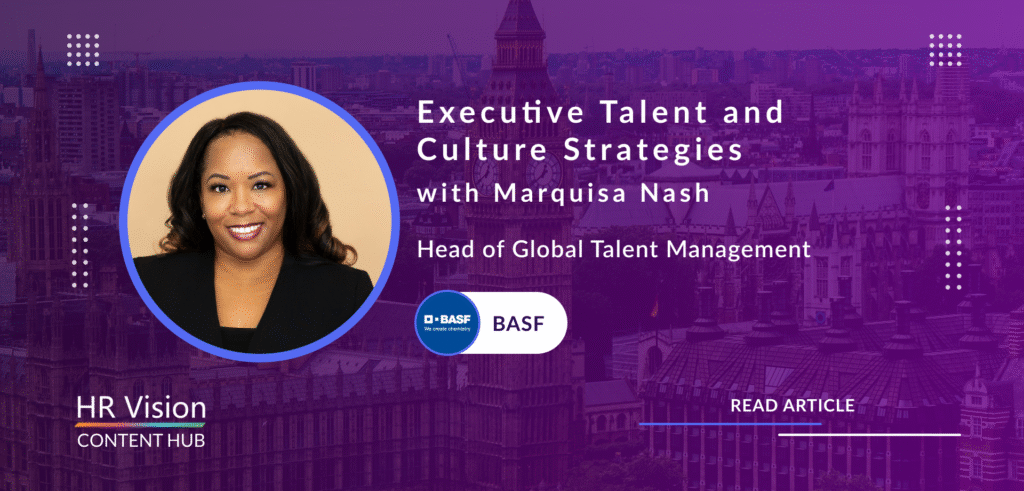
Introducing Marquisa Nash: A global HR executive and leadership coach based in Brussels, partnering with CEOs and senior leaders to turn strategy into people-powered results. At BASF, she leads talent, culture, and leadership initiatives at scale, shaping succession planning and leadership pipelines. As Founder of The HR Savant, she specializes in executive transition coaching and team effectiveness. An active Board-Ready Leader and member of European Women on Boards (EWOB), Marquisa helps organizations build sustainable leadership, culture, and talent strategies that drive long-term business value.
- With 20+ years working in global organizations and advising C-suite leaders, what key traits help executives succeed in today’s fast-changing world?
Self-awareness, resilience, and agility. Leaders must understand the impact they have on others, stay grounded during volatility, and pivot quickly when strategies shift. The most successful executives I have worked with balance confidence with humility—they know when to decide, when to listen, and when to adapt. Just as important, they build and maintain trust by taking their organizations along with them through consistent, clear communication and the right level of transparency, even when not all the answers are known.
- Leading global talent management and mobility at BASF, Performance Materials Division, and other top firms, how do you create talent strategies that work across cultures?
It starts with a unifying purpose and vision tied directly to business goals. From there, I build frameworks that support global alignment while leaving space to tailor execution to local context. I combine data-driven insights with cultural intelligence, understanding how values and behaviors differ across regions. For example, succession planning only succeeds when it reflects both global business needs and local realities. Deep listening to regional leaders is essential for sustainable strategies that reinforce confidence in the organization, ensuring that talent in each region is representative of the customers, communities, and markets served.
- Certified in Change Management and Six Sigma, how do you apply these tools to leadership and change initiatives?
I bring structure and discipline to what often feels ambiguous. Six Sigma enables me to solve problems by identifying root causes and reducing complexity, while change management frameworks such as Prosci ensure that people are brought along the journey. Leadership sponsorship is critical. When executives model the expected behaviors, communicate the “why,” and pace change in ways that people can absorb, transformation becomes both sustainable and credible.
- You help leaders build confidence and clarity. What practical steps can executives take to stay confident in uncertainty?
Pause, reflect, and reconnect to purpose and objectives. I work by the principle of “beginning with the end in mind.” Confidence grows when leaders are clear on their values and the outcomes they want to drive. Practically, this means creating time to think, building a trusted circle of advisors, and testing decisions against long-term objectives instead of reacting to short-term noise. This focus accelerates clarity and enables leaders to deliver results even in uncertain environments.
- Leaders must innovate while maintaining stability. How can HR foster a culture that embraces change yet stays focused?
In partnership with business leaders, HR has a unique role to help create the conditions for “safe experimentation.” That includes promoting and role modeling psychological safety, recognizing smart risk-taking, and ensuring that innovation ties directly to business priorities. Stability, meanwhile, comes from clear governance, transparent communication, and shared accountability. The strongest cultures are both adaptive and disciplined, allowing organizations to innovate with confidence.
- You focus on measurable leadership impact. Which metrics best show the success of leadership programs?
Leadership programs should strengthen capability to achieve results. Key measures include engagement scores, leadership feedback, retention of critical talent, and successor readiness. These leading indicators must also connect to business outcomes such as revenue growth, customer satisfaction, and the strength of the innovation pipeline. Ultimately, leadership success is evident in both business performance and how people feel about working in the organization. Investing in leadership ensures that executives can navigate ongoing challenges and guide their teams effectively.
- As a coach, what mindset shift most boosts executive performance?
The most powerful shift is moving from “I must have the answers” to “I must ask the right questions.” Executives often feel pressure and are expected to be the expert, but the most effective leaders I coach begin with self-awareness—understanding their strengths and development areas. From that foundation, they unlock performance by empowering their teams, staying curious, and focusing on removing obstacles rather than controlling outcomes. Leadership at its best is about influence and enabling others to thrive.
- Finally, you help leaders improve decision-making. What framework(s) work best in complex situations?
Scenario planning is one of the most effective tools because it allows leaders to explore multiple futures and avoid binary thinking. Another is the “RAPID” decision framework (Recommend, Agree, Perform, Input, Decide), which clarifies roles and prevents paralysis. In both approaches, the goal is to slow down just enough to test assumptions, align on the true objective, and then act decisively once clarity emerges.
Ready to stay ahead in the ever-changing world of HR? Join us at HR Vision, where top HR leaders gather to explore the future of work, HR trends, and the power of HR analytics and technology.


