- You led HR for Shell’s Upstream and Downstream businesses. What’s the key to managing HR across global teams?
It starts with recognizing where HR sits in the business. Every business is different: upstream focuses on extracting resources, downstream on refining and producing fuel people use daily.
The key is a clear business strategy. From that, you define the people capabilities needed to succeed, that’s the people strategy. HR doesn’t own it entirely; the executive team is accountable for performance, coaching, and talent development. HR’s role is to specialize in learning, talent, design, and fair rewards. Confusing this often leaves HR alone with the tough conversations while line managers take the praise.
Downstream differs because of scale, 50,000 retail sites in 80 countries employ 500,000 people. Strategies must reach all these people consistently, 365 days a year, to protect the brand. Upstream is capital-intensive but still people-driven; both require strategies that reach employees globally, and technology is essential.
Technology collects and interprets people data, hires, attrition, reasons for leaving, to check whether your employee value proposition still works. Accurate data is crucial; garbage in, garbage out. Linking career progression to systems like Workday ensures employees keep profiles updated, improving decision-making.
Finally, HR must focus on people, not just processes. Treat employees as humans, show interest in their development, and the return is huge: motivated people perform better, now and long term.
- You’ve driven large-scale reorganizations and turnarounds. How do you keep employees engaged during big changes?
Let’s be honest — it’s hard. Often reorganizations happen because parts of the business aren’t performing, sometimes due to external factors like oil and gas prices.
There are three main things to do:
- Act quickly on the difficult decisions. Don’t leave people in uncertainty for years. Ideally, handle the tough parts within six to nine months. Prolonged uncertainty hurts morale and makes it harder for people to find another role.
- Pay people fairly when parting ways. Culture isn’t just about positive experiences; it’s also how you treat people when there’s no longer a role for them. Fair treatment keeps former employees loyal and reflects your company values.
- Keep the organization focused on goals. Be clear about the market position, total costs, and people costs. Explain what jobs will disappear, how you support those affected, and the steps to reach stability or a new strategy. Regular communication is critical.
A key risk is losing your best people first. Top talent often “votes with their feet” in uncertain times. That’s why it’s important to stay close to high performers and assure them about future prospects.
Reorganizations also require solid data. Know who your strong performers are, track performance conversations, and maintain records. Without that, you risk costly disputes and poor decision-making.
In short: be clear early, treat people fairly, protect your best talent, and communicate continuously. This is crucial in good times, and ten times more so in difficult times.
- How do you use performance data, and how do you measure it?
Performance is always relative, and any ranking includes some bias. It depends on who you compare people with and what you compare. But the basics matter: in most serious jobs, performance can be measured.
If someone works 40–50 hours a week and it’s impossible to tell whether they make a difference, you have to ask whether the job is truly needed. In commercial organizations, there is always a way to measure performance — if there isn’t, it’s probably not a real job.
Professionals know what good performance looks like, and also what weak performance looks like. The gap between the two should be clear and specific. That’s why targets must be set in a real conversation between the employee and the line manager. Targets should stretch people, but not be impossible; impossible targets demotivate.
Use simple, measurable criteria where possible:
- • number of happy customers
- • production output
- • safety performance
- • time worked without incidents
Don’t wait until the end of the year to discuss gaps. Check in quarterly. From a motivation point of view, nothing is worse than someone thinking they’re doing well all year and then getting bad news at year-end. That is a failure of line management.
Many managers prefer “nice weather” conversations and avoid difficult ones. Some even ask HR to have them — I always refused. HR can provide scripts or guidance, but the conversation itself must always be owned by the line manager.
This approach keeps engagement, clarity, and fairness, even during big changes.
- You started in marketing and sales. How has that shaped your HR approach?
Starting in marketing and sales early in my career taught me to speak business language — numbers, margins, customer value — and to read financial data seriously. That skill has been crucial in HR, because it lets me discuss people topics in the language of the business and build credibility with the executive team, especially the CFO.
I also learned a “play to win” mindset, which is energizing, motivating, and encourages curiosity about competitors. That mindset still shapes how I approach HR: I always start with the business. Where do we compete? How do people fit into that? Are we mobilizing talent to sustainably beat the competition?
People costs are a huge part of any business, often billions. Yet many companies don’t manage that investment professionally. Being curious about whether payroll and HR investments actually deliver returns changes how you approach performance management, engagement, and talent development. Even small improvements — reducing absence by one percentage point, or replacing a weak executive with a strong one — can deliver outsized returns.
After seven years in executive HR in a competitive downstream business, I can confidently say the value we created for the company far exceeded the cost of the HR function.
- You have a track record of building agile structures. What’s the first step to making agility real?
Agility starts with culture. You need a mindset where everyone aims to do their work a little better each day. Small daily improvements add up over weeks, months, and years — that’s how an organization becomes truly agile.
Agility is about adaptability: adjusting quickly to changing circumstances. For example, tasks that once took weeks can now be done in hours with AI, and organizations that adapt to opportunities like this become more responsive.
A key part of creating agility is encouraging questions, not just giving answers. Leaders should ask questions to help people think for themselves, so over time, employees can solve problems independently.
Another essential principle is focusing on fundamentals, not noise. Many organizations spend time on issues that don’t matter long-term. True agility requires clarity: what is your product or service, how do you compare to the competition, and are you keeping promises to customers?
For the people agenda, the same applies: have a clear people strategy aligned with the business, and don’t confuse HR processes with actually enabling your workforce to succeed. When culture, mindset, and strategy align, agility becomes real without relying on jargon or expensive consultants.
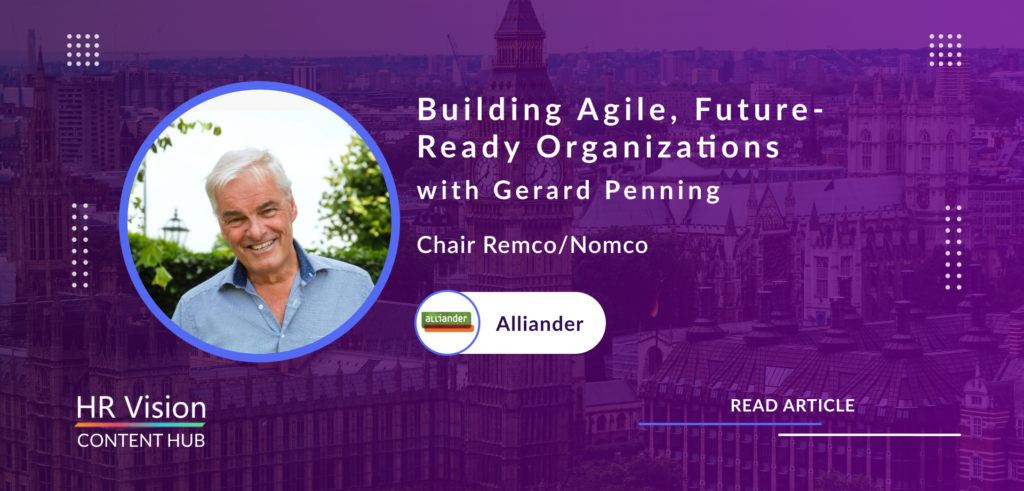
- At Alliander, you chair Remco/Nomco for 10,000+ employees. What’s the biggest talent challenge in a purpose-driven company?
It’s important to clarify that I’m not directly accountable for all 10,000 employees, that’s the CEO, Chief HR Officer, and their leadership team. As a non-executive director, my role is to hire and, if performance is poor, hold top executives like the CEO or CFO accountable. I also supervise everything the board does. In most modern companies, even the CEO has a “boss”, in this case, the non-executive directors, and I am one of those.
The biggest challenge is the sheer scale of growth. When I joined Alliander, the company had just over 5,000 people; today, it has 10,000, all in just four years. At the same time, capital investment increased from about 600 million euros to nearly 2.5 billion, and will soon reach 3 billion. Rapid growth at this scale creates huge leadership and HR challenges. You need to maintain a skilled and capable culture, ensure safety performance, and onboard a large number of new employees who need time, training, and guidance to reach full effectiveness.
Another challenge is maintaining clarity of culture during this growth. Alliander is a utility company, we provide electricity and gas to people’s homes, which is a fundamental service. Mistakes can have serious consequences, especially since utilities are sometimes targeted in crises. The company faces constant pressure from politics and the public, and stretching the organization too thin can lead to errors with real human impact.
The solution is a combination of training, culture, and integration. You need to educate thousands of employees, not only practically, through technical and safety training, but also by instilling the company’s values and culture. People need to understand what Alliander is about, why we exist, and what we stand for. That is especially important in a purpose-driven company, where alignment with the mission influences motivation, engagement, and ultimately performance.
Managing this successfully across thousands of employees is hard, but it’s also incredibly rewarding. It requires focus, consistency, and leadership commitment, and it’s what keeps me engaged and challenged several days a week.
- You’ve seen HR evolve dramatically. What part of HR will look completely different in 10 years?
AI will significantly change HR and many jobs. In the short term, roles focused on administration or data processing — like scheduling, arranging meetings, paralegals compiling case data — will be automated. Tasks that once took hours can now be done in minutes. That’s a like-for-like shift.
In the longer term, some job categories will be fully replaced by AI. But new jobs will also emerge where humans work alongside AI, doing things that weren’t possible before, and at a fraction of the previous time or cost. For example, planning a complex trip for multiple people could now be done in half an hour with AI support, instead of half a day.
The challenge for HR is readiness. Most HR departments today don’t understand AI or its longer-term business impact well enough to make informed decisions. HR leaders need to understand AI to plan strategically, anticipate changes, and prepare their workforce for scenarios 5–10 years ahead.
Looking further ahead, as AI increasingly automates tasks, the big societal challenge will be meaningful employment. Even as humans are still needed in essential roles — like healthcare or services — we must rethink work so billions of people continue to have purposeful, engaging roles. Otherwise, history shows that a lack of perspective can have negative social consequences.
- You mentioned that AI will influence the number of employees. How do you think it will affect the number of job vacancies?
In the short term, AI will create new roles — writing good prompts, curating AI content, or evaluating AI outputs, because AI often gives answers that aren’t fully accurate. Experts are still needed to verify and decide what’s useful.
In the longer term, AI could impact 10–30% of jobs that don’t have immediate substitutes. But predicting the future is tricky — pandemics, conflicts, or geopolitical shifts can change job markets quickly. For example, in Germany, many manufacturing jobs are shifting from automotive to defense production, something few would have expected five years ago.
The hope is that technology will solve problems humans haven’t been able to, improving medicine, services, and goods for people who need them most. There are challenges, but I remain optimistic. Instead of focusing on risks, it’s better to look for opportunities and silver linings to make things better. We truly live in interesting times.
Ready to navigate the future of work shaped by AI, agility, and evolving HR practices? Join us at HR Vision, where top HR leaders will explore the latest trends in HR, talent management, and HR technology, and discuss how to create a people-centered, future-ready workplace.