The afternoon of day 2 gave the opportunity to share learnings in smaller groups and offered two closing keynotes. In this third article, I will share with you my take-aways from the afternoon. I first attended two group sessions on Employee Experience (EX) and then the closing keynotes. Buckle-up, this will be a long ride. Hope you enjoy my take-aways.
EX is a mindset, not a strategy
First I participated in a group discussion on Employee Experience (EX). It was kicked off by Georgiana Chiper of Kincentric introducing her colleague Jenny Merry for a deep dive in Employee Experience. She raised the question: is Employee Experience just the Latest Fad? We had a lively conversation on EX that it is all about how culture and engagement come to life…(or not) …across moments that matter.
One of the participants had a great example. She explained that bias remorse kicks in after 2 months when you leave the company and start a new job. She told a story about an employer sending staff that left a bag of ‘Forget me not’-seeds after two months with a message ‘have you forgotten us? We haven’t forgotten you, so if you want to come back… ‘. And 30 % of the people came back. Keep it simple and keep doing it.
Then we elaborated a bit on customer experience (CX) versus employee experience (EX). Customers are looking for individualised experiences. How do you organise that for employees? Jenny shared her insights from Kincentric that they started to see and believe that it is about additional individual 1-on-1 experiences. EX is about moments that Inspire, Elevate, Connect or Remove friction.
Typical pitfalls were then shared:
- Get the “digital experience” really rocking by throwing all latest technology apps at employees.
- 8 out of 10 organisations are struggling with effective technology implementation.
- Failing to understand and manage the culture that EX represents.
Interesting facts:
- 84% of the market value of the S&P 500 is in the form of intangible assets – these intangible assets are created by people, or are people themselves.
- 27% of employers are currently effective in igniting employee behaviour change that leads to greater individual and organisational success. Room for improvement…
Then she showed us some figures about how extraordinary organisations unlock the power of their people compared to average organisations. Especially around the question who is responsible for delivering the EX?
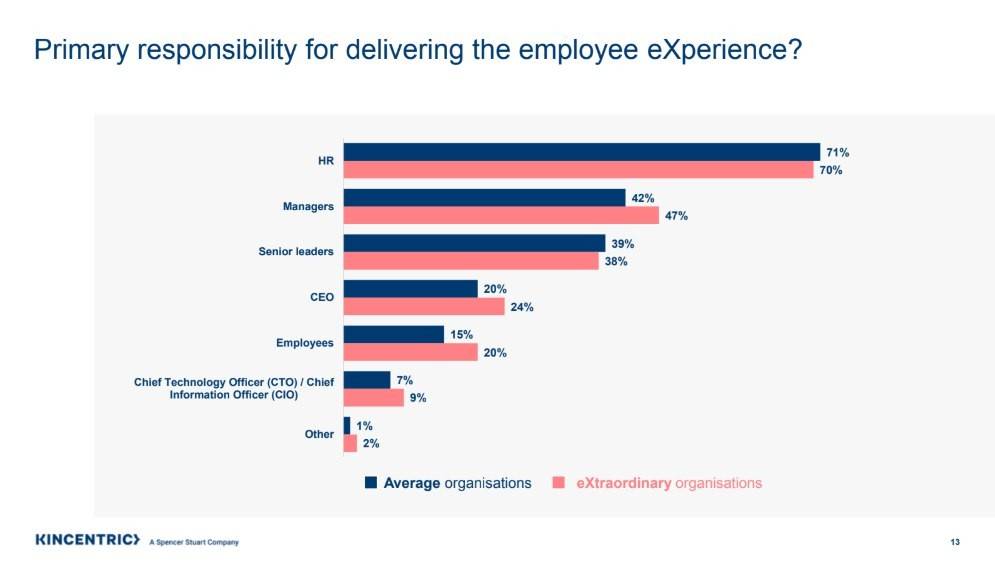
My take-away: there is not such a big difference in figures of average and extraordinary organisations. My conclusion on this is not to over-engineer employee engagement initiatives. Stay authentic and real. Just act like humans, appreciate each other, it’s a mindset. Don’t judge, respect different opinions. This actually has a lot to do with inclusiveness, equality and human interaction. Less ego, more connections.
But we all concluded you got to have the basics, the hygiene factors in order. Think about IT systems people have to work with or operational processes. If you have the intention to make it work for people and listen to what they need, you can focus your money and energy on the right things to get this basics in order. And for the rest: just treat people the way you would like to be treated. Just do it!
Empowerment goes viral
Next up was Paul Deemer, head of diversity and inclusion at NHS Employers. NHS is actually the fifth largest employer of the world. NHS Employers is an organisation which acts on behalf of NHS Trust in the National Health Services in England and Wales. It was formed in 2004 and negotiates contracts with healthcare staff on behalf of the government.
Because they are such a large employer they have a lot of data on what drives people. With 1.7 million staff they got half a million response on their Employee Engagement Survey. This showed a huge gap in what staff tells them formally and in an anonymous survey. Especially on diversity figures, like disabilities. We had some great conversations on how diversity can move to differences being an advantage. Empowering people to be their authentic selves at work.
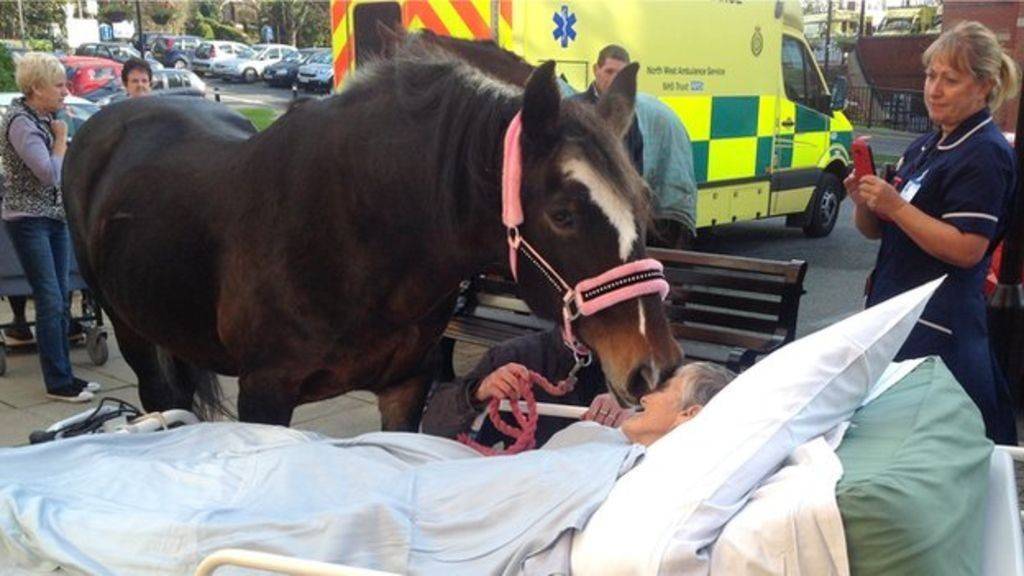
The story that I just have to share here was about how empowerment went viral. A patient Sheila told her nurse that she had a last wish before she died. This was seeing her favourite horse. The nurse felt empowered and just did it. She drove the bed to the parking lot where Sheila could have a last moment of contact with her favourite horse. The picture went viral and soon after this Sheila passed away.
Closing keynotes
The first keynote was from Valerie Hughes-D’Aeth on her last day as CHRO at the BBC. She shared her experiences with putting culture to work: the BBC’s journey of reinvention and the challenge of a company with almost 100 years of history. This means many legacy issues, history can be a strength and a challenge at the same time. According to her, there has never been a better time to be an HR professional. I have to agree with that.
BBC’s need for change is, of course, the fact that there are challenges from new competitors and shifting behaviour of their audience.
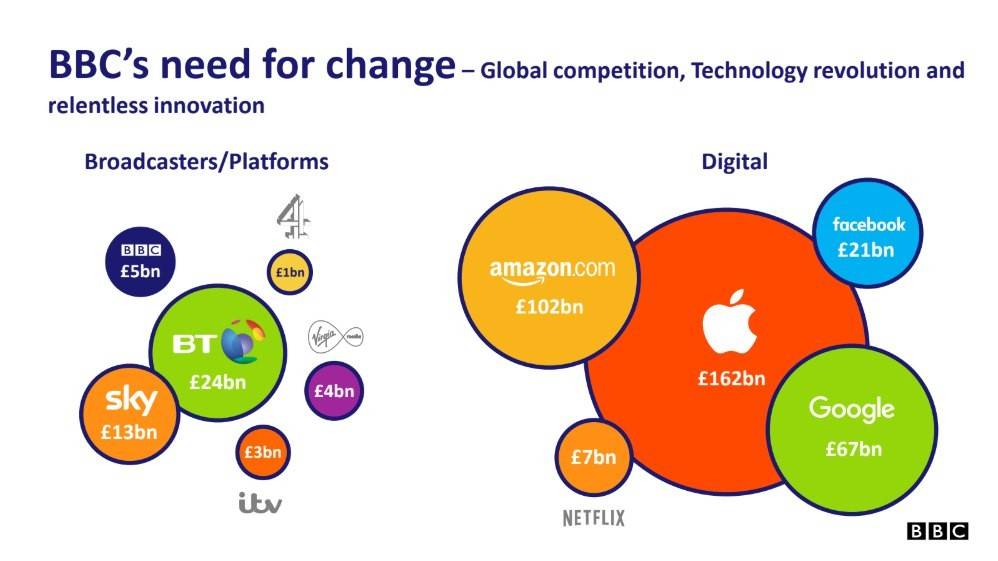
BBC’s answer to that was a new strategy and as people are the foundation of realising this, they created a People strategy with 4 pillars:
- Effective HR Support
- Organisation Design
- Workforce Planning
- Engaging in culture
This also called for a new HR Community. Originally people started working in HR because they like working with people. But this needs to shift to people who like working with people things: future HR skills need to be developed like technical skills, analytics, data, reward, etc.
Organisation Design
I liked to hear that HR BBC takes their role in Organisation Design seriously. Valerie showed us how HR was working on this. What are your principles? What is the most logical way to organise? How many layers of management do we need?
E.g. The strategy is to spend money on content instead of support. This has to do with the actual work, how do you organise in a way that people can actually spend time on the right things? How do you build a career framework that actually is about the work and with that framework being used, you have the data to see how many people work on which kind of jobs and does that make sense?
Built, buy, bot
Apart from design, you need the right workforce, and nowadays, this is not just about make or buy. It is about what is the right mix in your workforce between building your own workforce, hiring (buy flexible) and bot (robotising). And of course, the answer needs to be part of the social context and labour market in your country and your beliefs as an employer.
Culture is key
Once the right mix is onboard, culture is key. BBC wants to be the best place to work for everyone. They understand that this means finding a way to make the work interesting and purposeful for everyone. They link strategy to personal objectives by values and employee commitment. How did they start? In teams, people came together to watch a video of the CEO on the strategy and then each team had a group discussion on what that means for their own work.
There are still many challenges for the BBC, but they are on the right track towards really engaging people to work for them and unleash their creativity to create interesting content for their audience.
Future of work
HR Vision is not complete without a speaker on the future of work. The last keynote was from Kate Barker, HR Futurist at NEOM. She talked about the workforce of the Future and how culture is being re-imagined in the digital age. She kicked off with a video on the future of work by Jacob Morgan.
She explained that the 4th industrial revolution gives impetus to transform HR operating models and ensure HR is enabling business growth and provides the right (digital) experience to her customers. She shared some figures on shortages versus growth in jobs. Creative jobs ask for human and soft skills, while other tasks can be robotized. Fact is that technology gets more accurate than people in face recognition: 99,7 % accuracy by technology versus 77,9 by humans. The current complexity is already overwhelming and the gig economy and the sharing economy will add on the complexity. The gig economy is growing but the reason is shifting. This rapid change and disruption demands a new organisation culture.
Where did all the people go?
An interesting slide was about the 3 biggest companies 20 years ago compared to now and the difference in revenues versus the number of employees. Where did all the people go who worked in manufacturing plants? Did they reinvent themselves, becoming Uber-drivers and delivery clerks? But they have to learn new skills if we go into self-driving cars and drones. And this will go on and on and on in a much quicker pace than a 20 years timeframe.
Trends to act upon
I liked the 3 emerging trends to watch that Kate shared, and the fact that most organisations do not seem to really be focusing on this, apart from probably talking about it ;-):
- Longevity Dividend – investing in your workforce – create roles for older people (only 16% have a plan about how to create roles for older workers).
- The workforce ecosystem – workforce unleashed (only 16% of organisations have a well-defined strategy to deal with the hybrid workforce)
- Leadership for the 21st century – transparency is key to building trust in business.
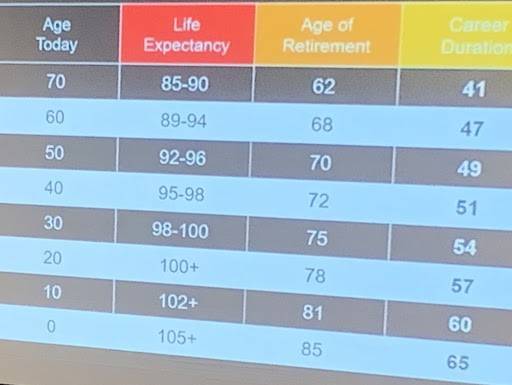
The first one struck me the most and I actually saw a lot of older people working in the UK, also in the venue of the conference where they provided us with coffee and lunch and they really seemed to enjoy their work, being still part of society. As in many countries people of old age get sad and lonely, keeping them at work in a way that fits their age makes perfect sense, but I still see the ease with which we say goodbye to some really talented older co-workers. The following slide which is extracted from the book ‘The 100-year life’ from Gratton and Scott, might help you to wake up:
So, what do we need now?
Kate ended explaining the third trend with some bad and good examples of leaders to build trust by walking the talk. In the past 20 years, unfortunately, we have seen more bad than good examples, but my gut feeling says that the new generation of leaders will flip the chart. What we need is to start working on a Symphonic C-suite according to Kate and I like that thought. A culture of connecting and collaboration starts by doing the right thing at the C-suite level. Even though we see people working together despite bad examples, still it is toxic and hard to stick as part of the culture if leaders don’t walk the talk. She shared some facts that show we still have a long way to go:
- 85% of executives rate C-suite collaboration as important, with 51% saying it’s very important.
- 73% said their C-suite leaders rarely if ever work together on projects and strategic initiatives.
- 54% said their companies are not ready or only somewhat ready for the level of collaboration needed to drive their enterprise in the future of work.
So, I guess HR needs to shift to being the connectors of humans on all levels?
The final closing of or chair Steven was that it all comes back to talents and the fact that we are humans. Technology is great, but it is the human factor that makes the difference. HR is all about understanding and listening. Listening to understand. And…we are more similar than different. Look for the human connection!