It’s Thursday evening, your Slack channels have gone quiet, and your team is already off hiking, volunteering, or simply unplugging—because Friday is the new Saturday. What once sounded like a Silicon Valley fantasy is suddenly being written into union contracts, national policy proposals, and CEO town-hall slides. A sweeping global appetite for mental-health safeguards and flexible work is forcing HR leaders to ask a once-taboo question: do we still need five full days to drive world-class results?
When people talk about a “four-day workweek,” they usually mean a 32-hour schedule with no cut in pay or productivity expectations. That’s very different from the older “four-tens” compressed model, which packs the same 40 hours into longer days and often leaves employees more drained than delighted. Think of the true four-day week as redesigning the job itself, not just tacking extra hours onto the calendar.
The Evolution of the Workweek
The first major break from six-day, 60-hour factory weeks came in 1926, when Henry Ford shifted to five eight-hour days—believing well-rested workers would be more productive (and have more leisure time to buy cars). Congress followed in 1938 with the Fair Labor Standards Act, capping the workweek at 44 hours (40 by 1940) and requiring overtime pay beyond that.

Fast-forward to today’s digitally connected, knowledge-based economy: data from four-day-week pilots, results-only work environments, and “core hours” models consistently show that trimming or reshaping the traditional schedule doesn’t harm performance—it boosts it. Organizations granting employees greater control over when they work report higher productivity, engagement, and retention.
COVID-19 forced remote and flexible work, demonstrating that employees could maintain performance without rigid “nine-to-five” schedules. As workers now prioritize well-being and autonomy, a four-day week offers built-in balance and has become a key differentiator in talent markets.
What the Latest Data Tell Us
Four-day-week pilots around the world have moved beyond anecdotes, offering concrete data on how reduced hours impact revenue, burnout, and long-term adoption. Early results suggest that, with the right design and support, many organizations can maintain—or even improve—performance while boosting employee well-being. Below is a snapshot of recent high-profile trials and legislative proposals:
| Geography / Pilot | Key Findings |
| U.K. (61 orgs, 2024) | 35% average revenue increase 71% reduction in burnout |
| Germany (2025 pilot) | Productivity held steady or improved across industries |
| Spain (bill May 2025) | Proposal: 37.5-hour statutory week for 12 million workers |
| U.S. & Canada company pilots | 69% experience reduced burnout 42% have better ental health 37% see improvements in physical health |
These snapshots illustrate how different contexts—from voluntary company pilots to proposed national legislation—are testing the four-day concept. In the U.K., more than 90 percent of participating organizations chose to make the shorter week permanent after seeing both financial upside and significant burnout reductions.
Meanwhile, Spain’s May 2025 legislative proposal aims to redefine a full-time week at 37.5 hours, putting 12 million workers under a shorter statutory baseline. Collectively, these data points have shifted four-day weeks from experimental curiosities to legitimate strategic considerations for HR leaders worldwide.
HR & Business Upsides
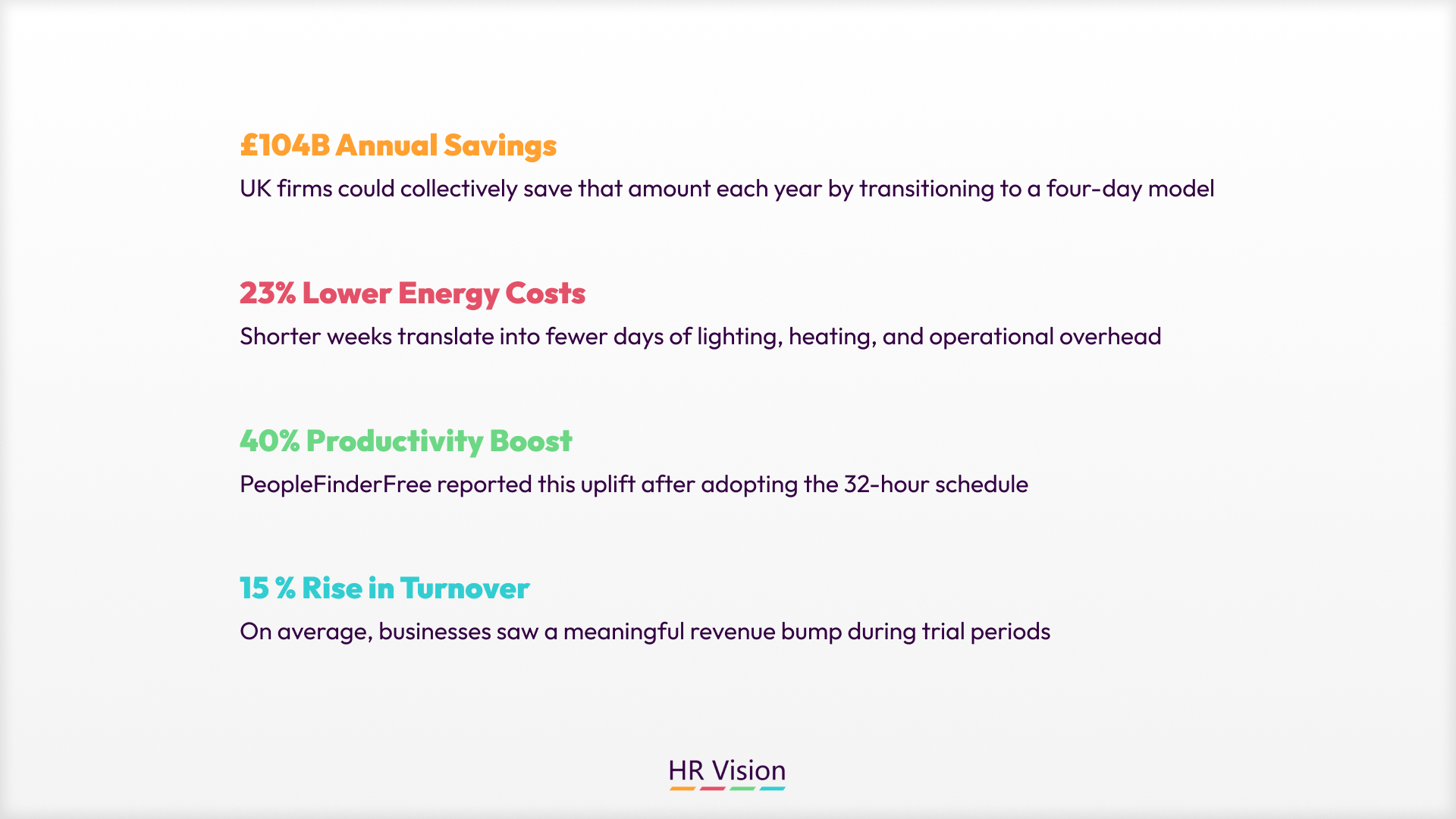
Organizations embracing a four-day week consistently report that focusing on output rather than hours drives stronger performance. In multiple trials, employees completed their usual workloads in about 80% of the time, translating into clear productivity gains. For example, Eden Cheng’s company, PeopleFinderFree, saw a 40% boost in productivity, while the 4-Day Week Global report noted an average 15% rise in company turnover during pilot programs.
Beyond revenue, reduced hours can sharpen focus. When employees know they have fewer days to deliver, meetings become tighter, priorities clearer, and decision cycles faster. In the U.K. trial, organizations discovered that cutting one weekday didn’t hamper output—it often accelerated it.
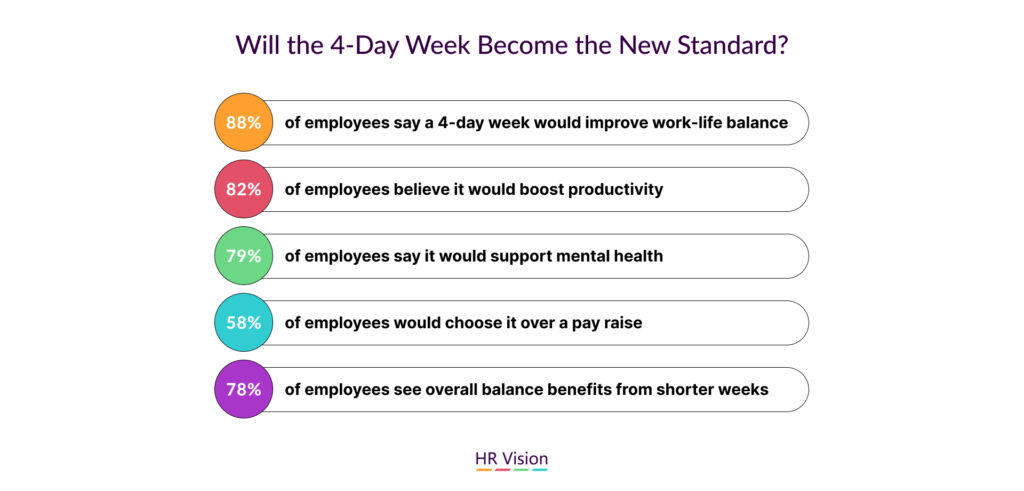
Reducing the workweek also yields powerful engagement and retention benefits. Studies show that 58% of employees would swap a salary increase for a four-day week, signaling how much value they place on extra downtime. In trials, organizations slashed turnover by 57% and saw sick leave drop by 62%—clear evidence that happier, healthier employees stick around longer. Moreover, stress levels plummeted: in the U.K. pilot, 39% of participants reported significantly lower stress, while average mental-health scores climbed from 2.95 to 3.32.
Finally, the environmental and employer-branding upside is substantial. With a four-day week, companies see roughly a 23.1% reduction in energy and operational costs, and 66% of employers report overall cost savings. Beyond the bottom line, marketing a four-day schedule can differentiate an employer brand—positioning the organization as progressive, employee-centric, and eco-conscious. In competitive talent markets, that positioning can pay dividends in attracting top candidates who prioritize both purpose and balance.
The Not-So-Hidden Challenges
- Work Intensification & Schedule Compression
While a shorter week can yield well-being gains for many, compressing tasks into fewer days often means a faster pace and less downtime. In pilot studies, some employees report heightened stress as they rush to meet the same deadlines in four days that previously spanned five. For example, a recent analysis found that 16.7% of participants said their stress increased when forced to “fit work into a tighter schedule,” even as 32.4% reported reduced stress overall—highlighting that not every role or individual adapts seamlessly to compressed workflows.
- Sector and Role Suitability
A four-day, 32-hour model depends heavily on job function. Hourly, customer-facing, and 24/7 operations (e.g., retail, healthcare, manufacturing) often struggle to condense coverage without incurring overtime or hiring extra shifts. Conversely, knowledge-based or project-driven teams (e.g., software development, marketing) can measure output by deliverables rather than hours—and thus may adapt more readily. HR leaders must assess which roles truly benefit from reduced days versus those requiring continuous or unpredictable staffing.
- Legal & Compliance Hurdles
Navigating labor laws is critical when moving to a four-day week. In the U.S., a compressed schedule (e.g., four ten-hour days) can trigger daily or weekly overtime for non-exempt employees, and exempt staff must still meet minimum salary thresholds. Unionized environments—such as Germany’s IG Metall negotiations—often require collective bargaining to secure reduced hours at existing pay rates. Elsewhere, country-specific rules add complexity: Belgium’s system lets workers bank “voluntary overtime” as compensatory leave, while California’s recent AB 2932 proposal (though not passed) would have redefined overtime pay to begin after 32 hours, potentially raising costs for employers.
In short, HR must work closely with legal and finance teams to model how different schedules affect overtime, classification, and contractual obligations before launching a pilot.
The HR Perspective: How to Prepare
Implementing a four-day workweek isn’t just a scheduling change—it’s an organizational shift. For HR leaders, preparation is key to ensuring both business continuity and employee buy-in. Here’s how to lay the groundwork:
- Pilot Programs and Metrics
Start with a structured pilot in select teams or departments. Define clear success metrics—productivity, engagement, turnover, absenteeism—and compare results against historical benchmarks. Aim for a three- to six-month period to gather reliable data and account for seasonal variations.
- Communication and Change Management
Transparent, ongoing communication is essential. Launch with a clear message from leadership explaining the pilot’s purpose, scope, and expectations. Support middle managers with training on goal-setting and time management, and prepare FAQs to address common concerns. Weekly pulse surveys and feedback check-ins can help maintain momentum and flag issues early.
- Legal and Policy Frameworks
Work closely with legal counsel to update handbooks, clarify overtime policies, and ensure pay equity. Consider how changes will affect exempt vs. non-exempt status, part-time roles, and leave accrual. In unionized settings, engage representatives early and incorporate the pilot into bargaining conversations if needed.
- Employee Feedback Mechanisms
Continuous feedback is crucial. Use short, regular surveys and focus groups to capture qualitative insights. Monitor not just performance data, but how people feel about the shift—stress levels, work-life balance, and team dynamics. These insights will be vital in deciding whether to scale, adjust, or pause the initiative.
With the right structure, communication, and support, HR can lead the transition from “experiment” to strategic advantage—ensuring that both employees and the business thrive in a shorter workweek model.
Future Outlook
Governments are slowly moving toward shorter workweek policies—Spain, Germany, and California have all introduced proposals—but widespread standardization is still years away. In the meantime, private-sector adoption is likely to grow, especially in knowledge-based industries where talent competition is fierce.
Over the next 5–10 years, the four-day week may become the default expectation in progressive, high-performing workplaces. But it won’t be universal—many companies will adopt hybrid models, like four core days with flexible fifth days or rotating team schedules.
The future is flexible, not uniform. Personalized scheduling and output-based performance models are poised to reshape what “full-time” really means.
Conclusion
The four-day workweek offers compelling benefits: higher productivity, lower burnout, reduced turnover, and even cost savings. But it’s not without challenges—some employees experience compressed stress, not every role fits the model, and legal hurdles must be carefully navigated.
Still, what began as a trend is evolving into a serious conversation about how we define work in the modern era. With pilots showing strong results and employee demand rising, the question is shifting from if to how.
So now it’s your turn: Is your organization ready to adapt—and lead the change?
Curious how leading organizations are redesigning work for a shorter, smarter future? Join us at HR Vision. Learn from top HR leaders about the future of work and the evolving trends in HR.