


One of the most profound changes in recent years is the integration of automation into various facets of business, including Human Resources. HR automation process refers to the use of technology, such as software and artificial intelligence, to streamline and optimize various HR processes. This transformation of traditional HR practices is reshaping the way companies manage their most valuable asset – their workforce.
What Is Automation in HR?
Automation in HR encompasses a wide range of technologies and tools designed to simplify and expedite HR tasks. From recruitment and onboarding to performance management and payroll processing, HR automation processes leverage advanced tools and software solutions to reduce manual efforts, minimize errors, and enhance overall organizational productivity. These technologies include, but are not limited to:
- Applicant Tracking Systems (ATS): ATS software helps organizations manage and streamline the recruitment process by automating job posting, resume screening, and candidate communication.
- Onboarding Software: Onboarding automation tools assist new employees in completing essential paperwork, orientation, and training, reducing the administrative burden on HR teams.
- Performance Management Software: Automation in performance management allows for real-time feedback, goal tracking, and data-driven evaluations of employee performance, making the process more effective and transparent.
- Payroll and Benefits Administration: HR automation simplifies payroll calculations, tax compliance, and benefits management, reducing the likelihood of errors and ensuring timely disbursements.
- Chatbots and Virtual Assistants: Chatbots and virtual assistants are being used to answer frequently asked HR questions, offering immediate support to employees and candidates, even outside regular business hours.
Predictive Analytics: Advanced data analysis and machine learning algorithms enable HR professionals to make more informed decisions regarding workforce planning, talent acquisition, and employee engagement.

The Benefits of Automation in HR
Every business can benefit from HR workflow automation, and the statistics underline this imperative. Research indicates that a staggering 80% of organizations are projected to embrace intelligent automation by 2025. This means that every company that wants to remain relevant and future-proof is automating its workflows.
Moreover, the commitment to automation is palpable, as more than 80% of organizations have plans to increase their investments in automation solutions. Automation is becoming an indispensable tool for HR professionals as it offers a multitude of advantages that extend far beyond mere operational efficiency.

Automation in HR delivers a myriad of benefits, from operational efficiency and enhanced accuracy to substantial cost savings and improved recruitment and onboarding processes. Employee self-service portals further strengthen the connection between HR and employees, fostering a more responsive and collaborative work environment. Embracing and maximizing the potential of HR automation processes is crucial for staying ahead in the evolving world of HR management. While automated HR processes can provide substantial benefits, organizations must strike a balance between automation and maintaining a human touch in certain aspects of HR.
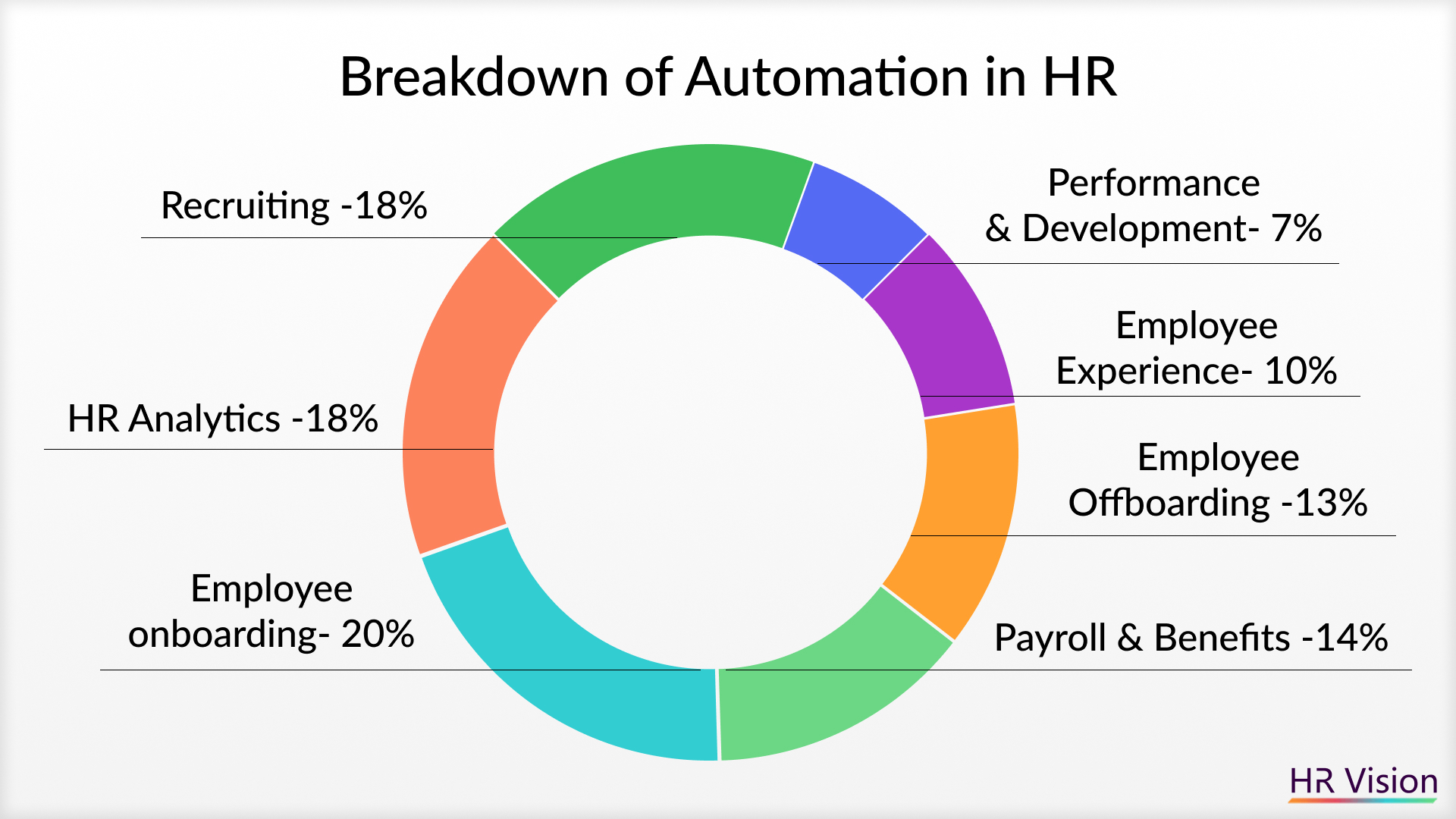
Breakdown of Automation in HR
A key aspect of this transformation is the breakdown of automation across various HR functions. Understanding how automation is being utilized in HR is crucial for organizations aiming to remain competitive and adaptable in this digital age.
HR Workflow Automation
One of the primary areas where automation is revolutionizing HR is in workflow management. Traditional HR workflows often involve a multitude of manual and time-consuming tasks, such as resume screening, interview scheduling, and onboarding processes. Automation technologies, powered by artificial intelligence (AI) and machine learning (ML), are reshaping these workflows by introducing speed, accuracy, and scalability. The automation of HR workflows represents a paradigm shift in how organizations manage their human capital. As organizations continue to recognize the transformative potential of technology in HR, the adoption of automated HR processes is becoming increasingly prevalent in the modern workplace.
Automation in Recruitment
Recruitment is a fundamental pillar of the HR function, and the integration of automation has revolutionized the way organizations attract, assess, and onboard talent. By leveraging various HR automation process tools and technologies,, HR professionals can streamline the recruitment process, identify top talent more efficiently, and make data-driven decisions for optimal candidate selection.
- Applicant Tracking Systems (ATS)
Applicant tracking systems (ATS) enable HR teams to manage the entire recruitment process, from job posting and candidate sourcing to interview scheduling and offer management. ATS solutions help streamline the application process, ensuring that candidate data is organized and easily accessible. They also facilitate collaboration among hiring managers and recruiters, allowing for a more efficient and transparent hiring process.
- Resume Screening and Matching
Automation has significantly expedited the resume screening and matching process, enabling HR teams to sift through a large volume of applications more efficiently. With the help of AI-powered algorithms, ATS can automatically scan resumes for specific keywords, qualifications, and experience, matching them with the requirements outlined in the job description. This automated screening process not only saves time but also ensures that recruiters can focus their attention on the most qualified candidates, improving the overall quality of the candidate pool.
- Interview Scheduling and Assessment
Gone are the days of back-and-forth emails and phone calls to schedule interviews. Automation has streamlined the interview scheduling process, allowing candidates to choose interview slots based on their availability and the hiring team’s schedule. Automated interview scheduling tools can send calendar invitations, and reminders, and even conduct virtual interviews, making the process more convenient for both candidates and hiring managers.
Key Automation Statistics in Recruitment
- Recruiting automations have risen in adoption by 316% year-over-year (YoY).
- In a survey of over 1,000 millennials, 93% said that a company having up-to-date technology is an important aspect when deciding to accept or reject a job offer. (Frevvo)
- 45% of HR professionals believe automation will make their job better in the future specifically for recruitment. (Jobvite)
- Automated offer letter creation is the most popular use case, owning a 33% share of all recruitment automation.
- Interview scheduling saw the biggest rise—YoY—of any recruitment automation, at 1,000%.
- 25% of organizations use HR automation, primarily for recruitment.
- 69% of HR professionals using automation in hiring greatly reduce time spent on the process.
Automation in Employee Onboarding
Employee onboarding serves as the initial touchpoint for new hires, shaping their early experiences within the organization. With the integration of automation, the onboarding process has undergone a significant transformation, allowing organizations to provide a seamless and engaging experience for new employees.
The use of onboarding software has simplified the completion of essential paperwork and documentation, reducing the administrative burden on HR teams and new hires alike. Automated onboarding platforms guide employees through the necessary forms and processes, ensuring that all required information is accurately and securely collected. This not only expedites the onboarding process but also minimizes errors and ensures that new employees have a smooth transition into the organization. Additionally, these platforms often provide interactive modules and videos that introduce new hires to the company culture, policies, and procedures, fostering a deeper understanding of the organization’s values and expectations.
Furthermore, automation in employee onboarding has facilitated the provisioning of access to essential systems and tools. By automating the setup of accounts and permissions for various software and communication platforms, organizations can ensure that new employees have the necessary tools and resources readily available from the onset. This streamlines the integration of new hires into their respective teams and departments, enabling them to be productive and collaborative from their first day. Moreover, automated provisioning minimizes the risk of delays or errors in the setup process, contributing to a more positive and efficient onboarding experience for new employees.
Key Automation Statistics in Employee Onboarding
- Onboarding automations make up 20% of all HR automations.
- 36% of HR professionals reported their onboarding processes are hindered due to a lack of onboarding automation.
- 18% improvement in performance is reported due to the use of HR automation for onboarding.
- Companies that do use HR automation said their onboarding process was 67% faster.
- Automating onboarding resulted in a 16% increase in new hire retention.
Conclusion
Automation in HR is more than a mere technological upgrade; it is a transformative force reshaping the entire HR workflow landscape. With the power to improve efficiency, accuracy, and cost-effectiveness, automation optimizes HR processes, making them more agile and responsive to evolving business needs. Moreover, by harnessing data-driven insights and predictive analytics, HR professionals can make smarter, more strategic decisions, ultimately contributing to the organization’s success. The introduction of automation in recruitment and employee onboarding has created a more efficient, candidate-centric experience, setting the stage for positive, long-term employee relationships. Embracing HR workflow automation is a key strategy for organizations seeking to streamline their human resources operations and stay competitive in today’s dynamic business environment.
Are you ready to be at the forefront of the transformative HR landscape? Join us at HR Vision, where top HR leaders gather to explore the future of work, HR trends, and the power of HR analytics and technology.


