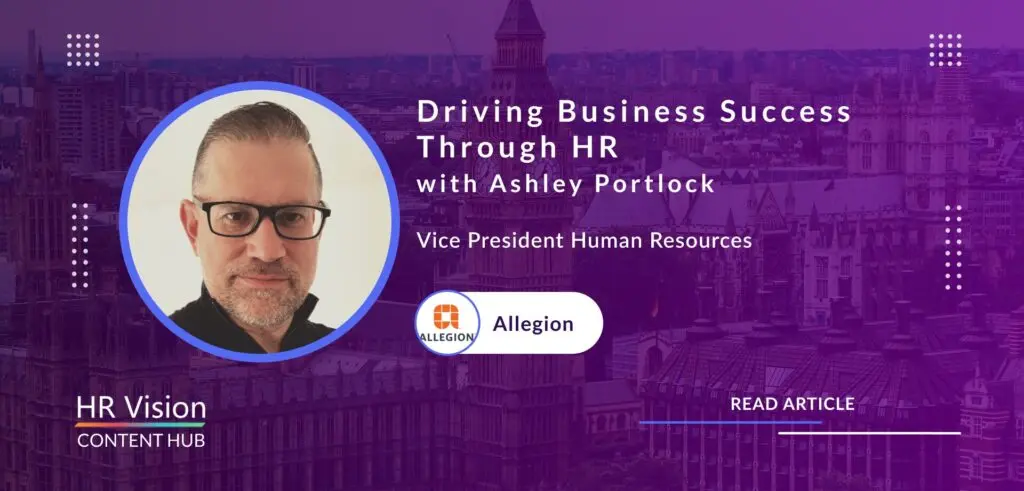
- With your extensive experience in senior international HR roles, what key qualities do you believe define a successful HR leader in today’s global market?
Many qualities that make for success in HR leadership are the same today as they were when I began my career (many years ago!). Not least, combining a people-centered approach with business acumen and a willingness to take risks remain as important today as they ever were. Technology and related trends create a world of ever-great ambiguity – being curious and open-minded is helpful and the ability to ask the right questions is more powerful than knowing the answers.
- You have a proven record of delivering world-class HR solutions. Can you share a specific example where your HR strategy significantly impacted business performance?
Within Allegion, our approach towards building culture through strong values and engagement are hugely impactful to our business performance. A specific example of this is our ability to retain high-performing talent where our data informs us that we retain high performers at roughly double the level of comparable organisations. We know this is largely attributable to the employee experience we promote and maintain, its impact on the bottom line may not be quantifiable but we know it is significant.
- You are known for delivering financial results through effective HR practices. What advice would you give to HR professionals looking to demonstrate their value to the financial bottom line?
It is great to look for metrics and data that will show a bottom-line impact from HR activities – but be careful not to over-complicate this. Often the link is too indirect to prove cause and effect in a way that is really data-driven and we should not be afraid of tackling the argument that doing the right things will bring us the right outcomes. Try to frame all your activities in the context of their strategic impact on the organisation’s objectives. Most importantly, the more we act and talk as business leaders first and HR leaders second the more credibility we have when we are asking business leaders to “go with us” on something.
- As a high-performing leader, how do you foster a culture of collaboration and communication within diverse teams?
To be honest, I feel like it is much the same as you would do it for any team. Build trust, be positive, make it safe, make it fun and bring people together at every opportunity. In some ways, doing all this in a diverse team is more effective – there are more natural moments to celebrate and appreciate each other.
- In the context of international HR, what strategies do you implement to manage cultural differences and ensure inclusivity?
For us, focusing on building a culture that is inclusive is the critical thing. I have been in organisations that push outcomes or metrics on diversity but in a truly diverse setting you soon realise that inclusion manifests in different ways for different people in different places. It is great to build awareness and skills in some of the obvious enablers towards inclusivity, e.g. bias mitigation, but in the end encouraging people to do what brings it to life at a local level is the winning approach. As leaders, it needs to be part of what we are and how we show up every minute of every day.
- Having navigated various HR landscapes, what emerging trends do you foresee shaping the future of human resources?
I believe the proliferation of generative AI is the most profoundly impactful thing that will shape the profession in all the years I have been working. Over a period of time into the future, the workplace will be fundamentally changed by this technology in the same way as it was by the Industrial Revolution. For all the uncertainty and potential threat this presents, I choose to embrace it as our biggest opportunity – I do not know the answers but I am challenging myself to explore the right questions, and fast!
- What are some best practices you recommend for implementing effective change management within organizations?
The single biggest success factor I have seen is the ability of leaders to live the change, “walk the talk” as one might say. Our challenge as HR leaders is to encourage our leadership colleagues to see where people need to be met where they are and understand how change will impact different people in the organisation, ideally enabling us to construct the “what’s in it for me” story. Once we understand that, keeping in mind that repetition and reinforcement of the message beyond the level you could possibly imagine would be appropriate is the only way it will cut through. Stay the course, stay calm in the face of problems, and keep looking forward. As leaders, always remember that your actions will inform people of your real intentions irrespective of what you are saying.
- How do you ensure that your HR strategies are not only innovative but also sustainable in the long term?
By sticking with them. Napoleon Hill famously advised in his book “Think and Grow Rich” that the most successful people make decisions quickly and change them slowly. When I am working in HR strategy, I like us to commit to ourselves that we will run with a strategy for a period of time irrespective of results. Of course, there are occasions when we have to adapt or course correct but too often I have seen organisations lose nerve too quickly when pursuing a strategy to give it a chance of being sustained. Ideas are great, but results take momentum and that takes time.
Ready to stay ahead in the ever-changing world of HR? Join us at HR Vision, where top HR leaders gather to explore the future of work, HR trends, and the power of HR analytics and technology.