In today’s business landscape, the concept of a growth mindset has emerged as a fundamental principle for personal and professional development. The workplace is no longer a space solely for completing tasks but a dynamic arena where individuals and organizations strive for continuous improvement, innovation, and adaptability.
Understanding the Concept of a Growth Mindset
To comprehend the concept of a growth mindset, it is crucial to delve into the foundational work of Dr. Carol Dweck, a renowned psychologist and professor at Stanford University. Dr. Dweck’s research has been instrumental in shaping our understanding of mindset and its impact on individual development. Her groundbreaking work, particularly detailed in her book “Mindset: The New Psychology of Success,” has identified two distinct mindsets: the fixed mindset and the growth mindset.
Dr. Dweck’s research reveals that individuals with a fixed mindset believe that their abilities and intelligence are static and predetermined. They tend to avoid challenges and view failures as an indication of their innate limitations. On the other hand, those with a growth mindset believe that their abilities can be developed through dedication and effort. They see challenges as opportunities to learn and persist in the face of setbacks.
Characteristics of a Growth Mindset
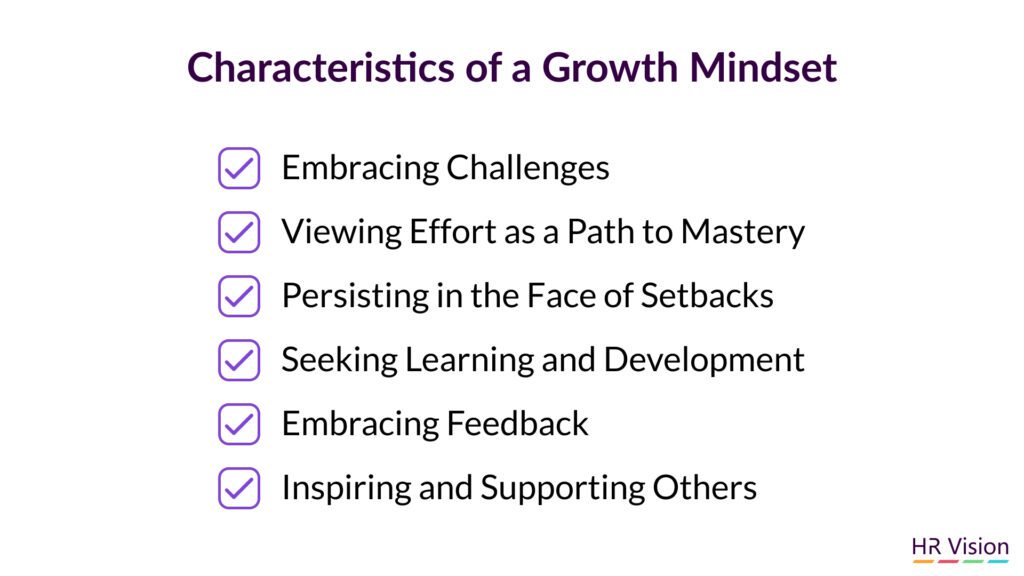
- Embracing Challenges: People with a growth mindset welcome challenges as opportunities for personal and professional growth by venturing out of their comfort zones.
- Viewing Effort as a Path to Mastery: Those with a growth mindset see effort as a means to achieve mastery, investing time and energy in improving their abilities.
- Persisting in the Face of Setbacks: A growth mindset fosters resilience; setbacks are viewed as temporary, providing opportunities for learning and adjusting.
- Seeking Learning and Development: Those with a growth mindset have a strong desire for continuous self-improvement, actively pursuing opportunities for growth.
- Embracing Feedback: Individuals with a growth mindset value constructive feedback, using it to enhance their skills and performance.
- Inspiring and Supporting Others: Those with a growth mindset inspire and support colleagues to cultivate a culture of learning, improvement, and mutual growth within their teams and organizations.
Fixed Mindset vs. Growth Mindset
A fixed mindset, in contrast, is characterized by a fear of challenges, avoidance of effort, giving up easily in the face of setbacks, and resistance to feedback. Those with a fixed mindset often find themselves trapped in a cycle of underachievement, as they believe that their abilities are predetermined and limited.
Here are some examples of fixed mindsets and growth mindsets:
Fixed Mindset Examples:
- An employee avoids taking on new responsibilities at work because they believe they lack the necessary skills and are afraid of making mistakes.
- An employee who, upon receiving negative feedback from a supervisor, becomes defensive and dismisses the feedback as unwarranted criticism, refusing to consider the potential for self-improvement.
Growth Mindset Examples:
- An employee who actively seeks out new challenges at work, even if it means stepping outside their comfort zone, as they see it as an opportunity to learn and develop new skills.
- An employee who, upon receiving negative feedback from a supervisor, reflects on the feedback with an open mind, acknowledges areas for improvement and actively seeks guidance and training to enhance their skills.
Strategies for Promoting a Growth Mindset in the Workplace
In order to foster a growth mindset in the workplace, organizations need to implement strategies that encourage individuals to embrace challenges, persist through setbacks, and continuously develop their skills and abilities. These strategies are not only essential for individual growth but also for the overall success and adaptability of the organization.
- Leadership’s Role in Cultivating a Growth Mindset
To cultivate a growth mindset, it is essential for leaders to lead by example. They should openly demonstrate a willingness to learn, admit their mistakes, and encourage their teams to do the same. When leaders show that they value and support a growth mindset, it sets the tone for the entire organization.
- Encouraging Risk-Taking and Learning from Failure
In a fixed mindset, people often fear failure and avoid taking risks. To promote a growth mindset, it is crucial to create an environment where calculated risks are encouraged, and failures are seen as valuable learning experiences. When employees understand that failure is a natural part of growth and not a mark of incompetence, they become more willing to take on challenging projects and push their boundaries.
- Providing Opportunities for Skill Development
Organizations should actively provide opportunities for employees to develop their skills and abilities. This can include offering training programs, workshops, mentorship, and resources for self-directed learning. By investing in the growth of their employees, organizations not only enhance their workforce but also convey the message that learning and development are highly valued.
- Offering Regular Feedback and Coaching
Feedback is a powerful tool for growth, provided it is delivered constructively. Regular feedback and coaching sessions can help employees understand their strengths and areas for improvement. It’s important that feedback is given in a way that encourages growth rather than discourages employees. Constructive feedback should focus on actions and behaviors rather than personal attributes.
- Employee Development and Training Programs
Organizations can implement structured employee development and training programs that align with their strategic goals. These programs should be designed to provide opportunities for employees to acquire new skills, expand their knowledge, and apply what they’ve learned in their roles. Such programs can include on-the-job training, workshops, courses, and certifications.
- Building a Supportive and Inclusive Environment
A growth mindset thrives in an environment where individuals feel supported and included. Building a culture of inclusivity, where diverse perspectives are valued and different learning styles are accommodated, is key to promoting a growth mindset. When employees feel safe to express their ideas and take risks, they are more likely to develop a growth-oriented outlook.
Interested in connecting with top HR leaders who are leading the way in fostering growth mindsets in the workplace? Join us at HR Vision, where we’ll delve into the future of work, including the latest trends in HR, talent management, and leadership.