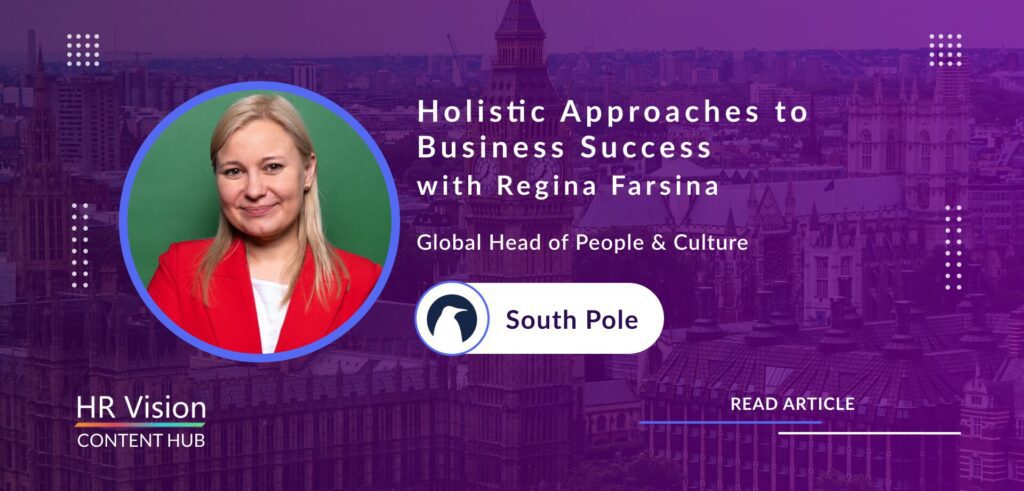
1. With your experience as the Global Director of the People Performance Solutions Center, could you share insights into how holistic frameworks contribute to business success?
At different stages of the organisational growth, you might need different approaches: solutions that allow for you to scale up faster, or tailor-made approaches to whatever the team/function needs right now/in the future to be fit for purpose. A rapidly growing organisation should first be able to have a holistic view of problems that they are trying to solve: what can we implement that will serve multiple businesses within the organisation in the same efficient way? What will contribute to us being compliant/consequent with whatever we do? Etc. An example could be when you have no bonus scheme and you create various schemes that don’t speak with each other or are even conflicting/confusing/ creating disparity, it won’t help. However, when you do have a strategy, you can then think of tailor-made solutions that will be in line with the frameworks that are a point of reference. The frameworks can help an organization be faster, more efficient, fair, transparent and they set clear accountability.
2. As a leader in driving employee experience initiatives, what key elements do you prioritize to create a positive workplace culture?
It’s a paradox but employees do expect a lot and at the same time they don’t really need much. One of the core basic principles I am a fan of are simplicity in the processes related to their employment, transparency, and showing them that you listen as an employer and that you at least more often than not do the way they suggest. I think that on a higher level of Maslow’s hierarchy of needs, transparency becomes dominant when it comes to their desire to stay with the organisation.

3. In your opinion, how does investing in People & Culture initiatives correlate with boosting company profitability?
We live in the moment when people don’t work for salaries anymore. They want more, and this ‘’more’’ means investing in them on all fronts: be it development, well-being support, giving them an inspiring manager, talking to them. When we do it, they are happy, when they are happy, they stay and they contribute and if all goes well – they outperform because they love this place. Ultimately, the point we want to bring them to is to outperform and be their best self, be the ambassadors to the organisation, which means they ‘’create’’ the next generation or external pipeline to the people who will be considering (or not) to join your company in the future to keep that loop of contributing to the profitability growth.
4. Having kicked off the establishment of the solutions centre focusing on core business needs, what advice would you give to HR professionals striving to align their strategies with organisational goals?
Listening to the business is key. In HR we’ve got the know-how, so I have seen many professionals who sometimes copy-paste from their experience in past organisations, but it will not necessarily solve the problem statement that you have at the table. Check-in with the business is another important element: are we on track? Is this what you were expecting? What will make our solution better / more user-friendly / more employee-focused? Asking for milestone feedback does not mean that we don’t know what it should look like, it means that we care that this product will not dust on the shelf but will truly create value.
5. With your extensive experience in talent management and development, what strategies have you found most effective in nurturing high-performing teams?
‘’It’s the manager’’ (This is a book written by Jim Clifton & Jim Harter if you are keen to read). It is truly the response to many dilemmas, employees choosing to stay or leave. Hence, investing in leadership is one of the core elements of success. A development program for the employee will mean nothing if they don’t discuss the follow-up with the manager and don’t see how the learning plays out in practice. A high-performer by nature does not need a micro-manager – it will not only boost their accountability and drive but bring down their motivation and interest. If a manager does not understand why they need to build a succession pipeline and doesn’t feel proud by threatened about it – the beautifully created PowerPoint slides won’t help you bring the ready-now succession to shine … so many facets to the role of a manager or a leader that we can talk about for hours.
6. How do you approach performance management in a global context, considering diverse cultural and organisational nuances?
I love the ‘’Culture Map’’ book by Erin Meyer – I did run a few workshops a few years ago to share how some cultures perceive feedback (among other things) which is instrumental in performance management in my view. We operate in 40 countries, so by default, some of our managers have a diversity density that they often haven’t experienced before. You have to flex your style and expectations as a manager when it comes to tracking goals and performance: in South Asia, it is typically ‘’normal’’ to do long hours, however, the availability of your colleagues in Asia does not mean that they are by default higher performers than employees in the Netherlands who prioritise their families after 6 p.m. It is still a challenge for many of our managers to master how to weave the cultural elements into the PM process because you need to try it out, fail, and learn, and in the People & Culture team we do appreciate this challenge.
7. In your experience, how crucial is it for HR to adapt to the evolving needs of a company, especially in sectors like climate investments?
Climate and sustainability in general is not an easy industry to understand for HR / other support functions’ professionals if you haven’t been in it for a while. Climate Investments is one of the pillars of South Pole as a company. From closing the deals perspective, the area is relatively slow and the industry lacks professionals who know the investment part, so attracting talent into climate investment is never easy. In the ideal world you would put effort into redeployment and re-skilling but this takes lots of time and effort and the competition is very high (including for our talent), so then you’d start looking into the compensation because this is what you’d want to have at the right level, etc. For smaller companies that represent climate investments, I imagine the pressure is even higher, so the employer value proposition should be strong to both attract and retain talent.
8. With your focus on leadership and culture, how do you foster leadership development within your organisation?
We have different leaders in the organisation which is quite a nice blend: those who have been around for a while, and those who joined the company in the hyper-growth period a couple of years ago. It’s interesting sometimes to see how some of the new joiners bring the ‘’wisdom’’ of being a good leader from other organisations which opens up room for peer-to-peer learning. We also have formal tools like leadership training for the senior leaders and group coaching. And this year we will be implementing a few signature programs for senior leaders to boost business acumen in many areas beyond their direct expertise.
9. Recently, Great Britain has introduced a pilot project of a 4-day working week. What’s your opinion about it? What advantages and disadvantages do you see both for employers and employees? Would you take part in the experiment, and why?
I do love the concept of it and if I have an opportunity to test it – I would do it. For the employees it may be well perceived as a benefit, especially considering that many employers are trying to bring employees back to the office – flexibility of how you structure your work to have 1 more day with your family / dedicated to your personal development and leisure, will cost a lot in the future. For the organisations, it is a great way to optimize the processes and make them more efficient, start creating the ‘’stop doing’’ activity list, etc. It’s not very hard to implement it in one country of business operation, however, the challenge of implementing it in an international environment (at South Pole we have around 40 countries where we operate) becomes more feasible. You may be opening a debate for discrimination if you go with a few countries only (subject to the best practice of labour norms etc). In consulting where the clients would hope to receive the support preferably without consideration of the working hours of their partner, it is critical to consider whether this is a model that could work well for both parties. Having multiple facets to it, it is not an easy-to-implement solution but definitely worth looking into it and trying to assess whether it can work for your organization – it will be a huge competitive advantage I believe.
Ready to stay ahead in the ever-changing world of HR? Join us at HR Vision, where top HR leaders gather to explore the future of work, HR trends, and the power of HR analytics and technology.