1. What’s a key lesson from your time as Head of Talent that significantly shaped your approach to HR leadership?
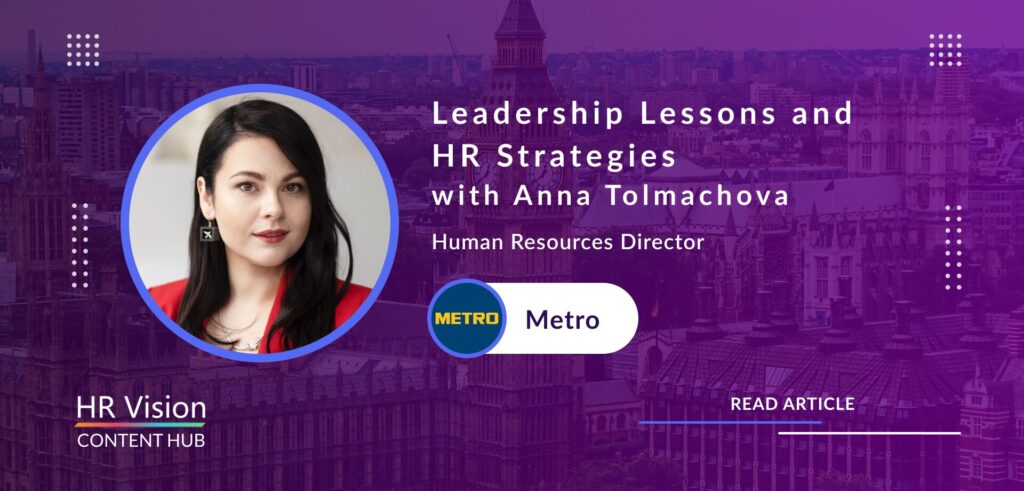
I worked for METRO Ukraine as Head of Talent one pandemic and one full-scale invasion ago. Or just 4 years ago. It was the biggest challenge in my 15-year career. I was lucky to overcome this challenge because after 4 years in this role, I learned the following lessons. The most important skill to invest in is personal resilience. Whatever your business goals are, whatever you are transforming, whatever is happening, resilience will make a big, sometimes even bigger difference to the organization. I am almost certain it will never be the key to success, but it can always be the reason for failure. Business acumen, strategic thinking, or digital competence will not save you from a never-normal environment and the “black swans”, you can only apply all your skills before you give up.
This lesson has shaped me as an HR strategist and leader and defined my leadership choices. I have learned to develop practices that put employee well-being at the center and find sustainable solutions.
2. What strategies do you find most effective in leading leadership and culture transformation within an organization?
Every organization faces this problem, but by no means everyone is successful. I have experienced both successes and failures, but what has worked for me in different organizations are 3 strategies applied in parallel to bring about change.
The first is the communication strategy. This starts with explaining the “why” and “what is this for me?” and continues with many more nuggets and tips along the way. Two-way communication, honest and inspiring messages offset resistance to change and provide both rational and emotional “food for thoughts”.
The strategy of influence. The sponsors, leaders, and a critical number of change agents are the first task on the transformation journey. I firmly believe that a team of influencers from different levels and corners of the organization plays an essential role in establishing new attitudes and behaviors. This strategy is closely linked to talent management, recognition, and reward practices.
The capability strategy. I intentionally leave out the word “learning” because very often organizations rely too much on traditional learning tools. Learning is never enough, because culture change requires new capabilities (processes, organizational design, tools, skills, attitudes, and metrics), not just knowledge. A new leadership and a new culture need the right space and the right business processes to come to life.
3. How do you balance business needs with creating a seamless and best-in-class employee experience?
I’m in the process of convincing the company that a first-class employee experience is a key business need. Too defiant? Exactly, but that’s the challenge that we as HR managers should overcome. It’s not up to us to influence EX directly, it’s up to leaders to be able to ensure the best rational and emotional EX and turn those experiences into performance and business results. I believe that EX comes first, and performance relative to business needs is a product of that.
4. What initiatives or strategies have you implemented to prioritize employee safety and well-being?
The well-being of our employees is at the heart of our corporate culture. We call it “care to dare” and for 7 years we have been fostering an environment in which everyone can take care of their physical, mental, financial, and social health. To achieve this, we have adapted the EVP, learning strategy, career management practices health and safety, recognition and compensation, as well as completely changed the leadership style in the organization to improve the secure base and empowerment. It’s not about one or two initiatives, but a comprehensive transformation of the HR and leadership structure that changes internal beliefs and attitudes and supports them with practices.
5. How are you navigating digital employee experience transformation and driving continuous improvement?
Digital transformation is an integral pillar of our strategy. For this reason, we have developed and introduced a framework for the digital capabilities of our organization, which explains the roles and skills we need for implementation. Based on this, everyone within the organization has their digital role, which is described by specific skills, responsibilities, and expected behaviors. Based on this framework, the learning ecosystem (we call it “Digit. All”) was created, where everyone can find the knowledge, skills, tools, guidelines, mentors, etc. to be ready for digital transformation. This end-to-end approach to digital transformation has facilitated the digitization of the employee experience itself, making it an integral part of the journey.
One of the biggest challenges in reskilling and upskilling the organization within digital transformation is the digital literacy of the HR department, which plays a leading role in this reskilling. Therefore, every HR employee must become the owner of EX-digitization, starting with training in technology, change management, and working with data.
6. What initiatives have proven effective in enhancing the skills and competencies of the HR team?
And again, it’s not about learning initiatives. One of the best impulses we had was to redesign the HR operating model to align it with the new business and HR strategy. We moved from Ulrich’s model to an EX-driven setup, and what I like most about it is that everyone on the team now has three parts to their role: the deep functional expert, the architect of the EX (or part of it), and an owner of the digital solution within the area of responsibility. The second booster for HR capability is the co-creation mode. Every initiative, HR product, or change is co-created to integrate seamlessly from the EX’s perspective. When it comes to new benefits, it does not mean that only the entire compensation team does something for it, but we connect it with other processes and products to stay holistic and ensure the synergy effect that multiplies the value for an employee. This helps to broaden everyone’s perspective and improve skills in design and critical thinking, project management, and customer insight.
The third point is being a role model. I and other leaders on the HR team should start with ourselves to proactively improve skills and then lead others to that goal.
Ready to stay ahead in the ever-changing world of HR? Join us at HR Vision, where top HR leaders gather to explore the future of work, HR trends, and the power of HR analytics and technology.