Workforce metrics play a key role in helping organizations understand their employees and improve their overall performance. These metrics provide valuable insights into how well an organization is managing its people and where improvements can be made. Two of the most important metrics in this area are retention and attrition.
Retention measures how well a company keeps its employees, while attrition tracks the rate at which employees leave. Together, these metrics give HR teams a clear picture of workforce stability, helping to identify potential problems and opportunities to create a better work environment.
Defining Retention Metrics
Retention metrics measure how well an organization is able to keep its employees over a specific period of time. These metrics are essential for understanding workforce stability and identifying the effectiveness of employee engagement and satisfaction initiatives. A high retention rate often indicates a positive work environment where employees feel valued and supported.
Purpose of Retention Metrics
The primary purpose of retention metrics is to:
- • Track the stability of the workforce.
- • Evaluate the success of HR strategies aimed at employee satisfaction.
- • Identify trends that could lead to higher turnover rates if left unaddressed.
- • Reduce the cost and disruption caused by frequent hiring and training.
How to Calculate Retention Rates
A common formula used to calculate retention is:
Retention Rate (%) = (Number of employees at the end of the period / Number of employees at the start of the period) × 100
For example, if a company starts the year with 200 employees and ends the year with 190 employees (after accounting for new hires), the retention rate would be:
(190 / 200) × 100 = 95%.
Factors Influencing Retention
Several factors impact an organization’s retention rate, including:
- • Job Satisfaction: Employees are more likely to stay if they feel fulfilled and appreciated in their roles.
- • Career Development: Opportunities for growth, training, and promotions play a significant role in retaining top talent.
- • Work Culture: A positive and inclusive workplace culture fosters loyalty and long-term commitment.
- • Work-Life Balance: Providing flexibility and understanding employees’ personal needs contributes to better retention.
- • Leadership and Management: Supportive and effective leaders often inspire employees to stay and grow within the organization.
Defining Attrition Metrics
Attrition metrics measure the rate at which employees leave an organization over a specific period of time. These metrics help organizations identify patterns in employee departures, which can reveal underlying issues that impact workforce stability and productivity. Tracking attrition is crucial for understanding turnover trends and developing strategies to address them.
Purpose of Attrition Metrics
The primary purpose of attrition metrics is to:
- • Monitor employee turnover and its potential impact on the organization.
- • Identify reasons for employee departures, whether controllable or uncontrollable.
- • Develop proactive measures to reduce avoidable turnover.
- • Evaluate the effectiveness of retention and engagement strategies.
Types of Attrition
There are two main types of attrition that organizations track:
- Voluntary Attrition:
This occurs when employees choose to leave the organization on their own. Common reasons include:- ○ Better career opportunities elsewhere.
- ○ Lack of engagement or dissatisfaction with the work environment.
- ○ Limited opportunities for career growth or development.
- Involuntary Attrition:
This happens when the organization terminates employees due to reasons such as:- ○ Poor performance or misconduct.
- ○ Restructuring, downsizing, or layoffs.
- ○ Changes in business strategy or operations.
Key Differences Between Retention and Attrition
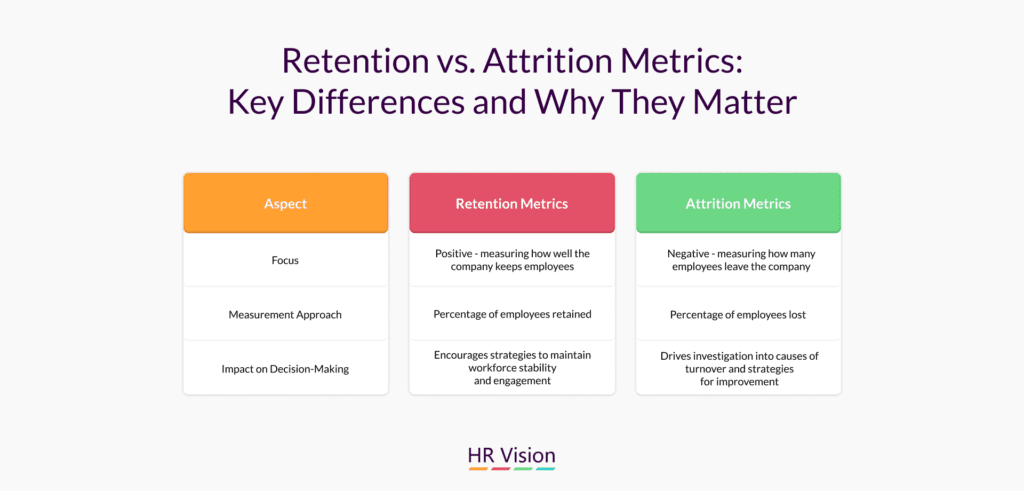
Retention and attrition metrics are two sides of the same coin but focus on different aspects of employee movement within an organization. Retention metrics focus on the positive side of workforce stability by measuring how well a company keeps its employees over time. In contrast, attrition metrics highlight the negative aspect, tracking the rate at which employees leave, whether voluntarily or involuntarily. While retention reflects the success of an organization’s efforts to keep its talent, attrition points to areas where the company may be losing employees, potentially due to dissatisfaction or external factors.
The way retention and attrition are measured also differs. Retention is typically calculated by determining the percentage of employees who remain with the company over a set period. It emphasizes the portion of the workforce that stays, thus providing a measure of loyalty and engagement. On the other hand, attrition is calculated by determining the percentage of employees who leave the organization, offering insights into the loss of talent. Both metrics are expressed as percentages, but retention emphasizes what’s retained, while attrition emphasizes what’s lost.
These differences have a direct impact on decision-making within HR. High retention rates may lead to strategies aimed at maintaining the status quo, reinforcing the factors that keep employees satisfied. On the other hand, high attrition rates may prompt HR teams to investigate the root causes of turnover, whether it’s poor management, lack of career growth, or competitive external opportunities. By understanding both metrics, HR leaders can make informed decisions to enhance employee engagement, address weaknesses, and ultimately improve overall workforce stability.
Why These Metrics Matter
Retention and attrition metrics play a crucial role in shaping an organization’s overall performance. High retention rates typically indicate that employees are engaged, committed, and aligned with the company’s goals, which often translates into better productivity, quality, and consistency. On the flip side, high attrition rates can lead to decreased performance as new employees take time to reach full productivity and existing teams may experience disruption. By tracking these metrics, organizations can identify patterns in employee movement that directly impact their ability to meet strategic objectives and maintain a competitive edge.

Employee morale is heavily influenced by both retention and attrition metrics. A high retention rate often signals a positive work environment where employees feel valued, appreciated, and secure, leading to higher job satisfaction and motivation. In contrast, high attrition can have a negative impact on morale, as employees may feel uncertain about the organization’s stability or question the reasons behind frequent turnover. Employees witnessing others leave may also experience stress, diminishing their confidence in leadership and the company’s direction. By monitoring both retention and attrition, companies can address morale issues before they escalate into larger concerns.
Retention and attrition metrics are also directly tied to talent acquisition costs. High attrition rates mean organizations must continually invest in recruiting, onboarding, and training new employees, which can be expensive and time-consuming. When retention is high, these costs are reduced, as the organization benefits from the experience and skills of long-term employees. Tracking these metrics helps HR teams assess the financial impact of turnover and retention, allowing them to allocate resources more effectively.
Conclusion
Understanding both retention and attrition metrics is essential for HR leaders looking to create a stable and engaged workforce. Retention metrics help organizations assess the success of their employee engagement efforts and measure the loyalty of their workforce, while attrition metrics highlight areas where turnover is high and can pinpoint potential problems within the organization. These metrics provide a comprehensive view of workforce health, offering valuable insights into employee satisfaction, organizational culture, and overall business performance.
Ready to dive deeper into the power of HR metrics and the future of people management? Join us at HR Vision, where top HR leaders will gather to explore the latest trends in HR analytics, talent management, and leadership.